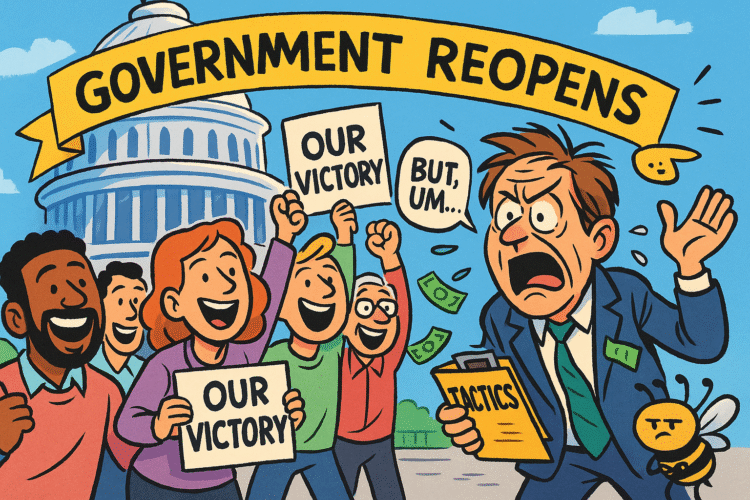
There are many ways to end a government shutdown. You can compromise. You can capitulate. Or, if you are the Democratic Party, you can split into factions and hold a family intervention in the middle of a burning building. The forty-three-day shutdown ended the way every American civics textbook secretly dreams: not with a unifying declaration of victory, but with a procedural knife fight over who forgot to extend the Affordable Care Act subsidies.
The timeline reads like a tragicomedy written by a rules committee.
The Senate, exhausted and self-congratulatory, returned from a week of floor speeches and finger-pointing to cobble together a continuing resolution that reopened the government through January. The deal kept lights on, checks moving, and pay flowing—but left out a clean extension of the ACA premium credits that had been dangling like a loose wire since the summer. House Democrats, still on recess because Speaker Mike Johnson had taken the concept of “do-nothing Congress” to interpretive art, found out from the Senate press gallery that the government was reopening without them.
In Arizona, Representative-elect Adelita Grijalva was waiting to be sworn in, still technically in electoral limbo because the House had not reconvened. While she waited, Senate Majority Leader Chuck Schumer and Minority Leader Mitch McConnell shook hands on a stopgap bill that gave the country a few more months of solvency and the Democratic caucus a full-blown existential crisis.
Let’s break it down, step by painful step.
Day 1 through Day 40: The shutdown grinds on. Agencies furlough staff. SNAP benefits stall. Federal courts ration operating funds. Democrats repeat, in increasingly hoarse tones, that they will not reopen the government without a health care extension attached. Republicans, meanwhile, call the demand “hostage-taking,” a phrase that works only if you forget who locked the doors in the first place.
Day 41: The Senate, staring at collapsing poll numbers and exhausted airline passengers, decides that something—anything—must give. The upper chamber begins negotiating its own version of a continuing resolution. The goal: reopen the government without committing to anything controversial, like the idea that people should afford medical care.
Day 42: Word leaks that ACA premium credits, the lifeline for millions of middle-income Americans, have been quietly dropped from the final text. Senate aides call it a “clean CR.” House progressives call it “an open wound with a Band-Aid labeled bipartisanship.”
Day 43: The deal passes with Rule XXII precision. For the uninitiated, Rule XXII is the Senate’s cloture mechanism: sixty votes to end debate, the civics equivalent of a group project where forty senators show up, twenty pretend to care, and the rest decide democracy is overrated. The motion carries, the CR clears, and suddenly the longest government shutdown in modern history ends without the House even opening its doors.
When House Democrats returned to Washington, they were greeted by headlines celebrating “bipartisan cooperation” and “Senate adults in the room.” What they were not greeted by was a vote on ACA subsidies. The air in the caucus room smelled faintly of betrayal and burnt coffee. Members whispered about “process” the way normal people whisper about bad marriages.
Speaker Mike Johnson, who had presided over the entire shutdown from the comfort of a long recess, called the result “a win for fiscal sanity.” It was, in fact, a win for inertia. Johnson’s strategy had been simple: do nothing, blame the Senate, and wait for gravity to pull Democrats into another circular firing squad. It worked.
When Democrats finally reconvened, the symbolic no votes began. Every Democrat present voted against the CR that was already law. It was like performing CPR on a corpse that had already been buried. They called it “sending a message.” The message was mostly that they had been left out of the conversation.
Representative Hakeem Jeffries emerged from caucus meetings with the charisma of a man trying to deliver unity through clenched teeth. He blasted Johnson’s recess as “an abdication of leadership” and accused Senate Democrats of cutting a deal that left the House looking like “a seven-week spectator sport.” The quote was memorable mostly because it was true.
Progressives, led by Representatives Pramila Jayapal and Alexandria Ocasio-Cortez, turned their fire inward. They demanded that Democratic leadership attach an ACA subsidy extension to the next legislative vehicle—any vehicle, even a post office naming bill if necessary. They unveiled a discharge petition, a parliamentary Hail Mary that would force a vote if 218 members signed on. It was a classic move of desperation and principle: the procedural equivalent of spray-painting “vote on health care” on the Capitol steps.
Centrists groaned. They wanted to move past the shutdown and back to campaign-friendly issues like infrastructure, moderation, and pretending bipartisanship is a renewable resource. But progressives weren’t done. They argued that the CR not only punted health care but also signaled that Democrats were willing to reopen the government on GOP terms. “If this is what compromise looks like,” one unnamed aide said, “Republicans should send flowers.”
The split exposed the party’s core tension. Senate Democrats defended the deal as “necessary governance.” House Democrats called it “hostage negotiation without the hostages.” The White House, caught in the middle, offered muted praise and promised to “keep working to ensure affordable care for all Americans,” which is what an administration says when it doesn’t want to admit that it just lost a fight it didn’t start.
Rule XXII, the procedural ghost haunting the entire saga, became an unlikely celebrity. It is the Senate’s cloture rule, the gatekeeper that determines whether anything actually passes. Under Rule XXII, once a motion to invoke cloture receives sixty votes, the Senate moves forward, debate closes, and a final vote follows. This was the math that ended the shutdown: a bipartisan sixty-plus votes to reopen, none to address the core issue that started it.
In the fine print of the continuing resolution, the omission was obvious. No ACA extension. No enhanced premium credits. The text referenced “ongoing evaluation of health care affordability measures,” which might as well have been written in invisible ink. It meant nothing. It changed nothing. It bought time, not progress.
The irony is that the CR’s passage did exactly what Democrats had warned against. It normalized shutdown brinkmanship as a legislative bargaining chip. By accepting the GOP’s clean version, the Senate effectively said: yes, we can reopen government without fulfilling our own stated conditions. It was like promising your children dessert for eating vegetables, then giving them a single carrot and calling it cake.
The internal fallout was immediate. Progressives accused Schumer of negotiating “by candlelight and cowardice.” Senate moderates countered that they had saved the country from another credit downgrade. Meanwhile, House Democrats discovered that by remaining on recess, they had become spectators in their own crisis. Some called it a betrayal of process. Others called it a blessing—less time on C-SPAN, fewer cameras capturing the infighting.
But the most biting criticism came from within. “The Senate gave us a seven-week paid vacation,” one House member muttered, “and we still found a way to lose momentum.”
The consequences are now unfolding in real time.
The Office of Management and Budget is racing to reissue apportionments, the bureaucratic term for letting agencies actually spend money again. Federal workers await back pay. SNAP administrators scramble to restore benefits. Every delay ripples through millions of lives that have no patience for procedural self-flagellation.
And yet, while families check their bank accounts, the Democratic caucus is still holding emergency calls about messaging. The discharge petition for ACA subsidies has become both a moral crusade and a loyalty test. Signing it signals frustration with leadership but also commitment to policy. Not signing it signals deference but also political cowardice. It is the sort of intra-party puzzle Democrats are uniquely skilled at constructing for themselves.
The media, naturally, framed it as “Democrats in Disarray,” a phrase so familiar it might as well be engraved on the Capitol dome. But the real disarray is not ideological. It is structural. When one chamber negotiates and the other hibernates, the result is not governance. It is chaos by calendar.
What happens next depends on whether anyone remembers how to coordinate.
In the next seventy-two hours, OMB must certify that agencies can resume full operations. Treasury must reallocate withheld payments. The Department of Agriculture must confirm that SNAP and WIC systems restart without technical failure. Democrats must decide whether to turn their discharge petition into a public spectacle or a quiet negotiation chip. And Speaker Johnson must decide whether to block any follow-on fixes, because nothing thrills a far-right caucus like prolonging dysfunction.
Beyond that, the Senate must prepare for the next funding cliff, which looms like an approaching comet in January. The CR’s expiration date ensures that the same fight will repeat itself with slightly different slogans. The only variable is whether Democrats will have learned to fight each other privately by then.
The early signals suggest they have not. Some progressives want a hard line on health care before any new spending vote. Others argue for a clean bill to protect federal workers. Moderates are already whispering about compromise language that “balances affordability with fiscal responsibility,” a phrase so hollow it could double as a wind instrument.
Meanwhile, Republicans are basking in the glow of a crisis survived. Johnson’s allies insist that the shutdown proved Democrats are too divided to negotiate effectively. They are not wrong. The CR passed on GOP terms because Democrats could not hold a unified message long enough to make Republicans sweat. The ACA subsidies were the price of fragmentation.
And so, forty-three days of paralysis ended with a procedural shrug. Government reopened. Checks went out. The machine sputtered back to life. And Democrats went to war with themselves over who gets credit for preventing an even greater disaster.
There will be hearings. There will be statements. There will be performative accountability. But there will not, for now, be a renewed commitment to the policies that could have prevented this mess in the first place.
In the end, the Senate got its clean deal, the House got its symbolic outrage, the Speaker got his recess, and the American people got another reminder that democracy functions best when no one is watching the clock.
The final irony is almost poetic. Democrats spent forty-three days fighting for a moral high ground, only to reopen government on Republican terms while holding a seminar on what went wrong. They did not lose the argument. They simply forgot which one they were having.
The shutdown is over. The reckoning has just begun.