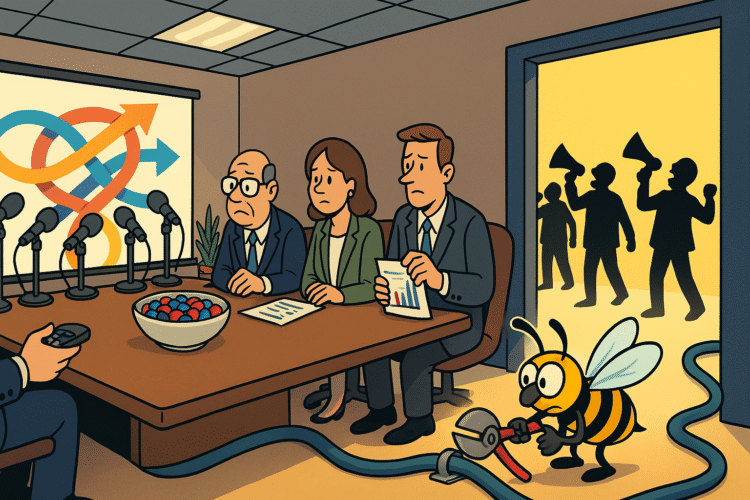
There is a certain kind of strategy meeting that feels like a hostage situation with snacks. A windowless conference room, a lonely fern, a PowerPoint with too many gradient arrows, and ten people who confuse caution with wisdom. Someone says the word “authentic” while polishing a sentence that has never met a human mouth. Someone else invokes “the median voter” like a long lost pen pal. There are charts. There are cross tabs. There is a bowl of red and blue M&M’s, meant to be cute, that looks like a ransom note for the soul of a party.
This is the room where Democrats keep taking promising leaders and teaching them to hold their breath.
Strategists, pollsters, message whisperers, I know your prayer. You say we need leaders who can speak from the heart and connect with people. You point to Donald Trump, to Jesse Jackson, to Barack Obama, and you say they made people feel heard, they made politics feel personal, they made a thought process feel like a porch conversation. You are not wrong. Where you go wrong is thinking the solution is a better script. The solution is a better permission structure.
We do not lack voices. We lack air.
Look across the bench. Kamala Harris can move through a room like a conductor who knows where every instrument lives inside her chest, warmth and steel, the prosecutor who still believes in mercy. Pete Buttigieg can translate an electrical grid into a love story about modern life. Alexandria Ocasio-Cortez can turn a committee hearing into a master class on power and how it hides. Bernie Sanders can bark a moral sentence and make a billionaire feel very small. Elizabeth Warren can build a policy out of plain English and then hand you the screws and tell you to help. Gavin Newsom knows how to throw a punch and smile like it was your idea. JB Pritzker can make competence sound like courage. Jasmine Crockett can shear hypocrisy in real time and leave it steaming on the floor. Cory Booker can tell you a story about dignity that makes your throat sting. Mark Kelly can talk about risk and landing anyway. Jon Ossoff can draw a line between corruption and the price of eggs. Adam Schiff knows how to stand still until the truth gets uncomfortable and comes to him. Gretchen Whitmer can look a bully in the eye without becoming one. Chris Murphy can hold a room quiet long enough for grief to organize itself. Amy Klobuchar can diagnose the procedural game and then play it to win. Julian Castro can narrate a country where kids get to keep their childhoods.
We have voices. What we keep doing is teaching those voices to clear their throats until the news cycle ends.
The consultant habit, born of real fear and a thousand bruises, is to manage risk by managing language. Say less, and say it more carefully. Round the edges so the headline cannot cut you. Test everything inside a two way mirror while a focus group shifts in their chairs, blinks at the free pizza, and tries to remember which politician is which. The instinct is understandable. The effect is fatal. People can hear the edits. People can smell the caution. People do not want a spokesperson for their pain. They want a witness who will do something.
Yes, Trump, Jackson, Obama connected. But not because they discovered a magic word. They chose a fight out loud, then made people feel like partners in the swing. Jackson named the coalition and put it in a chant. Obama named hope and refused to whisper it. Trump named grievance and performed it like a late night monologue. The lesson is not to copy their words. The lesson is to choose a clear why, say it like you mean it, then live it until it changes something real. The lesson is that performance without delivery curdles into resentment, and delivery without performance disappears in a footnote.
Democrats keep trying to win the argument and forgetting to win the moment.
The argument, to be clear, is usually good. The policies are mostly what people say they want when you remove the branding iron and ask in English. Lower costs, safer communities, freedom to form a family, freedom to read a book, freedom to vote without a scavenger hunt, clean air in your kid’s lungs, a hospital that does not ask for your credit card before it asks for your symptoms, a job that pays for a life. None of this is radical. The problem is that the party has developed an allergy to saying why in a voice that sounds like a person. We write the how in perfect bullet points, then forget the story that would make anyone lean in to hear it.
If you want to see how quickly the air can return, imagine a simple experiment. Hand each of those leaders a microphone, tell the staff to sit in the back and close their laptops, and ask a single question: what is the one thing you cannot stand to leave unsaid right now, and who do you need to say it to. No whiteboard. No talking points. One take, five minutes, straight into the camera. Do it weekly. Do it on union floors and church basements, on porches and factory floors, at border clinics and flooded towns. Treat the country like a listener, not a legal deposition. If a sentence sounds like it was workshopped by a committee, the camera turns off and you try again.
Would some mess happen. Of course. Humans talk like humans. But the risk of mess is smaller than the risk of silence. The public can forgive an awkward phrase. They cannot forgive the feeling that you are hiding from them behind a glass wall.
Part of what broke the political language machine is that Democrats trained themselves to be the adult in the room, then forgot that adults still have hearts. We enter with spreadsheets and great plans and a grant program that will, in time, change a life, and then we deliver the update like a quarterly earnings call. In the era of spectacle, competence is not a story by itself. It needs a spine. It needs an enemy, or at least an obstacle, and it needs a protagonist who knows the difference between empathy and pity. People will walk through complex policy with you if they trust your motive. They will not follow you through a flowchart if they do not know what you love.
This is where the permission structure matters. Give these leaders permission to choose the why first, then teach the how as an act of hospitality, not as a performance of expertise. Voters are not tabulating your command of acronyms. They are clocking whether you identify the harm correctly and whether you seem likely to fight it without flinching. They want to know who you cry for, who you laugh with, who you cannot stand to disappoint. They want a leader who can name a broken thing in public without negotiating with its publicist.
Take Kamala Harris as a case study. When she is most herself she can braid a mother’s voice with a courtroom’s clarity. She can look dead into a camera and say that a country that forces a 10 year old to carry a pregnancy has lost its way, then pivot to a plan without losing that heat. The room holds its breath for her when she does that. The lesson is not to prewrite the pivot. The lesson is to let the feeling breathe long enough to be real.
Or take Pete Buttigieg, who can explain supply chains in a way that makes you feel smarter rather than smaller. He could be sent on television with cards and a timer, or he could be sent to a loading dock at dawn to talk to the people whose lives write the graph. One version is technically correct. The other version makes a memory.
AOC needs no help on heat, but the party often treats her clarity like a liability to be managed rather than a bridge to be built. Send her where the lights are bright, yes, then also send her to rooms where the cameras are small and the stakes are intimate, where the moral physics of a paycheck can be mapped onto a face. Elizabeth Warren should be allowed to bring out the whiteboard, then be asked to tell the story of the first person who made her angry enough to build a whiteboard. Bernie should be encouraged to shout about a rigged system, then be handed a parade of small business owners and nurses and delivery drivers, not as props, but as co-authors of the indictment.
Newsom is at his best when he debates like a man who already knows the audience can tell when someone is selling them a lemon. Pritzker is at his best when he makes government sound like a kitchen you can fix rather than a cathedral you cannot touch. Jasmine Crockett is at her best when she makes a liar look uncombed, then smiles because the truth does not need to yell. Booker is at his best when he remembers that optimism is not denial, it is a choice to drag the facts into the light and love the world anyway. Kelly needs to talk about risk more, not less. Ossoff needs to translate oversight into a story with a villain who cashes checks and a victim who pays fees. Schiff needs to be allowed to stay calm, which in a fire season reads as courage. Whitmer needs to keep saying the quiet part, which is that bullies have terrible follow through. Murphy needs to keep grieving in public for kids he never met. Klobuchar needs to admit that procedure is a weapon if you know which end to hold. Castro needs to paint a city where a child can run down the block without learning to count sirens before they learn to count to ten.
All of them, all at once. This is not a search for one savior to carry the whole weight. That fantasy is how you end up waiting for permission from a person who is not coming. We have more than enough voices for a choir. The task is to stop teaching them to whisper.
I know the counterargument because I have made it. The press will clip the spiciest line. The opposition will build a scarecrow out of the raw footage and name it you. The algorithm loves a fight and hates a nuance. The donors call in the middle of the second paragraph to ask if a word can be adjusted so their brunch stays pleasant. The base wants fire while the suburbanites want to sleep through the alarm. Yes to all of it. And. The choice is not between being careful and being reckless. The choice is between being present and being background noise.
The Trump era has trained a lot of smart people to answer a different question than the public is asking. We spend our energy proving that we are not crazy, that the numbers add up, that we have read the bill, that we have learned the lessons of the last humiliation. The public is asking a simpler thing. Are you here for me or for your email list. Will you pick a fight that costs you something. Will you protect my kid when the school board turns into a circus. Will you say what the truth is when the lights are on. Will you stop the bad thing and then build the good thing and then stay long enough to maintain it.
We keep leading with the how because we are proud of it. We should be. But the how is a promise you make after you have shown me your why. The why is how we decide to trust you with the keys.
Let me be practical. Here are a few ways to take the oxygen mask off without setting the room on fire.
Replace the sentence, “We need to have a conversation about affordability,” with a story about a single cost that will be lower by a date certain, and the person whose life that affects. The receipts can come after. The moral is first.
Trade three bullet points for one vow. “I will not sign a bill that makes your life more expensive” is a vow. Force the debate to live on your vow. When you need to break it, and you will, explain the trade like an adult explains pain to a child they respect.
Choose one villain you are willing to name without a smile. Not every sentence needs an enemy. Some do. The public already knows someone is doing this to them. If you do not identify who, they will, and the list will get ugly fast.
Normalize the sentence, “I was wrong and here is what I learned and what I will do differently now.” The public can smell fake humility. They can also smell the mildew of never risking a mistake.
Create a rule that every press conference must name, in plain language, the person whose life changes next and when they will know it. If the answer is nobody and never, cancel the press conference and go back to work.
Stop pretending that people who are mad at you will be soothed by your homework. They will be soothed when something changes, or when you look them in the eye and tell the truth about why it has not. Make fewer promises. Fulfill more. Be seen connecting the dots between a belief and a bill and a body. If the dots do not connect, say so.
This is not a purity test. It is a performance standard. We are entering the portion of history where vibes are a material force. That does not mean you should lie louder. It means you should metabolize what people are living through, then speak to the part of them that has not given up. Speak to the person who has turned off their notifications because their heart cannot hold one more outrage but who still shows up for the people they love. Speak to the worker who picked up a second job, the parent who got a second mortgage, the teacher who has a second file on their desk labeled “things the school cannot say out loud.” Speak to them first. Ask for their help. Tell them what it will cost. Pay some of the cost yourself.
The Republican Party is no longer pretending that norms are sacred, except when they are useful. You can hate that. You should. You can also learn a narrower lesson. Norms are not virtue by themselves. Norms are tools. Some preserve democracy. Some protect power. Know the difference. Keep the ones that guard voting, equal protection, an independent judiciary, a press that can ask questions without asking for permission. Retire the ones that feed a fantasy of bipartisanship with people who perform cruelty for sport. Build new norms where you need them. Protect whistleblowers like they are national parks. Treat independent watchdogs like working smoke alarms. Make corruption boring again by making it risky again.
Above all, stop mistaking caution for responsibility. Responsibility is telling a community what you intend to do with their trust and then doing it even when the news cycle is hungry. Caution is what you feel when you care more about the news cycle than the community.
We do not need a single hero to fix this era. We need a lot of people talking like themselves, picking overlapping fights, and delivering overlapping wins. That means trusting the bench we actually have. It means letting Kamala be Kamala, Pete be Pete, AOC be AOC, Bernie be Bernie, Warren be Warren, Newsom be Newsom, Pritzker be Pritzker, Crockett be Crockett, Booker be Booker, Kelly be Kelly, Ossoff be Ossoff, Schiff be Schiff, Whitmer be Whitmer, Murphy be Murphy, Klobuchar be Klobuchar, Castro be Castro. It means staging the country like a series of rooms where each of them is most dangerous to the people who prefer silence. It means refusing to sand them down into interchangeable chyrons.
Find them a megaphone. Then stop moving their hands.
A final note for the strategy rooms that will read this with a red pen. Your work matters. Your counsel saves campaigns from unforced errors, and your discipline turns chaos into power. But somewhere along the way, discipline became a muzzle. The safer you make the sentence, the less oxygen it carries. Consider a new metric. If the line could survive a corporate press release, do not let it leave a human mouth. Measure the heartbeat of your copy. If you cannot feel it, it will not be felt.
We are in a fight with people who think volume is the same as truth. The antidote is not to whisper. The antidote is to say the truth louder, then prove it with something you can touch. It is to stop defending the existence of gravity in a debate with a man throwing confetti. It is to point to the ground and say, this is what keeps you on your feet, then pour the concrete and hand them the trowel.
In twenty years, I want to read a chapter about this decade that says we finally remembered how to talk like we live here. That we unhooked the oxygen tube from the back room and ran it out to the street. That we stopped telling people to be patient and started telling them where to stand while we turned the wrench. That we did not wait for one voice to save us, because we remembered that a choir is louder, and when it is singing from the gut the building shakes.
Give them the mic. Then get out of the way.