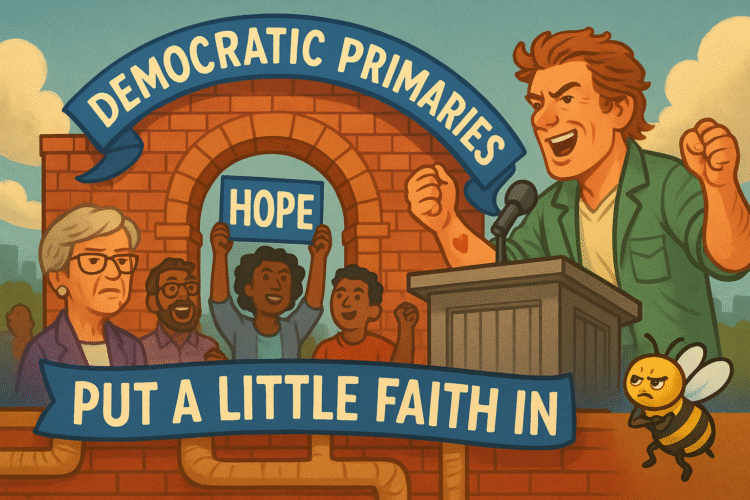
There’s a new morality tale making the rounds in political media, and this time it stars Graham Platner, the tattooed Maine oysterman who tried to run for Senate, briefly became a folk hero, and then turned into the cautionary example in Politico Magazine’s think piece about how Democrats keep “falling for fantasies.”
Their argument: Democrats are addicted to romantic figures—authentic, scrappy, populist, usually men with “a story”—who eventually crash under the weight of their own baggage. The subtext: the party should stop gambling on charisma and stick to people who know their way around a donor dinner.
But that conclusion misses the point entirely.
The issue isn’t that Democrats dream too much—it’s that the party elite doesn’t trust voters enough to sort dream from delusion on their own.
The Oysterman and the Overreaction
Let’s be honest: Graham Platner may not be the right candidate. The man comes with a binder full of red flags—a now-covered skull tattoo that looked uncomfortably close to an SS emblem, old online posts that trivialized sexual assault and hurled slurs, and a campaign that responded to the chaos by clamming up behind NDAs.
That’s not what you want in a nominee. It’s not what you want representing a movement, either.
But here’s the key point: it’s not supposed to be the DNC’s decision alone.
Platner’s rise and fall should play out where democracy still has jurisdiction—in a primary, not a panic room.
The Primary Is the Point
The vetting process exists for a reason. The primaries are not the children’s table of politics; they’re the crucible where candidates prove whether they can withstand scrutiny and connect beyond their curated base.
If Platner can’t survive that? Then voters will send him back to his oyster beds. Case closed.
But when party leadership parachutes in with a “grown-up” alternative—like drafting 77-year-old Governor Janet Mills into the race before ballots are printed—it doesn’t demonstrate wisdom. It demonstrates insecurity.
You don’t build a strong bench by replacing every unpredictable player with the political equivalent of an HR compliance officer.
Because that’s not “discipline.” It’s preemption. And preemption is what happens when fear replaces faith.
Faith Is the Operating System of Democracy
The hard truth about politics is that every great leader starts as a gamble.
Barack Obama was a freshman senator with a funny name and an impossible message—hope. His candidacy was treated as a beautiful fantasy until voters decided it wasn’t.
Bill Clinton was a long-shot governor from a small southern state. Jimmy Carter was an unknown peanut farmer. Each began as someone the political establishment would’ve laughed out of a Georgetown salon.
Faith is how democracy updates itself.
When we stop believing voters can handle the process—that they can read, debate, argue, and still make a rational decision—we’re not protecting democracy. We’re babysitting it.
And nothing kills hope faster than condescension dressed as caution.
The Perfection Trap
The obsession with finding the “right” candidate before the first primary ballot is cast has turned the Democratic Party into a kind of HR department for democracy. Everyone’s résumé gets background-checked, personality-tested, and pre-sanitized until there’s no actual risk left—and therefore no excitement either.
Platner’s flaws may be disqualifying. But disqualifying him before the people of Maine even weigh in doesn’t solve the problem—it repeats it.
Because somewhere between protecting the party brand and protecting democracy, the brand keeps winning.
We act like Obama’s rise was destiny. It wasn’t. It was permission. The voters were given a real choice, and they took it.
You don’t get those kinds of stories if every unconventional candidate is replaced by a “safe” one before they even file paperwork.
Fantasy vs. Faith
Politico calls it fantasy when Democrats rally behind someone who speaks to frustration and inequality in plain language. But that’s not fantasy—it’s faith.
Faith that people can change their minds. Faith that candidates can grow. Faith that the system, for all its mess, is supposed to let us test ideas, not throttle them.
If we only trust candidates who’ve already been approved by consultants, we’ll never find anyone worth believing in.
The entire premise of the democratic experiment is risk. You have to risk being wrong to have any chance of being right.
The alternative is stagnation—a gerontocracy of cautious, pre-cleared lifers repeating yesterday’s safe lines while the world burns outside.
The Right to Make a Mistake
Platner isn’t owed anyone’s support. But voters are owed the right to decide he doesn’t deserve it.
That distinction matters, because when elites step in to “save” the party from an untested insurgent, they’re really saving themselves from embarrassment. They’re protecting their reputations, not the republic.
And it’s not just about Platner. It’s about every candidate who might run after him—people who watch how the establishment reacts and decide not to try at all.
If running for office means having your life audited for every dumb thing you said at twenty-three, most normal people won’t bother. Which is how we end up with career politicians pretending to speak for the working class while actual working-class candidates never make it past the screening process.
That’s not strategy. That’s self-sabotage disguised as professionalism.
The Gerontocracy Reflex
Governor Janet Mills is a capable leader. She’s steady, experienced, and broadly respected. She’s also seventy-seven years old.
That fact alone shouldn’t disqualify her—but it should give us pause when the solution to every political problem seems to be resurrecting someone familiar and risk-free.
The Democratic Party has turned “steady hands” into a euphemism for “don’t scare the donors.” And while that logic keeps the lights on, it doesn’t keep the movement alive.
What younger voters see isn’t competence—it’s caution bordering on paralysis.
When every race becomes a choice between a 77-year-old incumbent and a candidate pre-canceled by Twitter, you’re not building a coalition. You’re running hospice care for democracy.
What the Establishment Misses
The establishment loves to talk about “electability.” But electability is retrospective fiction—a story we tell ourselves after the winner is already known.
Obama wasn’t “electable” until Iowa made him electable. Fetterman wasn’t “viable” until he was. Even Biden, written off in 2020 after Iowa and New Hampshire, only came back because Black voters in South Carolina decided to ignore the pundits.
Electability is just another word for fear disguised as strategy.
The problem isn’t that voters fall for fantasies—it’s that elites forget how democracy works. It’s supposed to be unpredictable. It’s supposed to let people surprise you.
That’s what separates democracy from management.
The Vetting Industrial Complex
Platner’s controversy became a feeding frenzy not because of its substance, but because of what it represented—a chance for the political class to prove its own moral hygiene.
Within hours, operatives were whispering about “brand risk.” Reporters dug through his Reddit history like archaeologists at a scandal site. The tattoo became a symbol of everything wrong with populism, and soon enough, “Never Again 2020” essays were back in style.
It’s as if the lesson of 2016 was not “listen to the working class,” but “screen them better next time.”
The same gatekeeping instinct that kills bad ideas also strangles good ones. Because the system can’t tell the difference between a liability and a live wire.
The Obama Paradox
Everyone wants another Obama. No one wants to take the risks that made him possible.
In 2007, most Democratic leaders didn’t back Barack Obama. They thought he was a distraction from Hillary Clinton’s inevitability. His candidacy was called naïve, risky, too idealistic—a fantasy.
Sound familiar?
It took months of grassroots energy and a few shocking wins to prove that the fantasy was, in fact, a plan.
That’s what faith looks like. Not blind devotion—but the willingness to let possibility breathe long enough to reveal its limits.
The point isn’t that Platner is Obama. He’s not. The point is that we don’t know who might be, because we keep shoving every imperfect candidate off the stage before the audience even walks in.
Hope Isn’t Naïve—It’s Necessary
There’s a particular kind of cynicism that creeps into political journalism—the kind that mistakes realism for resignation. It tells you that faith in candidates like Platner is childish, that authenticity always loses to professionalism, that hope is for people who don’t understand how power works.
But here’s the quiet truth: power doesn’t work without hope.
Hope is the emotional fuel that keeps voters showing up after disappointment. It’s the difference between apathy and turnout, between “why bother” and “maybe this time.”
If Democrats abandon that energy every time it gets messy, they’ll never win another generation.
Final Section: The Case for Faith Over Fear
So no, Graham Platner isn’t the next Obama. He’s probably not even the next senator from Maine. But that’s not the point. The point is that we shouldn’t have to decide that in October headlines.
That’s what primaries are for—real people, real votes, real consequences.
Democracy isn’t supposed to be clean. It’s supposed to be transparent.
The process doesn’t need to be rigged against bad candidates; it just needs to be trusted to expose them. And when we stop trusting that process, when we preemptively substitute our judgment for the people’s, we’re no longer protecting democracy. We’re managing it like a PR crisis.
Let the race play out. Let the voters choose. If Platner crashes, let him crash. But don’t take the wheel out of the public’s hands because you’re scared of another messy experiment in faith.
That’s how you get another Obama. That’s how you get anything worth believing in.
Because politics isn’t supposed to make you comfortable—it’s supposed to make you care. And if Democrats can’t remember that, no amount of “safety” will save them from themselves.