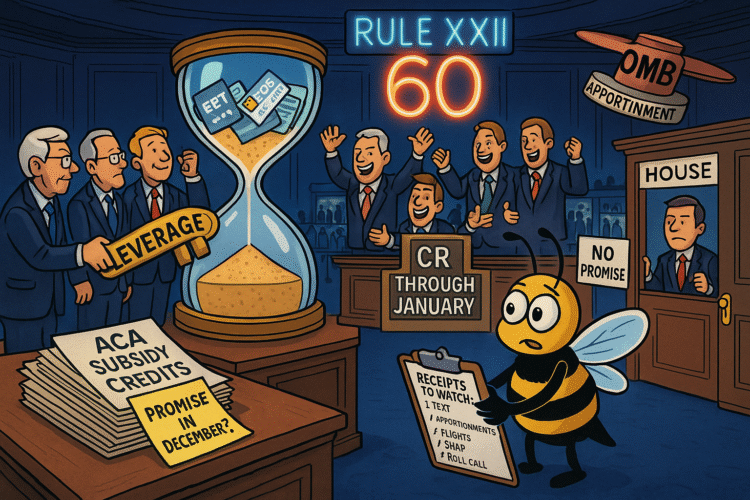
The shutdown was a test of priorities. Democrats chose speed over substance, Republicans chose leverage over food, and the math of Rule XXII did the rest.
The country just lived through a civics lesson that felt like a stress test. After forty days of a government shutdown that reached into kitchens, baggage claims, and clinic waiting rooms, the Senate gathered on a Sunday to decide whether to end the pain now or end it with terms that protected the people already paying the bill. The choice should have been simple. It was not. A cluster of Democrats signaled they would advance a Republican package to reopen the government through January with only a promise to vote later on Affordable Care Act subsidies. The promise had no binding power in the other chamber. The pain, as usual, did.
The most frustrating thing about today is that Democratic leaders have had weeks to plan an exit strategy and to share that with voters and make us part of the process. I understand wanting to end suffering. I do not understand backroom deals being forced down our throats with no explanation. We’re not going to “fix the Democrats’ brand” by doing TikToks or launching podcasts. The brand is a direct reflection of the strength of our elected officials. If we want to purge our weak branding, we have to purge the weak Democrats. I’m looking forward to a robust primary cycle and ushering in a new era of Democrats who actually know how to fight. Absolutely pathetic. I cannot believe we caved to this wannabe dictator and his goons. Thanks to the Democrats who voted no. We’ll remember who bent the knee.
Let us name the move without melodrama. Eight Democrats, joined by an independent who caucuses with them, gave Republicans the cloture math they needed. The list included Richard Durbin, Angus King, Tim Kaine, John Fetterman, Jeanne Shaheen, Maggie Hassan, Catherine Cortez Masto, and Jacky Rosen. That is the core of a deal that moves planes and paychecks without locking in the health care lifeline that millions use to keep premiums from doubling next year. If you hear a cheer coming from across the aisle, you are not imagining it. Senate leaders on the right called it progress and pushed the button. The Speaker on the House side declined to promise a vote on the very thing these Democrats accepted as a later fix. The imbalance is the point.
The scene had the choreography of a hostage handoff. Leaders convened on a weekend, whispered over text blocks, and walked onto the floor with a package that would carry enough to claim a win without carrying the one piece that justified the standoff. Airports were bleeding cancellations. Controllers and screeners were working without pay and then not working at all. Families on nutrition aid were whipsawed by litigation and guidance that turned hunger into leverage. The administration asked the courts to pause full SNAP payments. A justice obliged. Agencies then demanded states undo benefits already released. It was whiplash by design, and the Senate treated the pain as a countdown clock, not an argument for stronger terms.
Here is the rulebook underneath the theater. To break a filibuster in the Senate requires sixty votes under Rule XXII. That threshold turns a minority into a brake. It turns a handful of defections into the difference between a talking point and law. When a party fractures, the rule does not comfort them. It exposes them. The shutdown’s purse strings still live where the Constitution put them, in Congress, but purse power means nothing if you agree to reopen the store with the cashier missing and a rain check instead of a product. The structure is old. The lesson keeps arriving fresh.
Democratic leadership had a case worth fighting. Extend the enhanced health care subsidies now, not later. End a shutdown that was being used to starve airports and families. Prove that government can walk and chew policy. Then a handful decided that ending the shutdown on the other side’s terms was better politics than holding out for the policy that protects their voters from sticker shock. The Majority Leader across the aisle praised their realism. The House Speaker refused to promise the follow through. In other words, the leverage shifted, and it shifted because Democrats lent it out.
The cost showed up in places that do not care about floor speeches. Airlines crossed a grim threshold. Controllers who had already carried more than their share stopped showing up. Plans were cut. Hubs went dark for hours. Some of this was weather. Most of it was math. When you stop paying people to keep the sky safe, the sky slows down. That is not a talking point. It is a law of labor. Voters, who do not speak Senate, heard the alarm in the only language they trust, the missed connection and the empty fridge.
Meanwhile, the SNAP story became a choose your own cruelty. A district judge ordered full payments. States acted to comply and pushed money to families on tight calendars. Then the administration sprinted to the Supreme Court, won a temporary block, and turned back to the states with a threat, undo what you just did. Governors who read the first order and the statute told Washington to take them to court. The White House threatened to claw back administrative money. People set dinner tables with spreadsheets. This is not fiscal prudence. It is power as humiliation, and it made great leverage for those who wanted the Senate to blink. The Senate blinked.
To be clear, reopening the government is not a betrayal. It is a requirement. The betrayal lives in the gap between what could have been attached to the reopening and what was not. A clean extension of expanded premium tax credits would have made next year survivable for families shopping on the exchanges. Instead, the compromise offered a promise of a vote in December. A promise that the Speaker refused to make on the House side. The Senate traded live leverage for a theoretical scheduling notice. That is not compromise. That is hope as governance.
Some will argue that the package was not nothing. It folds three full year spending bills into the stopgap, protects back pay, and reverses some of the administration’s most vindictive personnel moves. True. And it still punts the health care cliff that was the entire point of holding out. If you are a federal worker desperate for a paycheck, you will not argue with a restart. If you are a parent whose premiums will double without the subsidy, you will wonder why your bills were used to extract concessions that never reached you. This is the difference between reopening the government and governing for the people who need it.
Inside the caucus, the split was naked. Chuck Schumer said he could not in good faith vote for a package that left millions staring at unaffordable premiums. Bernie Sanders said keep fighting. Others decided that after forty days, the politics of pain could not be carried any farther. That is the cynic’s victory, and it is how you turn a good election night into a bad week. Voters rewarded the party at the ballot box for talking like real life matters more than vibes. The Senate responded by accepting vibes. The Majority Leader across the aisle called it momentum. He was not wrong.
If you want the timeline without the fog, it starts with a rare Sunday session and ends with just enough Democrats crossing to reach sixty. In the middle, moderates negotiated a framework. It added three full year bills to a continuing resolution that runs through January. It offered government workers back pay promises and limited undo buttons on layoffs. It dangled a later vote on health care that the other chamber would not promise to entertain. It put airports, SNAP, and federal services on a restart track that depends on apportionments and agency guidance landing cleanly the minute the gavel drops. Every piece of that is checkable in the next ninety six hours.
Civics is supposed to prevent this kind of annual cliff diving. Article I gave Congress the purse for a reason. Rule XXII imposes a supermajority for a reason. The combination is supposed to force coalitions to form in daylight. Instead, it rewards brinkmanship and forces policy fights into shutdown roulette. The public gets lessons they did not sign up for. What is apportionment. When does back pay arrive. Is a promise of a vote binding. Why does a nutrition program become a chess piece. The answers make sense only if your job is to win floor tests. If your job is to feed a family or keep flights safe, the answers read like non sequiturs.
The politics are as bleak as the process. Ending a shutdown is a public good. Ending it on the other party’s terms right after voters rewarded your side for showing spine is a choice that converts momentum into mush. The Majority Leader who orchestrated the package will be praised on televisions that live for relief shots of the Capitol at night. The Speaker will bank the win and keep his options open. The base that did the calling and knocking will feel like they were traded for a press conference. If the December vote never materializes, or materializes as an exercise in blame, the lesson will land hard. Do not promise a fight you are not prepared to win.
Inside that lesson is a second one about leadership. Either the Democratic leader did not have his votes counted, which is malpractice, or he had them counted and decided to let retiring members and moderates take the heat, which is cowardice. You do not get to be the face of the resistance when you outsource the risk. The caucus did not need a perfect plan. It needed a whip count and a clear frame, reopen the government and protect the subsidy in the same bill or hold the line with real consequences for the other side. Instead, the line wavered and then moved.
The other side understood the map. They leaned on airports and food. They asked the courts to add confusion. They broadcast certainty. They waited for fatigue to do the rest. When the moment arrived, they cheered the Democrats who helped them break the filibuster and kept a straight face when asked about the follow up on health care. The public will remember the restart. The details will blur. The bill for the blur arrives next year when premiums land. Then everyone remembers.
This is where the editorial instinct to both sides the problem must be resisted. Republicans engineered the conditions. They used SNAP as bait. They starved air travel to raise the stakes. They refused to bind a promise on subsidies. Democrats still had agency, and a chunk of them used it to give away leverage. Both can be true. The result is not a split decision. It is a loss that will be marketed as responsibility.
So what now. Measure the next two to four days like an audit, not a vibe check. First, does the Senate actually swap in text that folds the three full year bills and pass the stopgap on schedule. Second, do airports restart operations on the timeline leaders promise, with flight cancellations and ground delays returning toward normal in hours, not days. Third, do agencies issue apportionments the minute the bill lands so payroll, grants, and back pay move, or do we get another round of guidance that muffles the restart. Fourth, does the House take up the Senate package cleanly, or does leadership play games and dare Democrats to relent again. Fifth, does any binding vehicle carry the extension of the health care subsidies, or are we fed statements about good faith while draft text dies in the other chamber.
There is also the litigation thread that will keep pulling at SNAP and other programs. The administration has already shown it prefers to fight relief in court and then use the uncertainty to pressure the Hill. Watch whether the Supreme Court’s temporary nod to the administration continues, whether lower courts shape limits, and whether agencies harass states that acted to pay full benefits under prior orders. That tells you whether hunger remains a bargaining chip. It also tells you whether governors, including some from the President’s party, will continue to resist.
In a healthier political culture, this shutdown would end with an accounting. Which tactics worked. Which harms were necessary and which were manufactured. Who used their office to protect the public and who used it to score a headline. Instead, the culture will pivot to holiday travel and sports scores. That is how the cycle wins. Pain disappears from the chyron and returns to the ledger with interest. If Democrats want a different ending, they can still write one. Attach the subsidy extension to the next must pass. Treat the House refusal to promise a vote as the insult it is. Stop praising compromise that does not protect your voters. And stop pretending the filibuster is a sacred text when the other side treats it like a tool.
I do not enjoy writing like this. I prefer to praise courage when it shows up. There were flashes of it in the last forty days, on picket lines outside federal buildings, in governor’s offices that decided to feed their people first and fight about jurisdiction second, in controller rooms where professionals kept planes from touching because safety mattered more than politics. It would be nice if the Senate matched that ethic. It did not.
What should readers track this week. The precise language of any Senate amendment that moves with the stopgap. Any attempt to slide the subsidy extension onto a sidecar with no guarantee of floor time. Any House statement that pretends a general commitment is the same thing as a scheduled vote. The cancellations and delay data as the system restarts. OMB apportionments with dates and times, because paperwork is policy. Agency guidance to states on SNAP and other programs, because the last forty days turned guidance into a weapon. The roll call, because votes tell the story more honestly than press releases.
There is a version of this story that ends with the public relieved and no one punished for playing games with their lives. That version would be comfortable for the people who caused the pain. It would be fatal for accountability. If Democrats want to shake off the loser’s glow that follows a self inflicted retreat, they have to act like the lesson landed. Use the reopened window to pass what the shutdown was allegedly about. Make the House own their obstruction. Refuse to sprinkle sugar on a deal that put vulnerable families through a grinder for a promise that may never be kept.
Ledger of Consequences
The Senate had leverage and traded it for speed. A group of Democrats crossed the aisle to reach sixty and moved a package that reopens the government without the health care guarantee that justified the standoff. Airports were already bleeding. SNAP was whipsawed by court orders and agency threats. The House refused to promise a vote on subsidies. The Majority Leader on the right cheered, the Speaker guarded his options, and millions were told to trust that a later vote would arrive in time to stop next year’s premium shocks. This week is the proof window. Watch the text that reaches the floor, the speed of agency apportionments, the flight data as the system restarts, the guidance that lands on state desks, and the roll calls that name who sold relief as realism. If the promise turns to dust, call it what it is. Not compromise. Capitulation dressed in Sunday clothes.