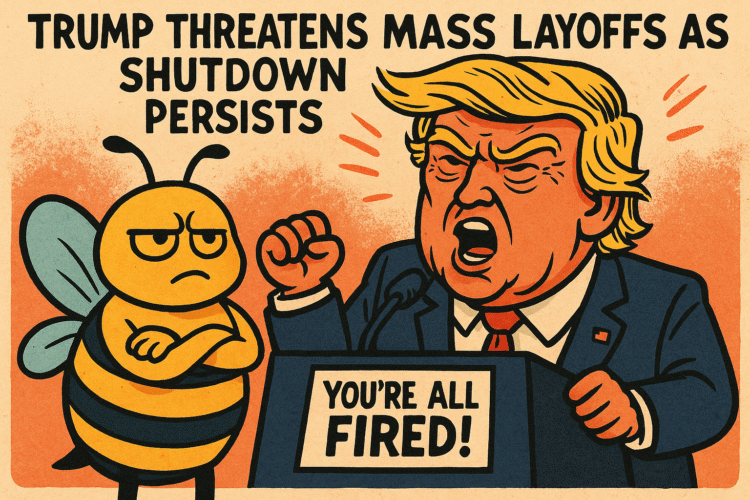
Day five of the shutdown, and the White House’s playbook just got darker. At 12:01 a.m. on October 1, federal funding lapsed. By October 5, director Kevin Hassett appeared on State of the Union to publicly warn: yes, mass federal layoffs could begin—if Trump deems negotiations “going nowhere.” He framed this as a conditional escalation, but make no mistake: it’s pre-threat, not contingency. Coupled with OMB Director Russ Vought’s “apportionment freezes” and his dorm room’s worth of contingency memoranda, the administration has weaponized job security as bargaining chip. What follows is how the tactic is meant to fracture the civil service, hollow out agency capacity, and force Democrats into submission.
Let’s walk through the names, mechanics, legal hazards, and ultimate madness of threatening permanent job cuts in the middle of what was supposed to be a temporary shutdown.
The Public Threat: Layoffs as Leverage
Kevin Hassett, in a rare moment of bluntness, went on CNN and said: if the president decides that negotiations with Democrats are going nowhere, mass layoffs would begin. He did not specify which agencies, when the cuts would land, or how many. He placed the power in Trump’s hand—but made the language conditional, so it could be activated or delayed at whim. “If the president decides… you could see large reductions,” Hassett said, tying the threat directly to political will.
Meanwhile, Trump’s messaging pivoted toward framing any future job losses as “Democrat layoffs.” He essentially wants to leverage the optics: They forced this; They want people unemployed. In his understanding, cutting jobs becomes a political cudgel rather than an administrative disaster.
Behind the scenes, Vought and OMB stand ready. Their toolkit includes apportionment freezes (halts in how agency funds are allocated internally), excepted-status triage (deciding which roles must stay on despite non-appropriation), and the ghost of Schedule F / RIF (reduction in force) playbooks trying to rip apart career protections. The federal bureaucracy sits in suspense: who will stay, who will go, and whether “temporary” becomes forever.
Who’s Working (Without Pay) vs. Who’s Shut Down
In theory, “essential” and “excepted” federal roles remain active during the shutdown—air traffic controllers, border security, National Security, military, etc.—but their pay is in limbo. They report, but they will not be paid until legislation passes. Non-essential staff are furloughed and stay home, unable to perform work, whether day jobs or grant reviews or oversight.
Research grants, environmental inspections, food-safety audits—all of these programs skitter toward pause. In many agencies, grant disbursements already halted. IRB reviews, academic funding, NSF programs, NIH labs—all face immediate disruption. Some projects that rely on staggered funding will die midstream. Local nonprofits dependent on federal dollars see lines freeze.
Services that limp on often do so with skeletal staffing, delayed processing, backlog explosion, or halt altogether. For example: slow permits, delayed inspections, stalled permits for construction or compliance, deluged hotlines, frozen filing systems, and frozen data reporting. Citizens feel the drag in passport processing, in environmental approvals, in loan guarantees and business support.
Legal Guardrails, Union Threats, and Constitutional Risk
It’s not lawless mania—yet. But pushing layoffs mid-shutdown collides with several legal constraints:
Antideficiency Act prohibits obligating funds without appropriations. It forbids spending on personnel without statutory authority. If the president directs mass job cuts, the administration must be cautious not to obligate funds before law. The moment you promise severance or benefits without legal appropriation is a violation.
Due process for layoffs: federal employees have protections—notice, appeal, union contracts. Sudden mass cuts without following statutory or contractual process invite litigation. Unions, POGO, government employees groups are prepping lawsuits. They will argue that emergency rhetoric cannot override civil service law.
Court challenges: judges may be asked to enjoin cuts mid-shutdown, force pay for continuing staff, or declare the presidential threat itself ultra vires. The legal posture is untested: is threatening personnel cuts as leverage constitutional? It may force a test case between executive flexibility and statutory boundaries.
It’s a gamble. If courts rule that threats are coercive overreach, the White House loses legal ground. If courts defer, precedent is set for executive personnel purges under budget gridlock.
The Political Calculation & Timeline
If Congress does nothing, when do pay cycles break? The next regularly scheduled pay period after October 15 is in jeopardy. Once that paycheck is missed, morale collapses. Loans default. Mortgages fail. BAH, BAS, commuting, family expenses—all evaporate.
Agency-by-agency exposure is uneven. Some pockets of federal workforce—contractors, grant-based staff, competitive service roles—are more vulnerable to RIFs. Others in essential national security domains may be insulated longer. But the psychological pressure is universal: no one will feel secure.
The political trick is cruelty disguised as firmness. Threatening job cuts under the rubric of budget crisis forces Democrats to act—or risk mass federal unemployment. It turns civil servants into voters with direct incentive to vote for reopening. It turns the shutdown itself into a political weapon aimed at the base’s nerves.
And the stakes run deeper: if a temporary shutdown can be converted, by presidential whim, into structural attrition of the civil service, then every labor protection is at risk. The anonymous bureaucrat becomes the next casualty of political showmanship.
The Madness of Promise Meeting Reality
Imagine standing onstage, in front of sailors and military families, promising “you’ll be paid,” while your own budget experts quietly instruct that in fact they will not be paid without new law. It is a dissonance so stark it sounds like parody. It’s theater built atop legal vacuum.
The moment rhetoric outraces statute, you weaken public trust. The troops hear the promise echoed, the agencies issue statements, civilians scramble, and pause—only to find the law did not change. That is how credibility dies: not by lies, but by the gap between oath and ink.
Final Thought
When you threaten layoffs as leverage in a shutdown, you no longer govern—you coerce. You treat employees as hostages, public servants as bargaining chips. You rewrite the rules not by negotiation, but by intimidation. And if courts don’t push back, future presidents will weaponize every lapse as pretext for purge.
If you believe in democracy, in statute, in contract — then you must call this what it is: mass coercion dressed as budget discipline. The moment the White House says you’ll “still be paid” even as its departments file non-pay guidance, you don’t have a shutdown. You have a legitimacy crisis.
Troops, employees, citizens—all deserve more than theater. They deserve law.