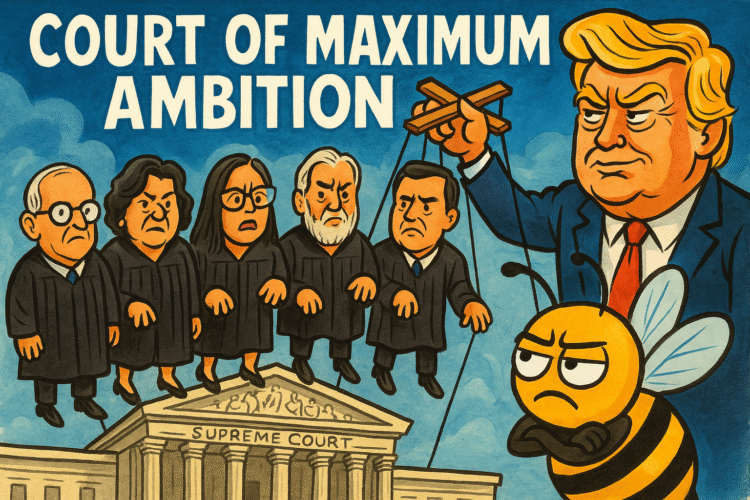
The curtain rises on a new Supreme Court term, and the docket does not so much whisper “constitutional law” as scream “everything you thought had limits now up for grabs.” Imagine a roulette table where the chips are tariffs, citizenship, regulators, voting rights, sports teams, and campaign cash. The wheel spins, the croupier smirks, and the stakes are the actual scaffolding of government. This is not judicial restraint; this is casino night at Article III.
The Tariff Tango: Can One Man Tax the World?
First up: tariffs. The administration insists the president alone can slam down sweeping import duties, reshape global trade flows, and call it “statutory discretion.” Congress, normally the dealer in commerce, is recast as a silent partner whose chips can be commandeered.
Industry plaintiffs scream of inflation, supply chain collapse, and price shocks that turn everyday goods into luxury items. Legal historians wave frantically at the page in their textbooks reminding everyone that Congress—not one man with a Sharpie—controls taxation. Yet the justices are asked: can a president become the world’s customs officer with no further paperwork?
The lower courts have blinked. District judges warned of unchecked authority. Appellate panels muttered about separation of powers. Now nine robed arbiters must decide whether the president can treat tariff law like an a la carte menu, spicing trade policy at will.
Birthright Roulette: Can an Executive Order Undo the Fourteenth Amendment?
The next spectacle: citizenship. The president issued an order prospectively denying birthright citizenship to children born in the U.S. to noncitizen parents. It is bold, it is brash, and it is almost certainly unconstitutional.
The Fourteenth Amendment says plainly that all persons born or naturalized in the United States are citizens. The 1898 Wong Kim Ark decision hammered that in. Lower courts have already lined up to strike down the order. Yet here it is, polished and petitioned, dangling before a Court whose conservative bloc has flirted with “textualism” until the text became inconvenient.
State officials warn of dual registries: infants with citizenship certificates in some states, denied in others. Hospitals, schools, and vital-records offices would be forced into parallel universes. Immigration lawyers whisper about chaos that will last decades, producing stateless residents and contested identities.
The question is not just legal—it is existential. Can a signature undo a clause? Can an executive order declare that history began yesterday?
Regulators on the Chopping Block: Independence or Loyalty Test?
The third act concerns independent agencies. Traditionally, heads of regulatory bodies like the Fed or the SEC enjoy removal protections. The executive appoints them, but cannot simply decapitate them mid-term for political inconvenience.
Now, the White House asks whether all such protections can be swept away. The rationale: accountability to voters. The subtext: loyalty to one man.
Critics warn this would turn watchdogs into lapdogs. Financial markets could swing at presidential tweets, energy regulators could be fired for inconvenient math, consumer-protection chiefs could be purged at whim. The administrative state, once designed to buffer expertise from raw politics, would become a direct extension of personality.
This is not minor tinkering; it is demolition. If the Court blesses it, presidents gain the power to remake every agency in their image overnight, a purge dressed in legal robes.
Culture-War Docket: Sports, Maps, and Money
Layered on top of institutional battles are culture-war flashpoints designed for maximum polarization.
- Transgender athletes under Title IX: The justices will weigh whether federal guidance protecting trans girls’ participation can override state bans. It is a collision of statutory interpretation, identity politics, and school sports fields. The briefs are soaked in rhetoric, but the consequences will be felt in locker rooms, courtrooms, and statehouses.
- Voting rights and Louisiana maps: A redistricting case threatens to pare back remedies under the Voting Rights Act. If the Court narrows them, entire congressional districts could flip control, shifting the House landscape. Democracy’s map is literally on the line.
- Campaign finance deregulation: Another case questions whether limits on political donations are unconstitutional restraints on speech. The potential outcome: an even freer flood of money, where billionaires become campaign managers by checkbook alone.
Each case on its own would be high stakes. Together, they form a culture-war omnibus—an opportunity to redraw the boundaries of rights, representation, and resources.
Emergency Orders, Emergency Lives
The prelude to this term was not subtle. Over the summer, the Court entertained emergency petitions, issuing signals sympathetic to the administration’s maximal claims. Now the cases arrive on the merits. The subtext: will those emergency inclinations harden into doctrine?
Every emergency order reshapes lives—ports clogged by tariffs, hospitals confused about newborn paperwork, regulators second-guessing their tenure. The justices are not simply refereeing theory; they are dictating policy in real time.
The Real-World Fallout
The AP rundown does not shy from consequence. Trade suits warn of consumer costs: groceries more expensive, factories hobbled by retaliatory tariffs, jobs whiplashed by unpredictability. Citizenship offices brace for litigation from parents denied certificates. Federal agencies warn they will hemorrhage expertise if independence evaporates. Schools and sports leagues brace for lawsuits on every game played. Voting-rights groups prepare to see entire communities erased from maps.
The through-line is simple: the docket is not about interpretation, it is about transformation.
Trumpworld’s Framing vs. Rule-of-Law Alarm
In Trumpworld, the narrative is triumph: long-overdue corrections to “decades of overreach.” The president’s allies cast tariffs as strength, citizenship as sovereignty, agency purges as accountability.
Civil-rights groups see a different picture: a presidency-first constitutional order that rewrites checks and balances. They warn of guardrails bent into pretzels, norms pulverized, and laws treated as polite suggestions.
The divide is not simply ideological, it is structural. One side seeks to prove the president can do anything. The other argues that if the Court agrees, the republic has redefined itself into a monarchy with better branding.
Why This Term Matters
The stakes are maximal. Never before has one docket tested so many pillars simultaneously: taxation power, constitutional citizenship, agency independence, civil rights in sports, voting maps, campaign finance. Each decision alone could reverberate for years. Together, they form a constitutional reset button.
Critics note the pattern: a conservative supermajority willing to lean toward executive power, now asked to take the final plunge. If they say yes across the board, the cost will not just be felt in law books but in daily lives—what you pay at the store, whether your child has citizenship, who regulates your bank, whether your vote counts, and how much influence billionaires may openly purchase.
The Satire of It All
Picture it as a reality show: “America’s Next Top Autocrat.” Contestants—tariffs, citizenship, regulators, voting maps, campaign cash—strut before the judges. The panel is robed, expressionless, pretending neutrality. But the scoring rubrics are skewed, the producers already whispering in earpieces.
The audience watches, some cheering, some horrified. The outcome is not entertainment; it is structural. Yet the format is familiar: suspense, elimination, a final crowning. The presidency emerges with new accessories: tariff wand, citizenship scissors, regulator guillotine.
The irony is layered. A Court that preaches originalism entertains tearing at text. A president who rails against judicial activism seeks activism in his favor. A nation that celebrates checks and balances now awaits rulings that could erase both.
Where It Leaves Us
At the end of the term, Americans will not remember the citations or the doctrine. They will remember whether groceries became unaffordable, whether newborns had papers, whether regulators kept their jobs, whether maps erased their communities, whether sports teams fractured, whether money became the only language of politics.
The justices will issue opinions, but the verdict will be written in wallets, birth certificates, agency rosters, district lines, and campaign ads.
The satire is that we are told this is ordinary judicial business. In reality, it is an extraordinary test of how much power one office can seize, how much one Court will allow, and how long a democracy can operate once its safeguards are treated as suggestions instead of law.
The Bench of Endless Power
The Court’s docket is a mirror. It reflects a presidency unwilling to accept limits, a Congress sidelined, and a judiciary deciding whether to play referee or enabler. The cases are not isolated—they are the architecture of the republic.
If the Court says yes too many times, it will not be a legal term, it will be a constitutional revolution carried out in robes and footnotes. The cost will echo not in theory but in lives: in tariffs paid, in citizenship denied, in regulators purged, in votes erased, in money amplified, in communities divided.
That is the stage. That is the gamble. And that is why this term is less a docket than a demolition derby, where the prize is nothing less than the blueprint of American democracy.v