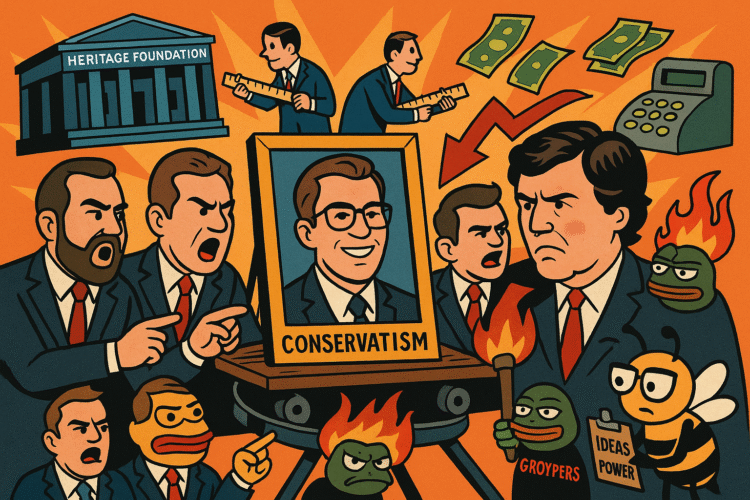
When ideas become identity and power becomes spectacle the civil war doesn’t wait for the historians—it breaks the think tanks first.
Here is something nobody expected in 2025: the right-wing ecosystem ripping itself apart in real time, not over policy spreadsheets or tax rates, but over who gets to control the spectacle, the donors, the platform and the future of an entire movement. The old conservative establishment—those think tanks, the speaking circuits, the conferences, the wired-in donors—thought they had the field mapped, the stars aligned, the next decade plotted. Then came the Heritage Foundation’s boss, Kevin Roberts, with his visionary-sounding project called Project 2025. And then along came the influencers, the alt-rights, the so-called Groypers, the swirling online ecosystem that isn’t asking for permission—it is demanding the mic. And at the center of the maelstrom is the spectacle of Tucker Carlson embracing Nick Fuentes, daring donors to blink, forcing the old guard to choose sides while the fundraising floorboards creak.
This is not a minor quarrel about immigration or military spending. This is a war about power, identity, brand, and who gets to say “we are the future.” The Groypers say they already are. The old guard says they are standing in for ideas. But when clicks pay more than consultants, when spectacle trumps policy memos, you get civil war.
Timeline of sparks and accelerants:
Let us lay out the key moves. First: Carlson books Fuentes, a figure openly tied to white nationalist networks and antisemitic rhetoric, on his show. A move considered wild, risky, beyond what the old guard would tolerate. Then the backlash arrives: movement conservatives such as Ben Shapiro blast the episode, calling it reputational arson, an institutional insult to the coalition they built. Meanwhile Roberts and the Heritage Foundation publicly defend Carlson’s right to host, refusing to distance themselves, and signalling that “cancel culture” cannot apply. That defence triggers an internal revolt among staff at Heritage, rising pressure from board members, donors fading, speakers pulling out of events. The mass movement pipeline—conference bookings, donor dinners, speaking engagements—shivers. As one media outlet put it, the right’s civil war is not in the streets. It is in the boardrooms of think tanks.
The incentives are obvious. Platform-owners—podcasts, influencer networks, alternative media—get clicks, subscriptions, attention when controversy reigns. Donors like “movement hustle” — the promise of a culture war payoff, not a policy architecture. Think tanks like Heritage want the governing credibility, the personnel pipelines, the appointments. Sponsors want brand safety. Speakers want the stage. But the Groypers want spectacle, grievance, identity reshaping. When Roberts says “Project 2025” will map the next administration’s staffing and policy blueprint, he signals to establishment donors: we are serious, governance-ready. But when Carlson guests Fuentes and the Groypers cheer “this is our side, no apologies,” they signal to a younger, online base: you cannot trust the establishment, we are the wave.
Buckets of receipts and incentives:
Clicks: Carlson booking Fuentes = click-bait gold. Media coverage explodes. Sponsor messages pause.
Checks: Donors to Heritage start whispering concerns when speakers cancel and board rows emerge.
Losses: Conference organizers see cancellations as brand risk. Some have “no booking for Fuentes orbit” discussions.
Pretenses: Many conservative voices still claim this is about ideas. Yet the fault-lines are identity and power, not just tax policy.
Legal and institutional posture:
A think tank like Heritage operates as a 501(c)(3), meaning it must abide by rules about political activity, though “education” is broad. Donor disclosures can be less transparent than a campaign. Platform rules vary: podcasts, influencers, alt-media thrive in spaces where standards loosen. Party committees—the RNC, state GOPs—have “extremism vetting” rules, but they are often ignored when ratings and fundraising spike. So the institution that pretends to police extremism bends when the content economy pays.
Reactions across the coalition:
In the Beltway, old-school conservatives warn of suburban blowback. If the right embraces blatant nationalism and anonymity around antisemitism, they fear votes lost in the suburbs. Meanwhile the Groypers claim to be the future, the authentic movement, calling the old guard “Conservative Inc.” Jewish and civil rights groups are documenting harm, saying the host-guest list, the tone, the tolerance matter. Advertisers and conference organizers are quietly backing away. Republican operatives are whispering about firewalls that won’t hold, because as long as the influencer economy pays better than the policy economy, spectacle wins.
What this reveals:
When the Heritage Foundation says it wants governance credibility while the Groypers say they want ideological purge and identity dominance you have a battlefield. The real question: can a conservative flagship surf a nationalist wave without being swallowed? Because if the platform is hijacked by accelerationists who prioritize grievance content over coalition building, the brand collapses. The question is not tax rates, it is whether the coalition of conservative voters will tolerate the mainstream being replaced by agitation.
Near-term checkpoints:
Will Heritage clarify its red lines or invite the tar pit? Will it say “no booking for white-nationalist hosts or guests” or will it double down on free-speech framing? Will campaign committees codify no-booking/no-funding standards for extremist guest lists? Will major advertisers issue public brand safety exclusions for hosts/platforms that host Fuentes-style content? Will state parties adopt resolution language that normalizes or rejects the Fuentes orbit? And importantly will the press call this plainly: this isn’t a debate about conservatism’s future idea pool. It is a test of whether the conservative flagship thinks it can surf a nationalist wave without being consumed.
Closing section: The Internal Audit of Power
The old establishments thought the fight was over ideas. The new ones are saying the fight is for identity, control, and money. When a host books a white nationalist and a think tank defends it, supporters retreat and staff revolt. When a donor sees their brand threatened, money shifts. When a conference organizer fears backlash, they cancel bookings. Platform economics eats policy architecture. The Groypers are not simply telling stories—they are building power and identity and doing so with youthful energy and digital reach. The Heritage Foundation and its peers must decide: are we governing institutions or reactionary fandom factories? Because the line disappears once the influencers have more sway than the policy wonks. The civil war on the right is not in committee hearings. It is in who controls the mic, who writes the memos, who sets the agenda, and who funds the show. And if you watch carefully you’ll see that the old guard might not lose a debate. They might just lose the future.