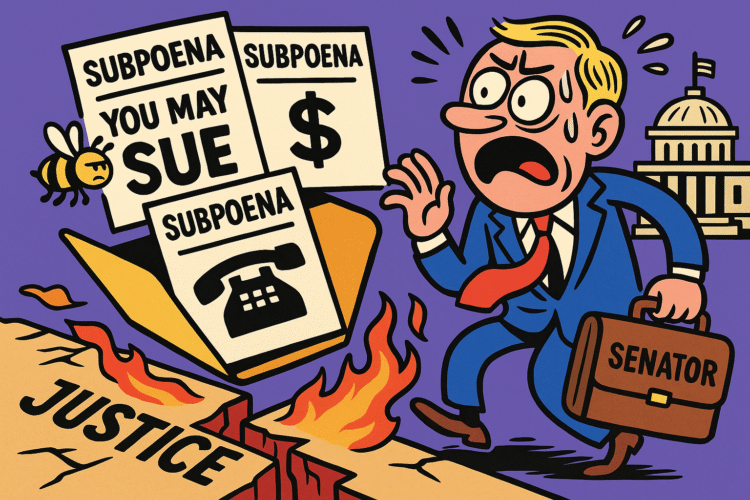
There is a special kind of American hypocrisy that blossoms only when senators learn that the law, the boring gray machinery of subpoenas and court orders, might apply to them. It is the kind of hypocrisy that smells like cologne, leather briefcases, and fear. And here we are again, watching lawmakers sprint down the Capitol steps because they just discovered that their phone records, the little metadata breadcrumbs of who they called and when, were pulled during an active criminal investigation into January 6. Not wiretaps. Not surveillance vans. Not agents hiding in shrubs. Plain old toll records, obtained with a judicial order, because some of these same senators were in contact with Donald Trump as a violent mob stormed the Capitol.
It was legal. It was standard. It was approved by a judge. And it was necessary, because investigators were trying to untangle whether certain lawmakers were helping a president cling to power like a toddler refusing to leave a playpen.
But instead of confronting the discomfort of being treated like any other citizen under suspicion, the Senate has decided the real crisis is not that some members may have been part of a coup attempt. No, the crisis is that investigators looked at their phone logs without sending them a fruit basket.
And so, tucked deep inside the shutdown funding deal, Congress has now gifted itself a brand new private right of action where senators can sue the government for at least five hundred thousand dollars per incident if investigators pull their phone metadata without telling them. They even forced carriers to notify Senate offices immediately. And they made the whole scheme retroactive, reaching back to the Arctic Frost period when Jack Smith’s team subpoenaed records during the January 6 probe.
This is legislative self reimbursement. It is a cashback rewards program for being investigated.
And it deserves a full accounting.
The shutdown ended not with quiet dignity but with Congress turning the appropriations bill into a vending machine for personal legal insulation. Behind the curtain of relief that agencies would reopen, senators quietly slipped themselves a golden ticket. It looks technical. It sounds procedural. It is neither. It is a workaround that converts lawful subpoenas into money.
To understand the audacity, we must return to the moment the mask slipped. When Arctic Frost disclosures revealed that phone carriers had notified Senate offices that investigators obtained metadata for certain lawmakers, several of whom were linked to Trump communications during January 6. Toll records are not content. They are not phone calls. They are not voicemails. They are timestamps. They are contacts. They are the building blocks of investigative mapping.
Law enforcement pulls them all the time, with a court order, to determine who was talking to whom when the country was under attack. It is Civics 101. It is not surveillance. It is how investigators determine whether public officials were participating in a pressure campaign to overturn an election.
Senators, however, responded as if the FBI had implanted microphones in their potted plants.
We were treated to breathless press conferences about “overreach” and “weaponization,” all delivered by people who have never objected to metadata collection when it is aimed at protesters, immigrants, or activists. The sudden privacy revival was not ideological. It was self preservation dressed as constitutional theater.
Then came the funding bill. Out of nowhere, a new legal remedy. Crafted with precision. Engineered with purpose. A private right of action that transforms metadata subpoenas into six figure checks. A mandatory carrier notification rule that overrides the secrecy courts normally allow in sensitive or ongoing probes. And the retroactivity clause, the crown jewel, allowing senators to cash in on the very January 6 subpoenas they are so desperate to distance themselves from.
Republicans declared victory. Democrats divided into three groups. The ones who supported transparency. The ones who were horrified at the precedent. And the ones who pretended to be busy reading when reporters approached.
Outside legal experts, meanwhile, began choking on the absurdity. There is no world where ordinary Americans get a notification when investigators seek their metadata. There is no world where they get half a million dollars per subpoena. There is no world where Congress extends privacy rights to the public. If anything, the public is treated as a constant source of data to be collected, cross referenced, and packaged.
But senators have now carved out a special sanctuary. Not for constituents. For themselves.
The justifications floating through the Capitol are, predictably, a stew of misdirection and myth. Some lawmakers invoked the Speech or Debate Clause, a constitutional protection designed to shield legislative acts from executive retaliation. Except toll records are not legislative acts. And investigators obtained them through judicial oversight. And January 6 was not a policy disagreement. It was an attempted coup.
Yet the rhetoric persists, a shield against admitting the truth. Senators resent being treated like citizens. They resent the idea that their phone calls can be scrutinized for evidence. They resent the possibility that their role on January 6 was not innocent or incidental. It is easier to pretend the subpoena process is corrupt than to confront their own proximity to presidential pressure campaigns.
The legal posture ahead is a circus of its own. OMB must issue guidance on how agencies comply with the rider. DOJ must determine whether any ongoing cases require adjustment. Carriers have to rewrite their protocols for congressional numbers. And the House must decide whether to keep the rider intact or strip it before final passage. Quiet conversations among staff already show discomfort. If senators can give themselves retroactive financial remedies, what is next. A legislated right to preempt investigations entirely. A fund for emotional distress following lawful subpoenas. A congressional punch card that grants free immunity after ten visits.
The next seventy two hours are a stress test. Which lawmakers will be the first to file lawsuits. Who will take the step of suing the government because their metadata, obtained under court order, was part of an investigation into an attack on democracy. How will DOJ argue jurisdiction. Will OMB narrow definitions through regulation. Will the House peel away the retroactivity clause. Will the press finally say what the rider really is. A self enrichment mechanism disguised as civil liberties.
Meanwhile, in the background, bar associations continue disciplinary proceedings for lawyers tied to the elector scheme. State prosecutors in Georgia, Arizona, and Michigan remind everyone that state investigations are untouched by federal legislation. And victims of the false elector plot quietly prepare civil suits that no Senate rider can erase.
Each of these storylines reveals the same pattern. Accountability does not disappear because the Senate does not like how it feels. Facts do not evaporate because lawmakers find them inconvenient. Phone logs do not become privileged material because someone in Congress wants a payout. The public interest remains. The record remains. The subpoenas remain.
What the Senate has done is not erase history. It has only revealed its fear of it.
The shutdown was the stage. The rider was the confession. Senators voted to fund the government and pay themselves for investigative discomfort in the same breath. It was efficient. It was brazen. It was self aware without being self reflective.
The press now faces a choice. It can launder the story into a procedural quirk. It can bury it beneath euphemisms like privacy concern or institutional prerogative. Or it can tell the truth. Congress just bought itself a retroactive shield. The phone records at the heart of this tantrum were obtained legally by court order because some senators were in contact with a president who tried to overturn an election. They were not wiretaps. They were not invasions. They were evidence collection in the aftermath of an insurrection.
Instead of confronting that, lawmakers have built a financial prize for being part of the story.
This is the quiet scandal at the core of the shutdown deal. A government that protects itself from legitimate inquiry while preaching accountability to everyone else is not safeguarding democracy. It is insulating power. It is curating privilege. It is reshaping the justice system into a two tiered structure where the rules that govern the public become optional for its leaders.
And that is the real civics lesson.
Not the shutdown. Not the funding levels. Not the press releases. The rider itself. A window into a branch of government that wants transparency only when someone else is exposed. A Congress that wants accountability only when it does not apply to them. A Senate that wants privacy only when investigators get too close.
A Senate that has quietly admitted, through legislation, that January 6 still haunts it.
The country deserved a clean end to the shutdown. What it got instead was a payout scheme for people upset that a judge allowed investigators to look at their phone logs on the day democracy was under siege.
The system is working. And that is exactly why they are trying to escape it.