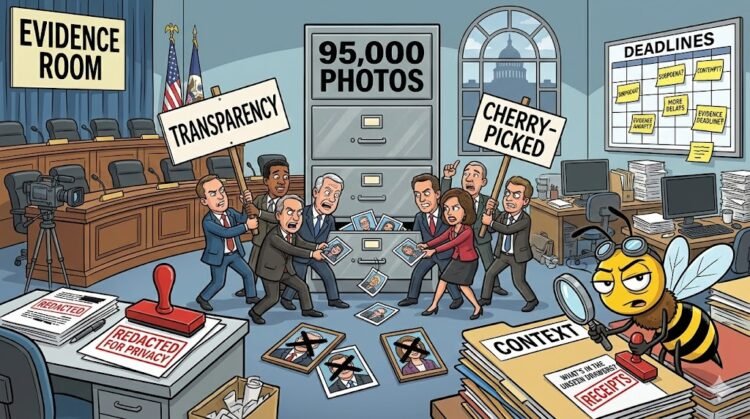
A small, redacted photo dump, a much larger unseen archive, and a political system that treats transparency like a weapon and privacy like an afterthought.
House Democrats on the Oversight and Government Reform Committee just did what Congress does best in an election-era adrenaline rush: released a limited batch of images from a vastly larger trove and then acted shocked that everyone immediately used them as ammunition. The photos come from more than 95,000 images provided by Jeffrey Epstein’s estate, and the committee’s public release includes pictures that show President Donald Trump at past social events, including at least one image of Trump with Epstein from decades ago, plus other shots of Trump with women whose faces are blurred. The same release also features photos of other powerful, famous men, including Bill Clinton, Bill Gates, Steve Bannon, Richard Branson, Woody Allen, Alan Dershowitz, and Andrew Mountbatten-Windsor, with additional scene-setting images from Epstein’s properties and travel universe like aircraft and interiors, and even a few sensational items highlighted in coverage, like a bubble bath photo of Epstein and novelty Epstein-collection ephemera.
If you’re trying to understand what happened here, it helps to picture Congress as a group of people standing over a locked filing cabinet, arguing about whether the key should be public, then slipping a handful of glossy snapshots under the door and yelling, “ACCOUNTABILITY,” like the word itself is a flashlight.
Democrats framed the release as a transparency step intended to spur accountability and further disclosures without exposing survivors. They say they’re still reviewing the full cache and will keep releasing material. Republicans and the White House attacked the move as politically motivated, cherry-picked, and context-free, arguing it proves no wrongdoing. Trump dismissed the photos as unsurprising, pointing out that Epstein circulated widely among wealthy Palm Beach social circles and insisting the images don’t change anything about his relationship with Epstein.
All of which can be true at the same time, and that’s the part that drives everyone insane. A photo can be real, disturbing, and still not prove a specific criminal act. A release can be framed as transparency and still be political theater. A refusal to release more can be sold as protecting privacy while also functioning as a shield for power. Welcome to the era where the facts are heavy and the motives are louder.
Selective Transparency and the Art of the Tease
The committee released a small, selectively redacted batch from a production so massive it basically qualifies as its own ecosystem. Ninety-five thousand images is not “a few boxes.” It’s a visual archive of a social world where money ate the concept of normal boundaries and then asked for seconds. Releasing a small subset from that kind of cache is inevitably going to feel like a tease, even when redactions are done for legitimate reasons.
Democrats say they’re trying to balance transparency with survivor privacy, and that’s not optional. If you do this recklessly, you risk exposing survivors or turning their trauma into content. That is the single most important constraint, and it’s also the constraint that politics loves to use as a costume. Every side claims to be protecting someone. Every side claims to be the adult in the room. Meanwhile, the public gets a controlled drip of images that instantly become meme fuel, opposition research, and a new round of televised moral panic.
A photo dump is not an investigation. It’s not testimony. It’s not a verified chain of events. It’s a set of artifacts, and artifacts are dangerous in the hands of people whose first instinct is to turn them into a story that flatters their team. We have built a political culture where documents are not read, they are deployed. Images are not reviewed, they are weaponized. Context is not provided, it is implied, and implied is where the internet goes to do unsupervised damage.
The result is a paradox. People demand transparency because institutions have failed and hidden too much. But when transparency arrives as a curated drop, it can feel like manipulation, because it is manipulation, even when the underlying intent includes legitimate accountability.
Everyone in the Photo, Nobody in the Narrative
One reason this release has such electric charge is that it includes images of multiple major public figures, across politics, tech, media, and aristocracy. That breadth reinforces a grim point everyone has known for years: Epstein’s social orbit was not a niche club. It was a power ecosystem. He was present in spaces where wealthy men collect each other the way they collect art, trading proximity as a form of currency.
That doesn’t mean every person photographed committed crimes. It does mean that the social world around Epstein was thick with access, status, and the kind of entitlement that treats ordinary rules as background noise. The problem with “he circulated widely” as a defense is that it’s also an admission about the culture that allowed him to circulate widely. It’s a statement about how power works when it’s bored, rich, and convinced it will never face consequences.
So the photos land as a moral Rorschach test. One side sees them as evidence of proximity that should prompt deeper disclosure and scrutiny. The other side sees them as a smear tactic that tries to turn social association into guilt. Both sides then use the same phrase, “context,” in opposite directions. Democrats say the context is systemic, that the scale of the estate’s production raises questions about who appears in unseen material and who facilitated access. Republicans say the context is social, that wealthy circles overlap and photos prove nothing.
The unsatisfying truth is that photos alone do not provide the missing context people actually want. They provide emotional fuel. They trigger memory. They provoke suspicion. They intensify demand for more, because a partial release is like opening one curtain in a house and expecting everyone not to wonder what’s in the other rooms.
Redactions and Blurred Faces: The Privacy Problem Nobody Solves Cleanly
The blurred faces in the Trump images are important because they represent the moral line this whole fight keeps approaching and crossing. You cannot treat survivors like collateral. You cannot publish identifying information casually. The committee’s redactions are meant to prevent that. But the act of blurring also creates a different kind of risk: it turns unnamed women into anonymous silhouettes, which can feed speculation, conspiracy, and online harassment.
This is the dark irony of modern transparency: even when you do the right thing by protecting privacy, you can still produce a spectacle that harms people indirectly. Because the public internet does not behave like a courtroom. It behaves like a mob with a search bar.
So the committee says it will keep releasing material while avoiding exposure. That is a reasonable goal and also a minefield. Every additional batch will generate new headlines and new insinuations. Every new release will be dissected by people who want proof, people who want chaos, and people who simply want their political enemies to sweat.
Meanwhile, the most important thing, the well-being and privacy of survivors, sits in the background like a moral test nobody wants to take on camera.
Oversight as a Messaging War, Again
This is what happens when Congress tries to do oversight in an era where oversight has been turned into content. Democrats frame their release as transparency, a step toward accountability, a push for further disclosure. Republicans frame it as a smear, cherry-picked and politically motivated. The White House attacks it as insinuation without context. Democrats argue the sheer scale of the estate’s production raises new questions about what else is in the archive.
It’s a familiar structure. The details change, the play stays the same. One side releases something that makes the other side look bad. The other side calls it partisan. The public demands more. The institutions stall. Deadlines loom. Subpoenas get threatened. Contempt is mentioned like a decorative vase. Then the cycle repeats.
The real consequence is not just the headline fight, it’s the growing pressure on the Justice Department and other agencies to disclose more unclassified Epstein-related records, investigative files, court materials, and agency documents. That pressure includes near-term document-release deadlines and the possibility of subpoenas or contempt threats, plus the constant argument over how to balance public transparency against victim privacy.
The balance matters. It’s not a bureaucratic footnote. It’s the difference between accountability and exploitation. If you dump everything, you risk exposing survivors and turning their lives into a voyeuristic public autopsy. If you dump too little, you reinforce distrust and feed the belief that institutions protect powerful people first.
Congress is now playing chicken with that dilemma, while the public watches and waits for someone to decide what “enough” means.
What Trump’s Defense Actually Does and Doesn’t Do
Trump’s response, that the photos are unsurprising because Epstein moved through wealthy social circles, is designed to normalize the association. It’s also designed to flatten the story into one of generic proximity, as if the entire scandal is about who stood next to whom at a party.
Normalization is a strategy. It works by exhausting the audience. If everything is unsurprising, nothing is scandalous. If every photo is just social life, then the archive becomes background noise. That framing attempts to drain the images of their power and redirect attention toward the committee’s motives instead of the broader accountability question.
But normalization has a weakness: people are tired of being told to accept that powerful men share spaces with predators and that the rest of us should treat it as ordinary. People don’t want “this is how the world works” as the final answer anymore, especially when “the world” consistently works in one direction.
At the same time, it’s also true that a photo is not a conviction. The danger here is the temptation to use images as a shortcut to certainty. That’s how misinformation spreads, and it’s how innocent people can get harmed in the stampede for a clean story. The ethical position is not to declare guilt based on proximity. The ethical position is to demand institutions do their job, fully, transparently where possible, and with privacy protections that treat survivors as humans instead of plot devices.
That’s harder than dunking on a photo. That’s why politics prefers the photo.
The Unseen Archive and the Hunger for the Next Drop
The committee’s release is small relative to the trove, and that’s the gasoline. When you tell the public you have 95,000 photos and you release a handful, you guarantee the public will ask what’s in the other ninety-four thousand and change. The scale itself becomes its own accusation, even though scale alone doesn’t establish wrongdoing. Scale establishes a world, and that world is what people are actually furious about: a world where power clusters around power and then acts shocked when the public asks what happened in the dark corners.
Democrats are signaling they will keep releasing material. Republicans are signaling they will resist what they call partisan insinuations. That means we’re heading toward a sustained oversight and messaging war, with deadlines, legal fights, and more curated disclosures. It will be described as transparency. It will function as political leverage. It will also, potentially, surface meaningful information if handled responsibly.
But here’s the most likely outcome, the one Congress can always deliver on: lots of heat, limited light, and an endless argument about process while the public’s core question remains unanswered. Who knew what. Who enabled what. Who facilitated access. Who benefited from the system that protected Epstein long enough for this archive to exist.
The photos don’t answer that. They provoke it.
Receipt Ledger
House Democrats released a small, selectively redacted set of images from an enormous Epstein estate photo production that includes pictures of Trump at social events plus images of other major public figures and scene-setting material from Epstein’s properties and travel life, framing the dump as a transparency step that protects survivors while signaling more releases to come, as Republicans and the White House call it a cherry-picked smear lacking context, Trump insists the images are unsurprising given Epstein’s wide circulation among wealthy circles, and the real consequence becomes a rolling oversight and messaging war over what Congress and the Justice Department disclose next, how deadlines and subpoenas pressure agencies and courts, and how transparency can be expanded without turning survivor privacy into collateral damage.