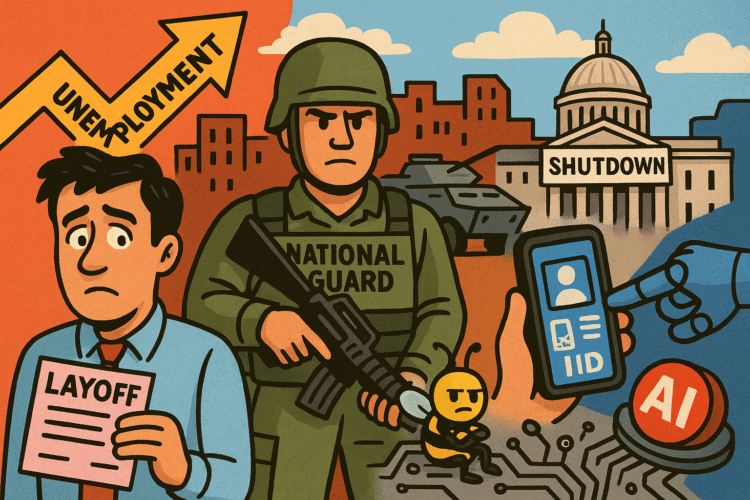
If you can’t see the connection between mass layoffs, record unemployment, AI automation, a government shutdown, SNAP benefit lapses, National Guard deployments, and the quiet rollout of digital IDs, congratulations. You are not “woke,” you are not “unbothered,” and you are not “staying out of politics.” You are the unpaid extra in a dystopian reboot of The Truman Show—a background actor who thinks the explosions are part of the set.
We’re told not to panic, that “everything is fine,” even as the economy looks like it’s being run on a prepaid card and democracy has gone to voicemail. Every week, a new headline hits like an unpaid electricity bill, and every response from Washington sounds like a recorded message: “Your suffering is important to us. Please remain on the line.”
Let’s call this what it is—a managed unraveling with the vibe of a tech startup and the compassion of a foreclosure notice. The country isn’t falling apart by accident. It’s being streamlined, optimized, and rebranded for efficiency. We’re not witnessing collapse; we’re watching a hostile takeover.
Mass layoffs are no longer an anomaly; they’re a business model. Every week, another “industry leader” cuts 20 percent of its workforce to “restructure for growth,” which is corporate for “we need to make the stock graph go up for five minutes.” The pink slips have become the new American currency. From Silicon Valley to Main Street, the script is the same: record profits, executive bonuses, and then a surprise announcement that thousands of people are “redundant.” Redundant. Like they were synonyms, not citizens.
The news outlets report these stories with the detachment of weather updates. “Tech sector sheds another 80,000 jobs.” As if shedding were a natural process, not a deliberate act of cruelty. Meanwhile, the executives are on panels about “workforce sustainability” while the newly unemployed are deciding which bill to pay before their health insurance evaporates. We used to call it exploitation. Now we call it efficiency.
The unemployment rate hasn’t been this high since 2009, but you wouldn’t know it from how the headlines are written. “Resilient labor market holds firm amid economic headwinds.” Translation: millions are broke, but the stock market looks great. What we’re living through isn’t a recession—it’s a reorganization of humanity. The unemployed aren’t seen as victims of policy; they’re seen as data points. To the think tanks, you’re not a person. You’re a variable in an economic model titled Acceptable Levels of Suffering.
The administration will tell you things are stabilizing. Economists will say it’s cyclical. But the reality is simpler and uglier: wages haven’t kept up with inflation since disco was a thing, and the safety nets have more holes than coverage. You’re supposed to survive on vibes and Amazon gift cards. Unemployment is no longer a social emergency; it’s a subscription plan. You pay with your sanity instead of your income.
Remember when AI was supposed to “free us from menial work”? Turns out the freedom was for corporations, not workers. They sold us the dream of automation as liberation—“let the machines do the drudgery”—and then forgot to mention that the drudgery was our paychecks. Now, CEOs are on CNBC bragging about “efficiency gains,” meaning ChatGPT is writing ad copy while the human who used to do it is standing in a food bank line. We were told that automation would elevate us to higher-level thinking jobs. Instead, we’ve been elevated right out of the labor force.
And the irony? The same executives who outsourced humanity to algorithms are now warning about “AI threats.” It’s the arsonist complaining about fire hazards. The new American work ethic is simple: survive the layoffs, outsmart the bots, and hope your replacement doesn’t come pre-installed.
Meanwhile, the federal government is in another “temporary funding lapse,” the euphemism that sounds like someone forgot to pay the electric bill for democracy. Hundreds of thousands of workers are either furloughed or forced to work unpaid, all while politicians stage budget theater for cable news hits. The shutdown isn’t a crisis anymore—it’s a ritual. Every few years, Congress performs its favorite moral drama about “fiscal responsibility,” and the rest of the country plays the role of collateral damage. Airports slow to a crawl. Food safety inspections stop. Housing vouchers lapse. But you can always count on one thing: the congressional gym stays open.
This isn’t gridlock. It’s governance by blackmail. The federal budget has become a hostage note written in talking points. The message is clear: they don’t care if the government works; they care that you know it doesn’t. Because a broken system justifies their existence.
When SNAP benefits lapsed, no one in power seemed to notice. The headlines barely made the front page. Tens of millions of Americans woke up to find their food assistance frozen while Congress argued about deficit optics. Poverty doesn’t trend. Hunger isn’t viral. And empathy doesn’t poll well in midterms. SNAP was one of the few things standing between millions of families and starvation, and now it’s an afterthought. The same politicians who call food aid “dependency” have never missed a meal in their lives. They talk about “fiscal responsibility” while spending millions on security details to protect them from the public they’re defunding. We’re witnessing a moral audit of America, and the accountants have decided that feeding children doesn’t offer enough return on investment.
If you’re wondering why National Guard convoys are rolling through U.S. cities, don’t worry—it’s not a coup. It’s just the new flavor of normal. Every crisis now comes with military decor. Hurricanes, protests, supply chain collapses, labor strikes—send in the Guard. Because nothing says “functioning democracy” like soldiers directing traffic and riot gear on every corner. The line between civilian oversight and martial optics has evaporated. They say it’s for “public safety.” But what public feels safe watching armored vehicles idle outside grocery stores while unemployment lines wrap around the block?
We’ve militarized anxiety. The troops aren’t there to protect us from enemies; they’re there to remind us who’s in charge when the economy stops pretending.
While the rest of us were busy worrying about rent, the federal government quietly rolled out digital identification systems “for security and efficiency.” The pitch sounds benign—streamlined access to benefits, medical records, and tax filing. But the fine print reads like an episode of Black Mirror. You can now verify your identity with your face. You can prove your citizenship with your fingerprint. And in exchange, the government—and its corporate partners—get to track where you go, what you buy, and when you last applied for unemployment. They call it modernization. I call it a surveillance coupon.
Once upon a time, the phrase “papers, please” was a dystopian cliché. Now it’s an app download away. The Digital ID isn’t a convenience; it’s a leash disguised as a lanyard.
Put all of this together, and the pattern becomes obvious. The economy collapses, the government shuts down, social safety nets vanish, the military appears in the streets, and digital tracking becomes the new normal. The result isn’t random—it’s orchestration. We’re watching a slow-motion merger between austerity and authoritarianism. The layoffs create desperation. The unemployment creates dependence. The benefit cuts create hunger. The digital IDs create control. The National Guard maintains order. It’s not a conspiracy. It’s a business plan.
Every crisis is an opportunity for consolidation. Every “temporary” policy becomes permanent once the public adjusts. The goal isn’t chaos—it’s compliance. And the beauty of it all? We’re cooperating.
Americans used to worship freedom. Now we worship efficiency. If something saves money, it’s moral. If it boosts productivity, it’s sacred. The question isn’t “Is this right?” but “Is this scalable?” We accept layoffs as economic necessity, surveillance as safety, and digital IDs as progress because we’ve been conditioned to think anything inconvenient must be outdated. Democracy, it turns out, is extremely inefficient.
Efficiency isn’t neutral. It’s a value system. It doesn’t care about dignity, community, or justice. It cares about metrics. It’s the logic of the spreadsheet applied to human life, and it always ends the same way: fewer people, fewer protections, and more profit. We are the data set being optimized out of existence.
Here’s the quiet truth nobody on CNBC will say out loud: the country isn’t being governed anymore; it’s being administered. The public sector is hollowed out, the private sector writes the rules, and the rest of us exist to generate data points for investors. Corporations are the new government. Tech companies are the new ministries. And AI isn’t the next industrial revolution—it’s the perfect bureaucrat. It doesn’t unionize, it doesn’t question orders, and it never asks for health insurance.
What we call “innovation” is actually privatized control. The layoffs, the automation, the surveillance—they’re not separate phenomena. They’re chapters of the same story: the commodification of everything, including governance. The government isn’t failing; it’s being phased out.
What’s most impressive about this grand implosion is how calm everyone is about it. You’d think mass unemployment, hunger, surveillance, and martial presence would cause riots. Instead, we get memes about “self-care” and influencers explaining “10 ways to stay positive during economic collapse.” The ruling class doesn’t need to silence dissent; it just needs to monetize it. Every outrage becomes content, every crisis becomes a brand opportunity. We’ve been turned from citizens into spectators. We don’t resist anymore—we react.
And when the government hands out digital IDs to manage the fallout of AI-driven unemployment, we’ll call it progress. Because the app will be free and come with a rewards program.
You don’t have to believe in conspiracies to see coordination. You just have to pay attention. Every system that once existed to stabilize society has been reengineered to extract value from instability. Layoffs make stocks soar. Automation makes profits skyrocket. Shutdowns justify privatization. Benefit cuts create cheap labor. Military presence maintains calm. Digital IDs close the loop.
The correlation isn’t accidental. It’s design. The chaos is choreographed, and the choreography is profitable. The trick is that it doesn’t look like tyranny—it looks like convenience.
Soon, you’ll need your digital ID to access federal benefits, medical services, and maybe even employment. You’ll “consent” to facial recognition because it’s faster than remembering your password. You’ll accept AI surveillance in workplaces because “it improves productivity.” You’ll tolerate the National Guard because “they keep things orderly.” And you’ll do it all willingly, because resistance has been rebranded as inefficiency.
In this new America, freedom doesn’t disappear overnight—it gets redesigned. It comes with an interface and a privacy policy. It updates automatically while you sleep. The future doesn’t need dictators. It has dashboards.
What makes this moment so darkly funny is how inevitable it feels. We invented machines to make our lives easier and ended up working for them. We built social programs to fight poverty and then defunded them. We created identification systems to protect ourselves and now use them to track each other. We engineered progress so perfectly that it no longer needs people.
This is not collapse; it’s consolidation disguised as efficiency. The rich are getting richer, the poor are getting digitized, and the government is getting rebranded as customer service. When history looks back on this era, it won’t see chaos—it will see compliance.
There’s something almost elegant about how predictably absurd this all is. Every headline is a punchline. “AI replaces 30,000 workers.” “Congress adjourns without budget.” “SNAP benefits suspended indefinitely.” “National Guard deployed to Chicago to assist with ‘urban stabilization.’” It reads like a parody that got greenlit. The writers’ room of history is trolling us.
Even the language has gone corporate. Layoffs are “rightsizing.” Hunger is “resource insecurity.” Surveillance is “identity protection.” Unemployment is “career transition.” The only people who talk plainly anymore are the ones losing everything. It’s almost beautiful, if you can ignore the smell of decline.
Here’s the real correlation: it’s not between the layoffs, the shutdown, or the digital IDs. It’s between power and amnesia. The ruling class has realized that people don’t rebel when they’re exhausted—they adapt. They’ll tell you that mass layoffs are “market correction.” That unemployment is “temporary.” That AI will “create new opportunities.” That the shutdown is “necessary for reform.” That benefit cuts “encourage independence.” That the National Guard is “keeping order.” That digital IDs “protect your identity.” And if you accept all that, congratulations. You’ve passed the modern citizenship test. You’re no longer a citizen. You’re a client.
The scariest part of all this isn’t the authoritarian drift—it’s how comfortable it feels. The lines outside unemployment offices are long, but the Wi-Fi is strong. The government is closed, but the apps are open. The soldiers in the street look friendly enough. We’ve mistaken stability for freedom and convenience for control. The American Dream didn’t die—it got a software update.
If you can’t see the correlation between mass layoffs, record unemployment, AI automation, the government shutdown, benefit cuts, militarized cities, and digital identification, it’s not because you’ve lost the plot. It’s because the plot has adapted. The new story doesn’t need villains or heroes. It just needs engagement.
And the ending? That’s the part you’ll have to subscribe for.