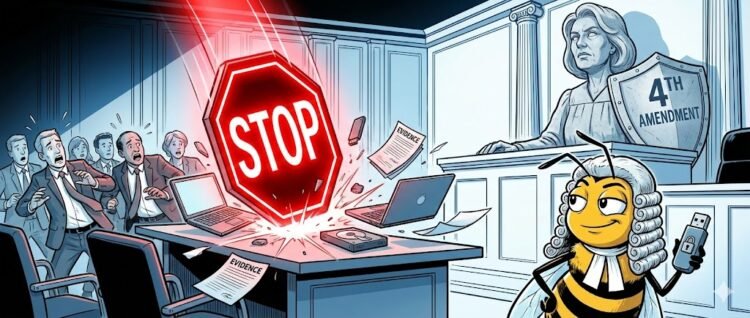
When you raid a lawyer’s iCloud without reading the Fourth Amendment first, you end up with a restraining order and a very embarrassing weekend.
It is a rare and beautiful thing to watch the Department of Justice trip over its own shoelaces in slow motion. Usually, the DOJ is the juggernaut, the unmovable object that grinds defendants into dust with the sheer weight of its resources. But this week, the juggernaut met a speed bump named Judge Colleen Kollar-Kotelly, and the result was a faceplant that resonated from the federal courthouse all the way to the J. Edgar Hoover Building.
On Friday, Judge Kollar-Kotelly issued a temporary restraining order that effectively put the FBI in a time-out. The order blocks the Justice Department and the FBI from accessing or using electronic files seized from Daniel Richman. For those of you who don’t follow the intricate lore of the Comey-verse, Richman is the longtime lawyer and informal confidant of former FBI Director James Comey. He is the guy who leaked the memos. He is the guy who knows where the bodies are buried. And apparently, he is the guy whose laptop the FBI decided to raid with the enthusiasm of a teenager hacking into a neighbor’s Wi-Fi.
Richman sued, claiming that the seizure and subsequent searches of his laptop, iCloud, and email accounts between 2019 and 2020 were unlawful and violated the Fourth Amendment. This is not a trivial accusation. The Fourth Amendment is the one that says the government can’t just rummage through your underwear drawer because they feel like it. They need a warrant. They need probable cause. They need to color inside the lines.
But the DOJ, in its infinite wisdom and zeal to nail Comey, apparently decided that the lines were more like suggestions. They grabbed everything. They hoovered up the data. And now, a federal judge has told them to put it down, step away from the keyboard, and keep their hands where she can see them.
The Fruits of the Poisonous Laptop
This ruling is a disaster for the prosecutors who are still trying to figure out how to put James Comey in handcuffs. Remember, the earlier indictment against Comey was dismissed on November 24 because the special prosecutor, Lindsey Halligan, was found to be unlawfully appointed. That was Embarrassment Number One. Now, with this restraining order, the DOJ has hit Embarrassment Number Two.
The materials seized from Richman helped form the basis of that earlier indictment. They were the building blocks of the case. Now, those blocks are radioactive. The judge’s order undercuts the prosecutors’ ability to rely on them. It places a giant “DO NOT TOUCH” sign on the very evidence they need to build a new case.
If you are a prosecutor, this is the nightmare scenario. You have a target. You have a theory. But your evidence is locked in a box, and the judge has the key, and she is looking at you like you are a toddler who just drew on the walls with a Sharpie.
The court ordered the government to identify and secure the data and to explain its handling by December 8. That is Monday. That means a lot of DOJ lawyers are spending their weekend frantically trying to figure out how to explain why they have been reading a lawyer’s emails for four years without a valid legal justification.
The Procedural Purgatory
The consequences of this ruling are cascading, and they are delicious. The DOJ’s contemplated effort to seek a new grand jury or re-indictment is now procedurally and evidentiaryly complicated. “Complicated” is a polite legal word for “totally screwed.”
How do you present a case to a grand jury when you can’t use the evidence you gathered? Do you ask the jurors to just trust you? Do you try to recreate the investigation from scratch, pretending you never saw the emails? That is called “parallel construction,” and judges tend to frown on it when they catch you doing it.
The issue of privileged material is also going to be a minefield. Richman is a lawyer. His laptop is full of attorney-client communications. The DOJ is not supposed to see that stuff. If they did see it—and let’s be honest, they probably did—it taints the entire prosecution team. It creates a conflict of interest that could disqualify everyone involved.
Then there is the Brady material. Brady is the rule that says prosecutors have to turn over exculpatory evidence to the defense. If there is stuff on that laptop that helps Comey, and the government is sitting on it while trying to hide their Fourth Amendment violations, that is a whole other level of misconduct. It is the kind of thing that gets cases dismissed with prejudice and gets prosecutors referred to the bar association.
The Political Blowback
This episode sharpens the political and legal arguments about prosecutorial overreach. The narrative from the Trump camp has always been that the “Deep State” broke the rules to get him. Now, we have a Trump-appointed DOJ breaking the rules to get Comey. It is a mirror image of incompetence and malice.
The critics will seize on this as proof that the investigation was corrupt from the start. They will argue that the government was so desperate to find a crime that they trampled on the Constitution to do it. And for once, the critics might have a point. When you start seizing lawyers’ iCloud accounts without a solid warrant, you are crossing a line that separates law enforcement from a police state.
Congressional oversight is likely to intensify. You can bet that Jim Jordan and the House Judiciary Committee will have some questions. Wait, wrong timeline. Let’s say Jerry Nadler and the Democrats will have questions. They will want to know who authorized these searches. They will want to know why the DOJ thought it could ignore the Fourth Amendment. They will want to see the warrant applications.
And the Inspector General will be sniffing around too. The IG loves a good process violation. This is the kind of mess that results in a 500-page report two years from now that uses words like “troubling” and “lack of candor.”
The Limits of the Dragnet
The broader implication here is about the limits of warrantless searches. We live in an age where our entire lives are digital. Our phones, our clouds, our emails—they are the modern equivalent of our papers and effects. The Fourth Amendment was written for parchment and saddlebags, but it applies to servers and hard drives too.
The government loves to argue that digital evidence is different. They argue that the “third-party doctrine” means you have no privacy interest in data you give to Apple or Google. But judges are starting to push back. They are starting to realize that if the government can search your cloud without a warrant, then the Fourth Amendment is dead.
Judge Kollar-Kotelly’s ruling is a victory for privacy. It is a reminder that the government’s investigative power is not absolute. They have to follow the rules. They have to get a warrant. They have to show probable cause. And if they don’t, they don’t get to use the evidence.
The Comey Connection
It is fitting that this revolves around James Comey. The man is a magnet for procedural weirdness. He was the Director who announced the reopening of the Hillary Clinton email investigation days before the election. He was the Director who took detailed memos of his conversations with Trump. He is a man who loves the rules, until he decides that his own moral compass overrides them.
Now, his lawyer is the one holding the line on the rules. Richman is fighting back against the very agency his client used to run. It is a civil war within the legal establishment. It is the FBI vs. the FBI’s ghosts.
The irony is that Comey probably would have approved these kinds of searches when he was in charge. The FBI has never been shy about pushing the envelope on surveillance. But now that the shoe is on the other foot, now that it is his lawyer’s laptop, suddenly the Fourth Amendment is sacrosanct.
The Footnote that Became a Headline
This case was supposed to be a footnote. It was supposed to be a clean-up operation. Indict Comey, get a conviction, move on. But the DOJ’s incompetence has turned it into a headline. They fumbled the special prosecutor appointment. They fumbled the evidence collection. They are currently fumbling the explanation.
It is a lesson in hubris. The administration thought they could just muscle this through. They thought the courts would roll over. They thought the rules didn’t apply to them because they were on a mission of righteous vengeance.
But the courts, occasionally, still work. Judges, occasionally, still read the Constitution. And when they do, the government’s grand plans tend to fall apart.
The Weekend Scramble
So now we have the weekend scramble. The DOJ lawyers are in the office, eating cold pizza, trying to draft a filing for Monday that explains why they aren’t actually monsters who hate privacy. They have to “identify and secure” the data. That means they have to find every copy, every backup, every thumb drive where those files might live.
And they have to explain their “handling” of the data. Did they share it with the White House? Did they leak it to the press? Did they let unauthorized people look at it? If the answer to any of those questions is “yes,” then Monday is going to be a very bad day for someone’s career.
Meanwhile, Daniel Richman is probably having a nice glass of wine. He won. For now. He got the government to back down. He exposed their overreach. He protected his client.
Conclusion: The Judicial Stop Sign
This ruling is a judicial stop sign. It tells the DOJ that they cannot just bulldoze their way to a conviction. It tells them that the ends do not justify the means. It tells them that even in a political prosecution, the basic rights of the accused (and their lawyers) still matter.
The case against Comey is now on life support. The prosecutor is gone. The evidence is frozen. The judge is angry. It is hard to see how they revive this without looking even more desperate and politicized than they already do.
But they will probably try. Because in this administration, you never admit defeat. You just file another motion, appoint another loyalist, and hope for a different judge.
Until then, the laptop stays closed. The cloud stays dark. And the Fourth Amendment gets to live another day.
Receipt Time
The invoice for this Fourth Amendment violation is being processed, and it includes a hefty surcharge for “Judicial Smackdown.” The DOJ spent years and millions of dollars seizing and searching data they had no right to touch. Now, they are paying the price in lost time, lost credibility, and lost evidence. The receipt shows a zero balance for “Convictions” and a massive debt for “Constitutional Integrity.” The taxpayers are footing the bill for a fishing expedition that caught nothing but a restraining order. And somewhere, James Comey is drafting a very smug tweet about the rule of law.