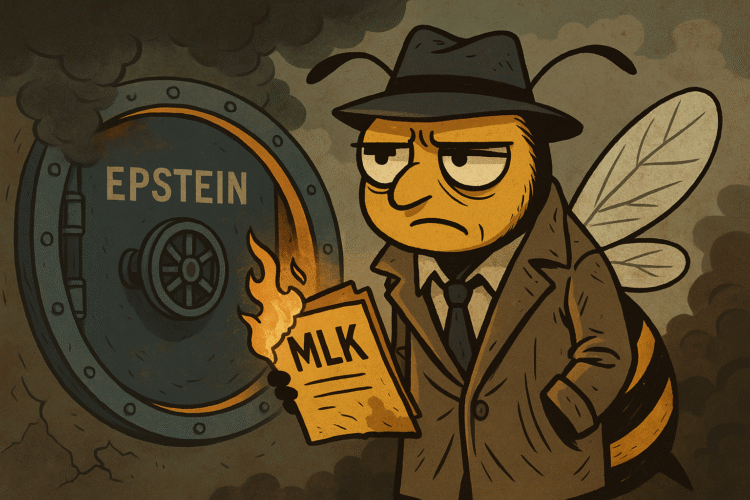
After 56 years, countless Freedom of Information requests, and one too many performances of Lift Every Voice and Sing by institutions that once tried to wiretap his grief, the federal government has finally—finally—released the MLK assassination files.
Well. Sort of.
They’ve been “released” in the way your emotionally unavailable ex “opens up” during arguments: technically, words come out, but most of the truth is buried under redactions and trauma. What we got was less a file dump and more a carefully curated scrapbook of plausible deniability, bound in Sharpie and steeped in institutional amnesia.
The first wave of headlines arrived with all the urgency of a lukewarm apology:
“Declassified Documents Provide New Glimpse Into FBI Surveillance of MLK.”
Which is media code for: We knew this, but we’re acting surprised because the PDFs are now public.
Let’s be clear: nobody with a functioning memory needed the files to know what happened. Dr. King wasn’t just surveilled—he was hunted, discredited, gaslit, and stalked by a federal agency so threatened by his existence they spent years trying to turn his righteousness into a scandal. The FBI didn’t just want to stop the movement. They wanted to script the downfall.
One newly unsealed memo—most of it redacted, naturally—outlines an explicit effort to discredit King by leaking surveillance tapes to clergy and journalists. Because nothing says “law and order” like bugging hotel rooms and ghostwriting suicide notes for a man whose biggest crime was believing Black people deserved dignity.
But here’s the twist no one’s saying out loud:
Why now?
Why, after decades of obstruction, does the government suddenly feel compelled to hand us this historical bone?
Could it possibly—just maybe—be connected to the mounting public pressure to release the Epstein client list?
Because here’s the thing: the American government doesn’t do transparency. It does distraction.
And what better decoy than one of the most weaponized legacies in modern memory? Releasing the MLK files now is like tossing confetti on a crime scene and calling it closure. A tidy little scandal from a previous generation to chew on while the current one simmers.
To be clear, this isn’t about minimizing what the FBI did to King—it’s about recognizing the pattern. Powerful men die mysteriously. Institutions stall, redact, delay. And when public pressure builds, they toss a bone from a different corpse and hope no one notices the smell.
The MLK documents are riddled with holes. Pages so redacted they read like avant-garde poetry. Whole paragraphs lost under thick black bars labeled “national security”—as if knowing which white men authorized psychological warfare against a Black preacher might cause the country to collapse in 2025.
Spoiler: some of those names probably still have offices. Or libraries.
Meanwhile, as we digest this carefully rationed truth, the Epstein files remain sealed tighter than a televangelist’s sphincter at Pride. Victims demand answers. Lawmakers grandstand. The press occasionally pretends to care—until the next AI-generated Drake single drops.
And somewhere in the bowels of government, a nameless bureaucrat hits “Upload” on a few more MLK documents and whispers, “That should hold them.”
Here’s the part they don’t say on the news:
The system doesn’t hate corruption. It hates exposure. And when it can’t prevent the latter, it manages the narrative by releasing history like an IV drip—just enough to numb, never enough to cure.
So yes, we got some new files. We got receipts of old crimes in new fonts. But what we didn’t get—again—is justice.
No apology. No accountability. No formal admission that our justice system tried to unmake a man whose only weapon was language. Just redacted history served as a placeholder while the real scandal simmers.
And still, they dare quote him.
Still, they post grainy MLK memes every January, pretending the man they erased died of natural causes somewhere between a press conference and a dream.
So no—we’re not shocked.
We’re not surprised.
We’re just flipping through the pages they gave us and asking:
Where the hell are the others?