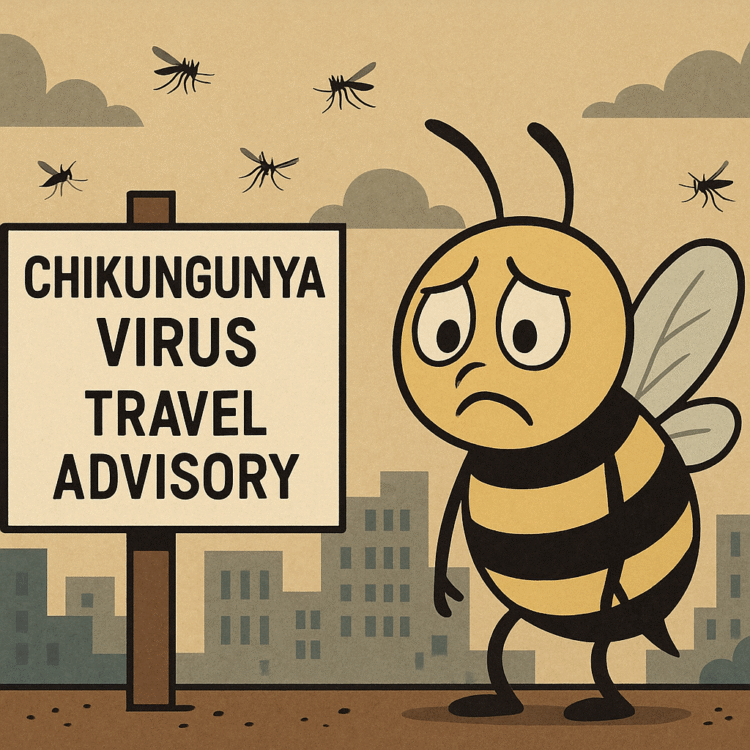
Just when you thought international travel had gotten too predictable—what with the climate collapse, digital border surveillance, and in-flight toddlers listening to CoComelon without headphones—the Chikungunya virus has re-emerged, now spreading through southern China like a mispronounced curse word in a ninth-grade spelling bee.
And naturally, the U.S. has issued a travel advisory, because nothing says “we care deeply about global health” like a bold-font webpage buried three clicks deep on a .gov site no one checks unless they’re printing customs forms.
Let’s be clear: chikungunya is not new.
It’s been around.
It’s the girlie who never quite made it viral.
Zika got the headlines. Dengue got the drama. COVID got the world tour.
But chikungunya? She’s the underground artist of vector-borne viruses—obscure, underfunded, and quietly ruinous.
Until now.
If you’re unfamiliar, chikungunya is transmitted by the Aedes mosquito, which already has an impressive resume that includes dengue, Zika, and probably several unproduced Netflix pilots.
Once bitten, you can expect:
- High fever
- Rash
- Nausea
- Joint pain so intense it makes you feel like you’re being haunted by your own skeleton
It’s not fatal, but it is very “I can’t walk without whispering ‘ow’ like a haunted Victorian orphan.”
Which is fun for exactly no one.
Especially not for tourists who flew 17 hours for a lantern festival and left with a full-body rehearsal of Les Misérables starring their immune system.
The CDC, of course, is issuing guidance:
- Wear insect repellent.
- Avoid stagnant water.
- Maybe don’t travel unless it’s essential.
- Absolutely don’t panic.
Which is bureaucratic for:
“This is going to get so much worse and we don’t have the infrastructure to stop it, but please enjoy your trip to Shenzhen.”
And in classic American fashion, the travel advisory isn’t actually about public health.
It’s about liability.
Because if you come home aching, rashy, and unable to open a jar without weeping, at least the State Department can say,
“Well, we did post a PDF about it. On page six. In size 10 font. Between the cautions about counterfeit handbags and tipping etiquette.”
Let’s be honest: we’re exhausted.
We’re still dealing with the long-tail psychic hangover of COVID.
We’re navigating Monkeypox, RSV, bird flu, whatever’s fermenting in the corner of that vape shop near the Greyhound station.
And now Chikungunya shows up like a girl from your high school reunion who insists she’s “doing really well, actually” but then explains she lives in a van with her ex.
The timing is rude.
The branding is inconsistent.
And the symptoms are both too dramatic to ignore and too niche to care about until it hits you personally.
Which, in America, is basically the criteria for all public policy.
Here’s what will happen next:
- A few viral TikToks from influencers with asymmetrical bangs in Bali:
“Hey guys, I tested positive for Chikungunya! Here’s my natural joint pain detox routine 🧃✨.” - A sudden run on citronella products at Trader Joe’s, followed by a niche anti-mosquito essential oil MLM.
- A right-wing media cycle blaming the spread on “illegal butterflies” or possibly George Soros.
- A pharma press release teasing a vaccine “in early-stage development,” which will cost $429 per dose and be covered by no one.
- And eventually—an abrupt collective forgetting until next summer, when someone sneezes in Guangzhou and the Dow drops 800 points.
But beneath the comedy of bureaucratic shrugging and Western panic, there’s a real horror:
Chikungunya is spreading.
Climate change is making sure mosquitos feel right at home in places they never used to be.
Urban density and inconsistent public health infrastructure mean that outbreaks aren’t if, but where next.
And while the media churns out headlines that sound like name generators for indie video games, the reality is:
Global health is no longer a science issue.
It’s a vibe check.
And right now, the vibe is: itchy, feverish, and deeply unprepared.
Final Thought:
Chikungunya isn’t just a mosquito-borne virus.
It’s a metaphor.
For the way we ignore danger until it lands—gently, buzzingly—on our own skin.
For the way we think borders can stop biology.
For the way we always find new ways to be surprised by problems we already had memos about.
So wear bug spray.
Avoid standing water.
And remember: the real infection was our belief that the pandemic era ever actually ended.