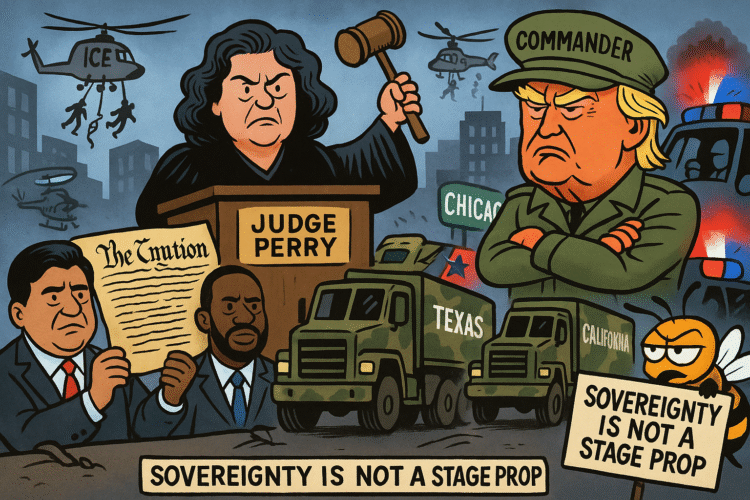
When America elects a man who treats the Constitution like a napkin for his Diet Coke spills, you get weeks like this: federal helicopters dangling agents over Chicago apartment buildings, immigration patrols conducting fashion-police stops downtown, and the President attempting to cosplay Lincoln while importing National Guard troops from Texas as if Illinois were suddenly Fort Sumter. And then—because sometimes the law remembers it has teeth—a federal judge in Chicago decides to remind the White House that the Insurrection Act is not a coupon you can redeem at will.
On October 9, 2025, U.S. District Judge April Perry issued a 14-day temporary restraining order blocking Donald Trump’s attempt to federalize and deploy Guard troops into Illinois. Her reasoning was devastatingly simple: the administration produced “no credible evidence” of a rebellion or breakdown of civil law. Translation: waving around scary headlines and grainy drone footage does not entitle you to militarize a Midwestern city already exhausted from immigration raids that feel more like street theater than security.
The order halts federalization until October 23, pending further hearings. In that window, Perry demanded real evidence, real predicates, and real respect for state sovereignty. Given that the Department of Homeland Security can’t even keep its “stop criteria” straight—agents admitted to considering “how people look” during traffic stops—one imagines the government’s evidentiary binder will be a coloring book.
Staging the Stagecraft
The irony is that by the time Perry dropped her ruling, roughly 500 troops had already been staged or en route: about 200 from Texas, 300 from Illinois, plus a cameo detachment from California spotted outside ICE’s Broadview facility. The whole thing looked like a dress rehearsal for a coup-themed LARP, with soldiers cooling their heels at staging sites while legal filings ricocheted between the courthouse and the White House.
This was not some abstract fear. Chicagoans had already endured a spate of federal action that bordered on parody:
- Downtown riverboat patrols by Border Patrol and ICE, turning the Chicago River into a live-action version of Miami Vice: Lake Michigan Edition.
- A helicopter rappel onto an apartment complex, because apparently subtlety died in 2016.
- An October 4 Brighton Park shooting, where federal agents wounded a U.S. citizen during a raid.
Governor J.B. Pritzker and Mayor Brandon Johnson cited these incidents in their lawsuit, arguing federal overreach was not only unlawful but also dangerous. Perry agreed, hinting that wrongful detentions of citizens and lawful residents are not the “collateral damage” of democracy—they are the definition of tyranny.
DOJ’s Pretzel Logic
In court, the Justice Department clung to its fallback line: the Guard was only there to “protect federal property.” This is the government equivalent of telling your landlord you bought a flamethrower strictly for “kitchen safety.” Plaintiffs countered that the Constitution does not allow importing out-of-state Guard units under Title 10 just because the President finds a city politically inconvenient.
The crux is whether the Insurrection Act applies. Perry’s answer—at least for now—is “not even close.” No rebellion, no insurrection, no suspension of law and order that local police and the Illinois Guard can’t handle. Which makes Trump’s gambit less like Lincoln in 1861 and more like Nixon trying to stage a pep rally with bayonets.
Posse Comitatus still means something, even if DHS would rather treat it like fine print in a timeshare agreement. Perry’s TRO joins earlier pushback in Portland, suggesting that courts are waking up to the idea that “federal troops on Main Street” is not a neutral phrase.
The Legal Theater
If the scene felt familiar, it’s because dueling affidavits turned into performance art. Plaintiffs presented sworn statements cataloging ICE’s abuse of stop powers, its reliance on vibes over evidence, and the chilling effect on immigrant communities. The Justice Department responded with boilerplate about “protecting assets” and vague references to “escalating unrest,” none of which they could substantiate with actual numbers.
Perry, notably, demanded transparency: arrest tallies, rules of engagement, timelines for deployments. DHS, which has treated such questions as optional, will now have to cough up receipts. If they can’t, expect the TRO to become a permanent injunction.
Politics by Patrol
The timing of this courtroom drama could not be more telling. Chicago has become the showcase city for “Operation Midway Blitz,” the administration’s immigration crackdown complete with street patrols, flashy raids, and the occasional helicopter rappel for dramatic flair. It is less about border security than about optics—an intimidation campaign disguised as enforcement.
But in a democracy, intimidation has a shelf life. Pritzker and Johnson hailed Perry’s order as a win for the rule of law, emphasizing that local autonomy matters even when the federal government is waving guns and flags. DHS vowed to appeal, effectively signaling that their definition of “rule of law” is whatever the executive tweets at 2 a.m.
Meanwhile, troops linger at staging sites, waiting for orders that may never come. Nothing says “professional military” like being used as extras in a legal soap opera.
The Statutory Knife’s Edge
At the heart of this dispute is a statutory knife fight. The administration insists it can use Title 10 authority to federalize Guard units. Plaintiffs argue that only the Insurrection Act could justify such a move, and since there’s no insurrection—unless you count the Cubs’ bullpen—there is no authority.
Perry sided with plaintiffs, at least preliminarily. The TRO forces the White House to confront an uncomfortable question: Can a President lawfully import out-of-state Guard troops to police a city when the state itself objects? For two centuries, the answer has been no—except in the most extraordinary circumstances. Perry’s ruling makes clear that “immigrants existing in public” is not extraordinary.
A Constitutional Crossroads
This case is more than a procedural fight. It is a referendum on the balance between federal power and state sovereignty. Trump’s administration has treated states like chess pieces, moving them around to stage militarized spectacles. Perry’s order reminds us that states are not pawns; they are co-equal sovereigns with constitutional dignity.
If DHS prevails on appeal, the precedent would be chilling: any President could override a governor and flood a city with troops based on “perceived disorder.” In other words, dissent itself could become grounds for occupation. That is not the rule of law—it is the rule of men with helicopters.
The Human Cost
Lost in the legalese are the human beings subjected to this chaos. When ICE agents justify stops based on “how people look,” they are green-lighting racial profiling as policy. When helicopters rappel onto apartment complexes, families are traumatized for the sake of political theater. When federal bullets hit U.S. citizens, the line between foreign battlefield and domestic policing collapses.
Perry’s ruling pauses this march toward authoritarianism, but only temporarily. The order expires October 23, and DHS will almost certainly appeal. The next two weeks will determine whether Illinois remains a sovereign state or becomes a cautionary tale.
Reactions: A Tale of Two Realities
The split screen was immediate. On one side, Pritzker and Johnson, standing shoulder to shoulder, framed the ruling as proof that constitutional order still matters. On the other, DHS vowed to appeal, implying that restraint is unpatriotic. Between them: 500 soldiers sitting in limbo, wondering whether they’ll be asked to defend democracy or dismantle it.
For Trump’s base, the narrative is simple: only he can protect America from imagined hordes of immigrants flooding Chicago’s streets. For anyone still tethered to facts, the picture is different: a city besieged by spectacle, a President addicted to militarization, and a court trying to hold the line.
The Endgame
The next hearing will test everything: statutory predicates, constitutional boundaries, and whether courts can enforce transparency against an executive branch allergic to it. Perry has already signaled her skepticism, but appellate courts remain a wildcard.
If Illinois wins, it sets a precedent that states cannot be occupied for political theater. If the administration wins, expect similar deployments in other blue cities—California, New York, maybe even Massachusetts—under the guise of “federal protection.”
Either way, the curtain has lifted on America’s latest constitutional showdown. What began as immigration enforcement has metastasized into a battle over sovereignty itself.
Closing Reflection: Sovereignty on Life Support
What happened in Chicago is not just a temporary restraining order—it is a diagnosis. America’s constitutional system is gasping for air, sustained only by the occasional judge willing to enforce limits. Perry’s ruling bought Illinois 14 days of oxygen. After that, it is anyone’s guess whether the patient survives or slips into a coma where sovereignty is optional and militarization is routine.
The helicopters may still circle, the troops may still loiter, but for now, at least, the Constitution has spoken. It whispered, weakly, but clearly: states are not stages, citizens are not props, and the President is not a king.