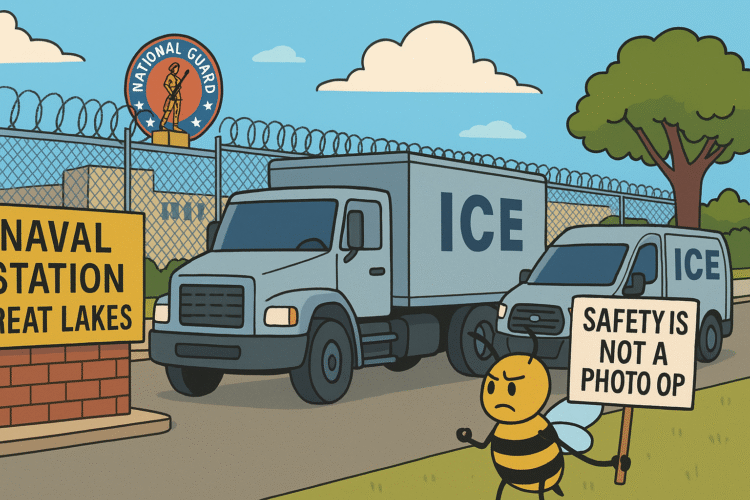
On August 28, 2025, while most of the country was still digesting the last “crime emergency” episode in Washington, the Trump administration quietly started drafting a sequel. This time, the stage is Chicago. The proposal: turn Naval Station Great Lakes—a training hub for sailors just north of the city—into a makeshift operations center for ICE “strike teams” and, possibly, a base of operations for National Guard deployment. The pitch is framed in familiar language: efficiency, safety, logistics.
But no one in Chicago asked for this. Not the mayor, not the governor, not the police superintendent, not the community leaders who have actually been charting crime reductions in the city. Violent crime is down significantly, and not because of federal theatrics, but because of local investment in violence prevention, neighborhood initiatives, and basic reality: fewer shootings. Yet here comes the White House with its cameras, Humvees, and power-point slides full of maps and “strike team” bullet points.
This is not about Chicago’s safety. This is about Chicago’s symbolism.
The Chicago Myth as Stage Prop
There is a very specific American shorthand when politicians say “Chicago.” It’s not a city; it’s a metaphor. For conservatives, Chicago is the evergreen bogeyman: crime-ridden, Democrat-run, allegedly lawless. For liberals, Chicago is a defensive talking point, proof that “actually, crime is falling and has been for years.” The city itself—its people, neighborhoods, rhythms—is erased in favor of an eternal fight about optics.
By setting sights on Great Lakes, the Trump administration is not protecting Chicago. It’s repurposing it as a backdrop. A stage where the President can once again announce, with full-body gravitas, that he is sending in the troops because local leadership has failed. It doesn’t matter that the numbers contradict him. Chicago has always been useful to power as a caricature.
The Absurdity of “Strike Teams”
The phrase itself is cinematic. “ICE Strike Teams.” One imagines paramilitary squads fast-roping down into Little Village, cutting through taco stands to seize undocumented immigrants in broad daylight while cameras roll. It is designed for spectacle, not safety.
In practice, ICE “strike teams” are overfunded task forces with vague jurisdiction, whose efficiency lies not in targeting crime but in producing arrest quotas. The bodies piled into detention centers become evidence that the operation was necessary, even if those bodies are largely workers with no criminal records.
The absurdity is that crime in Chicago has already been falling. By multiple metrics, violent crime is at its lowest in years. Yet the administration insists this is the perfect moment for militarization. Imagine a surgeon deciding to amputate after a wound has already healed—because the cameras were booked and the scalpel was polished.
Naval Station Great Lakes as Theater
There is no practical reason to house ICE “strike teams” at Great Lakes. The base is a training facility, not a detention hub. It exists to turn teenagers into sailors, not to detain fathers pulled from traffic stops. But as a visual, Great Lakes is perfect: a military base north of the city, with history, architecture, and runways for dramatic footage.
Picture the optics: Humvees rolling past naval flags, ICE agents strapping on gear in front of hangars, National Guard troops fanning out on highways. It looks like America means business. It looks like a government “finally” taking control of a lawless city. That the city in question has already seen major drops in violence is irrelevant. In fact, it’s almost useful—the less actual crime, the more arrests stand out.
Chicago’s Actual Work
What vanishes in this conversation is the mundane, local work already paying off. Community groups negotiating ceasefires, nonprofits expanding youth job programs, city funding redirected toward prevention. Police reform has been uneven, but data-driven strategies and neighborhood patrol adjustments are showing results. The homicide rate is lower than it’s been in nearly a decade. These gains are fragile, real, and unglamorous.
The administration can’t sell fragile, real, and unglamorous. It can only sell tanks at sunrise and podium speeches about “taking back our cities.”
Authoritarian Safety Illusions
We’ve been here before. Washington was declared safe after National Guard deployments. Crime dipped “23 percent” in the first two weeks, though analysts cautioned it was more about reporting lags than miracles. The illusion was enough. For Trump, optics are the currency, not outcomes.
The authoritarian trick is simple: if you flood a city with troops, you can claim order has been restored. If crime goes unreported, you declare victory. If critics cry over due process, you paint them as enemies of law and order. Authoritarian regimes have always been “crime-free” in this sense. Ask Nazi Germany. Ask the fictional Gilead. Ask any dictatorship where crime statistics are pristine, not because life is safe, but because life is policed into silence.
By that metric, Trump’s Chicago proposal isn’t a plan for safety. It’s an audition for authoritarian nostalgia.
Chicagoans Didn’t Ask
Local leaders are united in their response: unnecessary, unwanted, politically charged. Governor J.B. Pritzker called it a “power grab in search of a problem.” The mayor’s office stressed that crime is down, resources are already in place, and that the federal surge would destabilize rather than support. Community organizations, used to being erased from national conversations, pointed out that their work—not tanks—brought numbers down.
But Trump isn’t asking permission. He doesn’t need cooperation; he needs conflict. The refusal of Chicago’s leadership will itself be spun into proof that they are weak, incapable, or corrupt. Their no becomes his yes.
Courtrooms as Collateral Damage
If Washington is precedent, the collateral damage will be the courts. Federal magistrates already drowning in backlogs now brace for an influx of immigration-related detentions. The Pentagon is reportedly preparing to dispatch JAG lawyers again to handle the volume, as though America’s judicial system were a clogged drain that could be cleared with military plumbing.
Chicago courts are no better prepared. The system is already strained by ordinary caseloads. Add hundreds of expedited immigration arrests and the machine jams. Justice delayed becomes justice denied, but the optics remain intact: a thousand people in custody looks like a thousand victories.
Militarization as Ratings
What we are watching, again, is the conversion of governance into spectacle. Military trucks double as props, arrests double as plot points, naval stations double as soundstages. A President facing re-election can point to the footage and declare himself the only one brave enough to confront the crisis. The fact that the crisis is fabricated becomes irrelevant.
It is the oldest Trump trick: if the numbers don’t tell the story you want, stage a better story.
The Dangerous Normalization
Each of these incursions moves the line. Washington was extraordinary—now it is precedent. Chicago will be extraordinary—until the next city. If this continues, every urban area becomes a potential theater for federal militarization, whether they ask for it or not.
The danger is not just the troops on the ground. It is the normalization of the idea that the federal government can unilaterally seize control of local policing whenever it suits its optics. That safety is a photo op. That governance is a press release. That sovereignty is conditional.
The Real Chicago
Strip away the caricatures and Chicago is not a crime dystopia or a lawless wasteland. It is a city of neighborhoods, contradictions, vitality. It is jazz clubs in Bronzeville, murals in Pilsen, lakefront joggers, corner churches, Harold’s Chicken on a Friday night. It is also poverty, segregation, trauma, disinvestment. Crime exists, yes, but so does resilience.
Reducing all of this to a backdrop for ICE strike teams is not only dishonest. It is theft. It steals the city’s own work, its own struggles, its own narrative.
The Haunting Observation
The question isn’t whether ICE “strike teams” will lower crime in Chicago. They won’t. The question is whether the country will notice the sleight of hand: the way real progress is overshadowed by theatrical militarization, the way “safety” is redefined as a street full of soldiers.
Chicago does not need a naval base turned into a detention hub. It needs investment, trust, continuation of the quiet work already succeeding. But investment doesn’t look good on television. Tanks do.
One day, Chicagoans will look back at this moment and remember the absurdity of troops staged against a city whose crime was already falling. They will remember the dissonance of being declared unsafe while their own numbers proved otherwise.
And the haunting truth will linger: safety was never the point. The point was the picture.