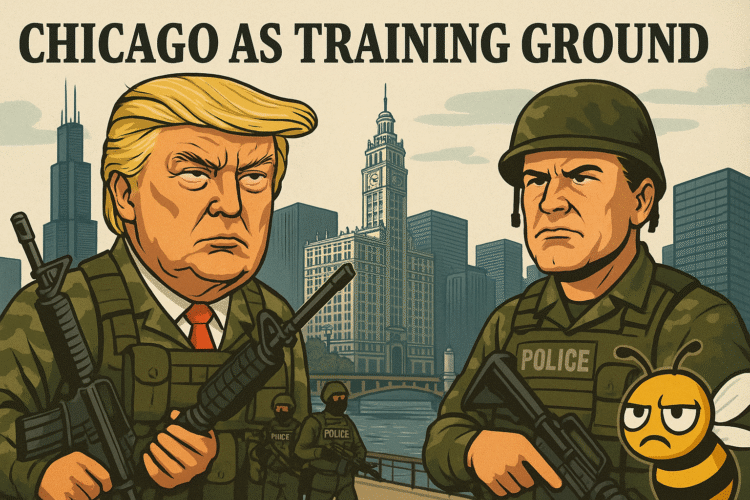
What is a city for, if not shopping, dining, living, and occasionally being transformed into a federal obstacle course? Chicago, always known for deep-dish pizza and mobster clichés, has now been recast as the Pentagon’s favorite indoor paintball arena. Only this time the paintball guns are real rifles, and the “players” are U.S. citizens unlucky enough to stroll too close to Trump Tower without looking sufficiently patriotic.
The story did not begin with Trump’s October 1 declaration of a “security umbrella” over the city, but with the late-September overture: Border Patrol boats, bristling with long guns, cruising the Chicago River like they were auditioning for a Michael Bay remake. Tourists who expected to Instagram the skyline instead found themselves framed against the barrel of a rifle. Nothing says “Welcome to the Windy City” like tactical agents floating past the riverwalk as if Wrigley Field had been moved to Fallujah.
By September 28, the action left the water and migrated to the sidewalks. Trump Tower, always a magnet for tacky Instagram photos, now doubled as a federal checkpoint. Agents in camo stood beneath its reflective glass, detaining people for the crime of existing. The federal name for this surge was Operation Midway Blitz, which sounds like a halftime snack at a Bears game but was in fact a rolling show of force designed to demonstrate how little state consent matters when Washington decides your city needs a makeover.
On September 29, the White House sent a polite memo to the Pentagon asking for a hundred troops, because apparently Chicago’s bridges and Broadview ICE facility could not be adequately protected without importing the military. The Pentagon, ever the consummate bureaucrat, confirmed it had received the request and was “reviewing” it, which is Washington-speak for: “We are counting how many lawyers it will take to pretend this is legal.”
October 1 brought the real theater. The administration framed this as “force protection” for federal officers. No, they weren’t deploying the military into city streets, they explained — they were simply safeguarding federal personnel. The fact that those personnel happened to be roving downtown detaining shoppers on Michigan Avenue was considered a detail too small to matter. Aides, speaking with their usual discretion, admitted privately that this was about more than protection. This was about turning Chicago into a training ground. If the footage looked like an authoritarian power grab, so be it. That was the point.
Governor J.B. Pritzker, who has a way with plain language, called the move exactly that — an authoritarian power grab. Mayor Brandon Johnson, who is tasked with the thankless job of keeping tourists spending while ICE conducts side-shows under his nose, warned that the spectacle would lead to racial profiling and would scare off the very businesses downtown was depending on to survive Q4. Meanwhile, Border Patrol commander Gregory Bovino, bless him, skipped the euphemisms and explained that his agents stopped people based on appearance. He even said, on record, that he ignored a tall white reporter because the man “looked like me.” It was the kind of candor that makes lawyers wince and authoritarian manuals proud.
The numbers rolled in vaguely, as they always do in these spectacles. Dozens detained here, hundreds shuffled through Broadview there. The ICE facility became the staging ground, its perimeter lined with agents wielding pepper balls and tear gas when protesters gathered. In Franklin Park, an ICE shooting left a civilian dead, a development the administration treated as an unfortunate but irrelevant footnote. Meanwhile, river bridges became checkpoints, tourists became collateral, and the riverwalk transformed into a gauntlet where shopping bags were swapped for handcuffs.
Legally, the contortions were impressive. The Posse Comitatus Act, the century-old safeguard that says the military cannot act as domestic police, was not so much bent as folded into an origami swan. The administration’s lawyers argued this was not about domestic policing, but about protecting federal property. Never mind that “federal property” was now defined as “any location a Border Patrol agent happens to be standing in.” Title 10 and Title 32 were invoked in a half-hearted legal tango: if Illinois refused to consent, the Guard could be federalized; if active-duty troops were restricted, the administration could simply redefine their mission. The technicalities did not matter. The message did.
Litigation appeared as predictable as lake-effect snow. Illinois’ attorney general drafted emergency filings before the ink on the troop request dried. The ACLU prepared suits demanding injunctions. Civil rights groups salivated at the chance to demand arrest logs, stop criteria, and internal memos. Federal lawyers rehearsed their favorite line: “Too sensitive to disclose.” Everyone knows how this dance goes. The difference this time is that the dance floor is Michigan Avenue.
The real casualties are less legal than civic. Downtown retailers, counting on holiday shopping, watched their future evaporate under the shadow of rifles. Tourists booking hotels in River North were suddenly picturing themselves caught in crowd-control crossfire. Commuters on the CTA eyed every checkpoint as a delay. Festivals and concerts began debating whether to cancel for “safety.” Chicago, the beating heart of the Midwest, was reframed as a testing ground for militarized immigration policy at the very moment when crime rates were lower year over year.
The precedent is clear. If Chicago can be turned into a training grid, so can New York, Los Angeles, or Portland. Sanctuary city or not, if your skyline doubles as a backdrop for campaign ads, you too can expect Border Patrol boats in your rivers and camo on your sidewalks. The legal hook is as expandable as chewing gum, and once stretched it never shrinks back.
So the questions now are blunt. Will the Pentagon actually deploy Guard units over a governor’s objection? Will hotels receive federal briefings about where they may host guests without risking a raid? Will this “model” be exported coast to coast? Or will the courts, in their plodding, careful way, force sunlight onto the arrest logs and targeting criteria that no one in Washington wants seen?
Chicago, for now, is the unlucky volunteer in this experiment. Its streets are where constitutional boundaries are being treated as optional. Its residents are the guinea pigs in a federal rehearsal for how much force the public will tolerate before calling it what it is. And the rest of the country ought to be paying attention, because what starts on the riverwalk rarely stays on the riverwalk.
This is not safety. It is choreography. It is intimidation staged as governance. It is a dress rehearsal in camouflage, where the city is the set, the people are the props, and the Constitution is the backdrop slowly being torn down behind the curtain.