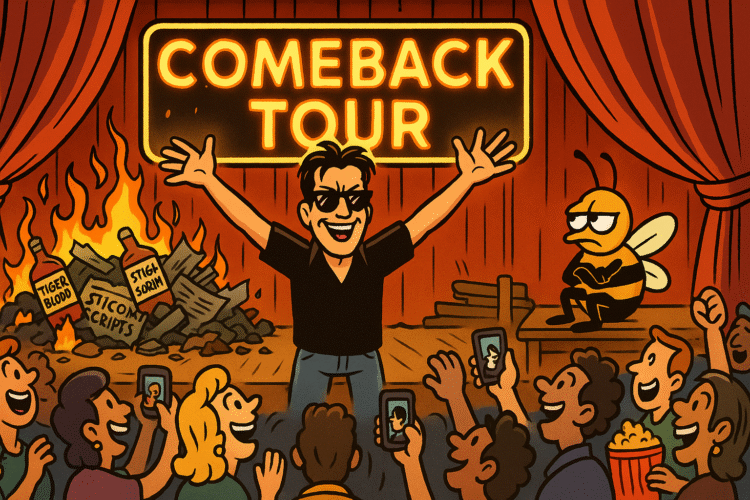
We are a nation addicted to watching houses burn down and then clapping when the insurance check arrives. That, in essence, is the plotline of Charlie Sheen’s life, which is now getting the full treatment—documentary, book, the kind of cultural reappraisal usually reserved for wars or Woodstock.
Why Charlie Sheen? Because he’s perfect for us. He was born famous, burned it to the ground in a haze of tiger blood and live-streamed self-destruction, then limped through the ashes, cigarette in hand, somehow still smirking. He is our favorite archetype: the scandal-riddled phoenix, rising not in grace but in meme.
The question isn’t why Charlie Sheen is back. The question is why we, the audience, are back—why after all the cocaine, all the porn-star villas, all the “winning” mantras shouted like a deranged Times Square preacher, we still want him to win.
The Build: Our Favorite Toy Soldier
America builds celebrities the way toddlers build block towers: not to admire them, but to enjoy the crash. Sheen had it all, of course: the pedigree (Martin Sheen’s son), the early promise (Platoon, Wall Street), the sitcom jackpot (Two and a Half Men). At one point, Sheen was the highest-paid actor on television, beaming into millions of living rooms as America’s lovable cad.
But what we loved more than the paycheck was the persona. The man wasn’t just playing a womanizing, booze-soaked scoundrel on TV—he was one. Art imitated life, and life ordered bottle service. He was the first reality star before reality television had fully weaponized itself.
We put Sheen on a pedestal, but with a trampoline underneath. The joy was always going to be in the bounce.
The Burn: A Public Bonfire
Then came the meltdown: tiger blood, Adonis DNA, goddesses, machetes, “winning.” For a brief season in 2011, Charlie Sheen turned daytime talk shows into Mad Libs and Twitter into his pulpit. He wasn’t just crashing—he was narrating the crash in real time, and we were there for every flaming shard.
He was fired from his sitcom, ranted at live shows that sold out on curiosity alone, and became a meme factory before we had words for meme factories. Sheen’s interviews were absurdist performance art, like Andy Kaufman filtered through a cocaine blizzard.
And we, the audience, loved it. The collapse of Sheen was the Superbowl of schadenfreude. America, as always, relishes the bonfire more than the building.
The Ashes: Reality Bites Back
Of course, behind the theater was reality. Substance abuse, broken relationships, health crises, lawsuits. The manic charm turned tragic, and the headlines shifted from LOL to yikes. The fall was no longer funny—it was sad, raw, human.
And then, like clockwork, we started missing him.
The Rise: Cue the Documentary
Now Sheen returns with a documentary and a book. The once-cartoonish wreckage is reframed as testimony, as survivor’s tale, as teachable moment. And it works, because America loves nothing more than a redemption arc. We cheered him when he soared, cackled when he crashed, and now we want to hug him when he limps back to the mic.
There is something impossible about not rooting for him. He’s been every flavor of mess—addict, egomaniac, sex scandal headliner—but in the ruins, he seems strangely human. We look at Charlie Sheen now and think: if this man can find a second act, maybe so can we.
That’s the trick of American celebrity: their redemption is our proxy.
The Lie We Tell Ourselves
We tell ourselves it’s about accountability, about watching stars “learn lessons.” But that’s not it. We’re not watching Sheen for moral improvement. We’re watching because we love the cycle. Build, burn, rebuild. It’s not justice—it’s entertainment.
Charlie Sheen isn’t proof that America believes in forgiveness. He’s proof that America believes in content. And he delivers it.
The New Charlie
Sheen today is reflective, maybe humbled, definitely older. He speaks of mistakes and lessons, of surviving storms of his own making. The documentary reframes the chaos, the book packages it for your nightstand. It’s still spectacle, but now with gravitas.
And you know what? We’ll buy it. We’ll watch it. We’ll read it. Not because we suddenly believe Charlie Sheen is a monk, but because we want to believe in the possibility of comebacks. We want to believe people can crawl out of holes dug with their own shovels.
Why We Can’t Quit Him
It’s simple: Charlie Sheen is fun. Even at his worst, he was never boring. He turned self-destruction into a genre, then turned survival into a sequel. He was reckless enough to implode publicly but charismatic enough that you couldn’t look away.
And now, with the dust settled, he feels oddly safe. He’s not the tiger-blood prophet screaming into cameras—he’s the survivor giving interviews. It’s the same reason we cheered for Robert Downey Jr., or Britney Spears, or even Martha Stewart. We love the narrative loop.
Charlie Sheen is us, if we had money, fame, and less impulse control. His redemption is our guilty pleasure.
What This Says About Us
Charlie Sheen’s comeback isn’t really about Charlie Sheen. It’s about us, the audience. We are the ones who demand the cycle. We are the ones who fund the documentary, preorder the memoir, click the headlines. We build idols not to worship them, but to burn them, and then we clap when they crawl back from the embers.
It’s Roman gladiators with better lighting.
Curtain Call
Charlie Sheen’s story, as told in his new projects, is equal parts confession and encore. He may never fully shake the caricature he created, but he doesn’t need to. For America, the caricature is the point.
We wanted him high, we wanted him low, and now we want him healed. Even after all the bullshit, we can’t help ourselves. We want Charlie Sheen to do well. We want to believe in the possibility of comeback, because if Charlie Sheen can rise again, maybe the rest of us can too.
When the Ashes Glow
The Sheen documentary and book will sell, not because they promise truth, but because they promise theater. And America has always been willing to pay for a good show.
So we’ll tune in, popcorn in hand, ready to watch the phoenix flap its wings again. Because we’ve seen him burn, and because some small, cynical, hopeful part of us still wants Charlie Sheen to fly.