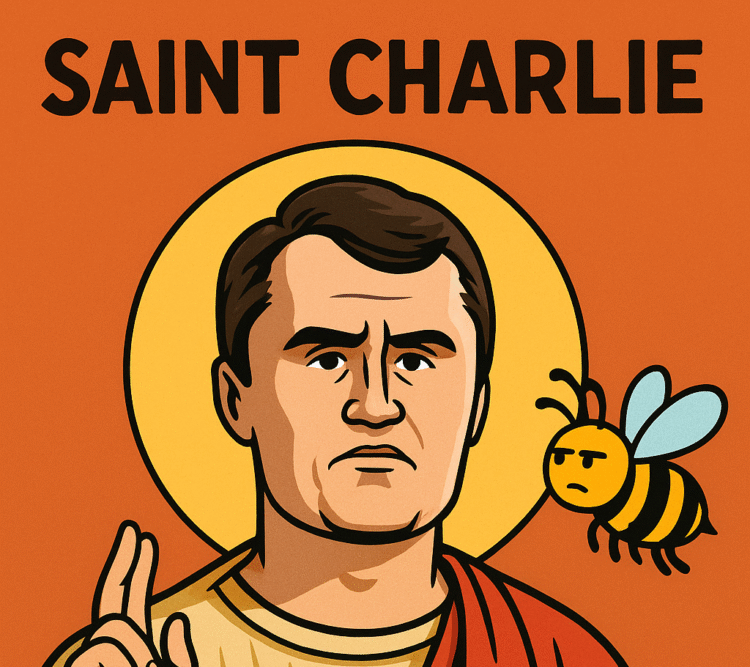
It’s troubling—horrifying, really—that Charlie Kirk was assassinated. Political violence is never the answer, not when it’s directed at the left, not when it’s directed at the right, not when it’s directed at the loud, obnoxious pundits who thrive on outrage, and not when it’s directed at their most vulnerable targets. A functioning democracy cannot survive if political disagreements are resolved through murder, intimidation, or bullets from rooftops.
Let’s start there: what happened on that campus stage was wrong, tragic, and dangerous for everyone. We should never try to fight with violence or death. That is the ground floor. But from that foundation, let’s climb carefully, because what’s happening in the aftermath of Kirk’s assassination is not grief—it’s canonization. It’s the immediate construction of a myth, one that tries to turn Kirk into a saint, a war hero, a fallen soldier of noble ideals.
And that’s where I call bullshit.
Charlie Kirk was not a saint. He was not a visionary. He was not even a particularly gifted thinker. He was, in the plainest terms, a racist, misogynist, right-wing provocateur who built his brand on inflaming division, belittling marginalized communities, and selling outrage like it was miracle tonic. His assassination doesn’t change that. His death was tragic, yes—but it doesn’t erase the damage of his life’s work.
The Problem with Canonizing a Culture Warrior
The American political machine loves a martyr. Give us a death, and we’ll give you a monument. But martyrdom requires virtue, and Charlie Kirk’s public career was not virtuous. He did not fight for unity, compassion, or democratic ideals. He fought for clicks, applause, and the unquenchable rage of a conservative movement addicted to its own cruelty.
He mocked women who spoke up about sexual assault. He ridiculed LGBTQ+ people, calling queerness a societal sickness. He pushed racist dog whistles about immigration, insisting that brown-skinned migrants were “replacing” white voters. He blamed gun violence on anything but guns. He questioned the reality of climate change while Texas froze and California burned.
These weren’t slips of the tongue. They were his brand. He didn’t stumble into cruelty—he curated it, monetized it, and wrapped it in the flag.
Racism as Political Currency
Kirk built much of his empire on fear of immigrants, fear of Muslims, fear of Black activists. He spoke with wide-eyed indignation about “illegals” invading the country, about how “the left wants to replace you.” He cloaked his rhetoric in pseudo-academic jargon, citing “voter integrity” or “cultural preservation,” but the message was clear: white people are under threat, and the enemy is brown.
He mainstreamed replacement theory—a conspiracy so toxic it has inspired mass shooters. And now, in a macabre twist, his own death is being leveraged to feed the same fear he helped spread.
Misogyny with a Microphone
Charlie Kirk treated women’s rights like a punchline. He dismissed feminism as hysteria, sneered at reproductive freedom, and regularly mocked female politicians as shrill or incompetent. He performed the conservative bro routine with smug precision: women were to be ridiculed unless they stood behind him nodding.
And yet, in the wake of his death, we’re told to remember his “courage.” Courage? To demean survivors of rape on live radio? To belittle women in politics with high school-level insults? That’s not courage—that’s cruelty dressed up as commentary.
The Weaponization of “Family Values”
Kirk’s rhetoric about “family values” was another fraud. He spoke reverently about protecting children, all while demonizing queer teachers and trans kids. He claimed to champion life while mocking grieving parents of gun violence victims. He conflated “family” with heterosexual, white, Christian households and labeled everything else a moral decline.
The hypocrisy was galling. He celebrated a culture that glorifies violence, then shrugged when children were massacred in classrooms. He cheered for guns as emblems of freedom, then insisted every shooting was the fault of “mental illness” or “broken homes.” He preached responsibility, but his politics only deepened America’s culture of cruelty.
The Shooter’s Mirror
And here’s the cruelest irony: the person who killed Charlie Kirk, according to early reports, came from a MAGA household. A home that celebrated gun culture, that normalized violence as patriotic ritual. This wasn’t some Antifa sleeper agent. This wasn’t the caricature Fox News loves to paint. This was one of his own, steeped in the same ecosystem of anger, paranoia, and gun fetishism that Kirk himself promoted.
The monster he warned his followers about didn’t crawl out of some progressive fever dream. It came from his own backyard, nurtured by the very rhetoric he spent his career amplifying. That’s not karma—it’s causality.
Death Doesn’t Erase the Damage
Here’s the hard truth: Kirk’s assassination doesn’t suddenly make him a noble figure. Death doesn’t absolve. We can mourn the violence without whitewashing the life.
Charlie Kirk leaves behind a legacy of division, paranoia, and cruelty. His empire trained young conservatives to treat opponents as enemies, not neighbors. His words emboldened extremists who believed violence was just politics by other means. His brand of politics wasn’t about ideas—it was about enemies.
And now, his death is being repackaged as proof of his righteousness, as if the bullet that killed him were some divine endorsement of his worldview. But no—his death was senseless, tragic, unacceptable. His life was something else entirely.
The Performance of Grief
Conservatives are already spinning this assassination into a morality play. Kirk is being elevated to martyrdom, his speeches clipped into inspirational montages, his face plastered onto banners of “freedom.” Politicians who laughed off violence against Democrats are now demanding respect, civility, and solemnity.
But where was that civility when Paul Pelosi’s skull was fractured by a hammer? Where was that solemnity when Black Lives Matter protesters were smeared as terrorists? Where was that reverence when LGBTQ+ clubs were shot up and children were massacred in schools?
The selective grief is obscene.
The Hypocrisy of Decorum
It’s worth spelling out the hypocrisy. The same right-wing commentators who mocked George Floyd’s death are now outraged that anyone would criticize Charlie Kirk in death. The same politicians who dismissed January 6 as “legitimate protest” are now pearl-clutching about “dangerous rhetoric.” The same movement that offers nothing but thoughts and prayers to parents burying their children now demands that Kirk be treated as untouchable.
Decorum, it seems, only matters when it’s their guy in the casket.
A Culture That Eats Its Own
What happened to Charlie Kirk is not a leftist plot, not an Antifa conspiracy. It’s the inevitable outcome of a culture that normalizes violence, fetishizes guns, and thrives on outrage. Kirk fed that culture. He built a career amplifying it. And in the end, that culture consumed him.
That doesn’t make his death any less tragic. But it does make the sainthood routine unbearable.
The Path Not Taken
Imagine if Kirk had used his platform differently. Imagine if he had told his followers that political opponents are not enemies but fellow citizens. Imagine if he had acknowledged systemic racism, supported women’s autonomy, defended LGBTQ+ youth, or treated gun violence as a solvable epidemic rather than a punchline.
Imagine if, instead of feeding paranoia, he had fostered dialogue. Instead of monetizing hate, he had championed dignity.
Would he still be alive? Who knows. But the culture he chose to nurture—a culture of enemies and guns—was always going to devour itself.
The Satire of Martyrdom
The satire here writes itself. A man who mocked, demeaned, and inflamed is now canonized as a fallen hero. A movement that cheered violence is now horrified by it. A culture that fetishizes guns is shocked when one is used.
The very ecosystem that produced Charlie Kirk produced the man who killed him. That’s not just irony—it’s indictment.
Summary of a Legacy We Shouldn’t Whitewash
Charlie Kirk’s assassination is troubling and tragic, but it does not erase who he was: a racist, misogynist, right-wing provocateur who built his career on cruelty. We must reject political violence unequivocally—but we must also reject the rush to martyrdom that paints Kirk as a saint. His legacy is one of division, paranoia, and hate, and the bitter irony is that the culture he helped foster—the gun-loving, outrage-fueled MAGA household—produced the man who killed him. To mourn his death is human. To sanctify his life is dishonest.