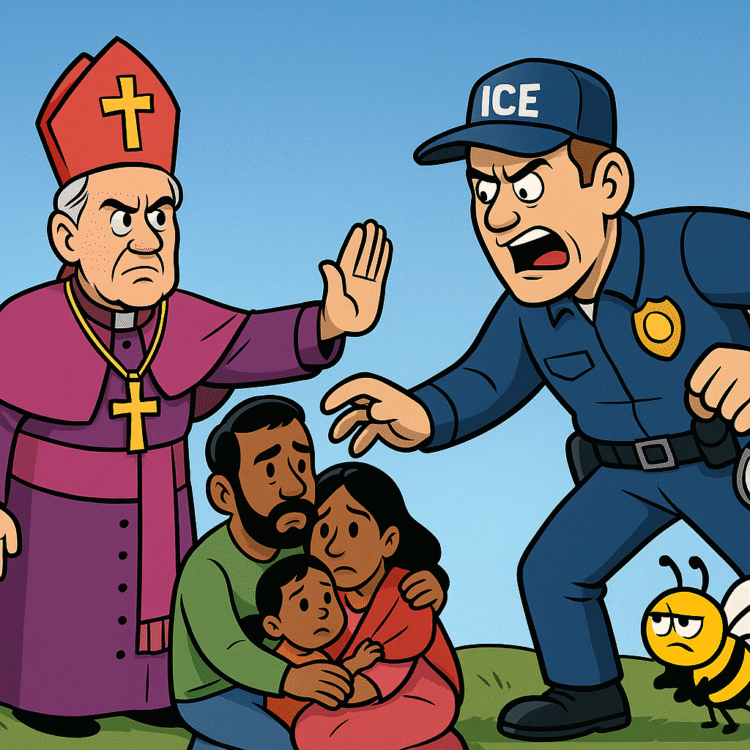
The bishops finally found their voices again. Not the soft indoor-voice homilies that float above parish pews like incense, but something closer to a raised eyebrow from God. America’s Catholic hierarchy, after years of sounding like they were trapped between a Fox News chyron and a Vatican footnote, just dropped a “Special Message” on immigration that reads like a pastoral clapback at the White House’s deportation fantasies. And to everyone’s collective surprise, they did it overwhelmingly. Not close. Not a polite internal memo that gets buried behind a hymn. They passed it 216 to 5. When three abstentions show up at the most consequential immigration vote in years, you know a few bishops chose the spiritual equivalent of sitting behind a potted plant until the danger passed.
But do not mistake this for a sudden outbreak of moral courage, or some renaissance of prophetic fire. This is what happens when a nation’s largest religious body finally looks up from the liturgical calendar and realizes the president is about to send ICE agents into their schools, their parishes, their hospitals, and every other “sensitive location” the administration now treats as a polite suggestion instead of a boundary. When the government starts swinging batons at their congregations, bishops remember why they wear rings that symbolize a marriage to the people they serve.
The statement is unprecedented for modern USCCB politics. Not hedged. Not muddled. It explicitly opposes “indiscriminate mass deportation,” condemns detention conditions, and announces a new nationwide pastoral aid campaign. It reads like the moment the Church hierarchy remembered that the Book of Exodus is more than a bedtime story. Better late than never.
And we should linger on that. Because when a body that spent years parsing verbs on immigration suddenly writes like its cassocks are on fire, it means the ground has shifted under them. The bishops did not discover theology in 2025. They rediscovered clarity. In Baltimore, during their annual assembly, they made a choice: either align with the administration’s crackdown or align with two thousand years of “welcome the stranger.” They chose the stranger.
It may also be the first time in his life that Donald Trump has been confronted by a group of men in matching outfits who did not immediately flatter him.
The statement’s passage unfolded with the precision of a Vatican chronicle. Internal debates simmered early in the week. Conference president Archbishop Timothy Broglio, a man who usually treats nuance like incense, found himself navigating the political equivalent of a Stations of the Cross procession. Committee heads crafted the language. Drafts circled. Arguments flared. And then, in the afternoon session, the bishops voted and released the document into the wild.
It was not subtle. It was not soft. It was not something the administration could spin as support.
Trump world immediately tried to shove it into the “political” bin. The same people who do not blink when prosperity gospel preachers tell the president he is the new King Cyrus suddenly decided religion should stay out of politics. Convenient. But the bishops’ message is theological at its core. Nations may control borders. Nations must also honor the dignity of every person caught in that system. It is Catechism 101, not Marxism.
The irony is so thick that even the Holy Spirit would need a machete.
Look beneath the language and the machinery becomes clear. The USCCB is not a loose collection of robed freelancers. It is an institution with committees, power blocks, voting blocs, and internal politics as Byzantine as anything the Senate cooked up this year. The bishops were not simply writing a press release. They were realigning the center of gravity for the largest religious denomination in the country.
And the White House noticed.
Because beneath the incense and homilies there is a very real set of consequences. ICE raids are already expanding. Families are bracing. Parishes are preparing legal clinics under the “You Are Not Alone” banner. Catholic Charities centers that survived pandemic collapse now face a flood of desperate families who fear a knock on the door at dawn. Clinics are drafting walkthroughs on rights during raids. Schools are preparing quiet rooms so children do not watch their parents dragged away. None of this is theoretical. It is the day after the press conference.
And here is the part the administration truly hates: the bishops’ statement creates a public record for every journalist, lawyer, and lawmaker to cite. It means every future mass deportation, raid, or detention scandal will carry the official stamp of disapproval from an institution that represents nearly a quarter of the nation. It is one thing to ignore activists. It is another to ignore bishops who warn that your policies violate human dignity.
There is more at stake than theology. There is also politics, and not just electoral politics. Structural politics. Charter renewal style politics, but inside the Church. When bishops take a stand this public, the ripple effects hit dioceses, Catholic Charities budgets, parish programs, and legal strategies. The Church governs itself through a system of committees and councils that make Congressional procedure look like kindergarten circle time. This vote was not symbolic. It was binding.
And now comes the fallout.
Republicans rushed to brand the bishops “misled.” Which is rich, considering the same party spent decades weaponizing “family values” to justify every cultural crusade under the sun. Now that the bishops have called mass deportation an affront to human dignity, the right finds itself lecturing the clergy on morality. Somewhere in Rome, a saint is rolling over in a reliquary.
Immigrant advocates, on the other hand, cheered the clarity. They have been begging the bishops to stop issuing guidance that reads like a Catholic version of the State Department’s travel advisories: cautious, conditional, and completely ignorable. This is the first time in years the USCCB spoke like it meant it.
Meanwhile dioceses around the country are scrambling. They are building shelter plans. They are organizing legal clinics. They are drafting protocols to protect children if parents are arrested during Mass. They are preparing to file amicus briefs and maybe even lawsuits if raids target churches or schools. Quiet hallways in parish centers have become operations rooms. Volunteers are training to respond to raids. Pastoral teams are being equipped like legal first responders.
And the administration is watching every bit of it.
Do not underestimate the risk. When a religious body this large takes a public stand against executive power, administrations often retaliate. They do not call it retaliation. They call it audits. Funding reviews. Investigations. “Routine compliance checks.” This White House has already weaponized the full bureaucracy against cities, agencies, prosecutors, and journalists. Churches are next on the list.
The bishops know it. Their lawyers know it. Every diocese knows it.
Which is why the next few weeks matter so much.
Will dioceses publish detailed shelter and legal capacity numbers. Will they follow through on the pastoral aid campaign they have promised. Will the USCCB file amicus briefs in the first major deportation cases. Will they join lawsuits if ICE raids churches. Will the White House punish Catholic Charities through funding cuts. Will Congress take up the bishops’ language or ignore it. Will media outlets report the truth instead of framing this as a “split” or a “debate.”
Because it is not a debate.
It is a declaration.
The largest religious body in the United States just told the president that his mass deportation project is incompatible with human dignity and that the Church will offer organized resistance. They did not whisper it. They did not bury it in footnotes. They wrote it clearly enough that even the least attentive disciple could understand.
And if history teaches anything, it is that once the bishops finally speak, they rarely unsay it.
For years they tried to thread the needle, balancing political alliances and theological clarity. That era is over. Families are being ripped apart. Churches are being targeted. Schools are bracing for raids. And the bishops have decided that if the administration insists on turning immigration policy into a spectacle of fear, then the Church will fight back with something far more dangerous to any government built on cruelty.
A moral record.
One that does not vanish with the next press conference.
One that will be cited for decades.
One that puts every raid, every deportation, and every shattered family on the wrong side of history.
And for the first time in far too long, the bishops seem prepared to stand there and say it plainly.
Human dignity is nonnegotiable.
Not even for a president who insists everything is negotiable.
Not even when the White House prefers silence.
Not even when speaking costs something.
This is not the Church many expected. But it is the Church the moment demands.