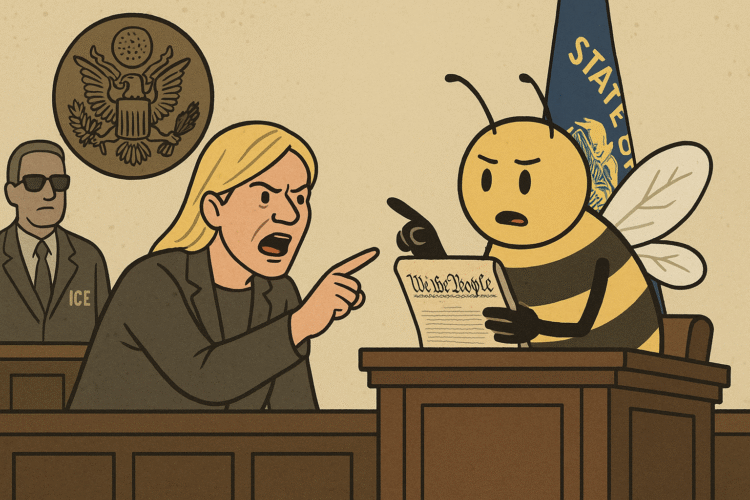
Ladies and gentlemen, grab your headphones: we’re about to listen to the sweetest harmony in a dystopian symphony—the sound of a governor giving the finger to federal pressure without ever raising her middle digit. On August 19, 2025, Oregon Governor Tina Kotek sent a letter to Attorney General Pam Bondi that reads like the quiet roar of a democracy still awake. The message? “Your threats are cute, but we’ll keep living by our laws.”
Let’s unpack this serenade to civic backbone, shall we?
I. The Herald: A Governor Writes a Letter That Hits Like a Clapback
A formal letter—how prosaic, how traditionally political. But read closely, and Governor Kotek’s prose sounds more like a scathing tweet from your smarter, cooler friend. She tells Justice Bondi—yes, that Pam Bondi—Oregon’s sanctuary law (dating back to 1987, ancient by digital-age standards) is not illegal, does not obstruct federal enforcement, and will remain in place.
She cites actual law, actual compliance procedures, and actual public support. For example: local police cannot ask about immigration status, cannot act as federal agents, and must deny undocumented requests without a judicial order. She even created a hotline—the Sanctuary Promise—so residents can report violations. That’s governance, not selfies with quotations.
II. The Federal Side Eye: When Threats Feel Like Petty Tapping
Enter the DOJ, waving executive orders from April and designating “sanctuary jurisdictions.” Translation: We want you to do more enforcement our way, or we’ll yank your money and sic our lawyers on you. Classic authoritarian posture—control by cash flow and legal foot-stomping.
But here’s the exquisite irony: for decades, Oregon’s law has asked only that local cops don’t become ICE informants, and they complied. The DOJ’s demand is basically, “Please stop following your own laws.” Governor Kotek basically said, “We do follow them, so we can’t stop.”
The request was so alarmingly empty—it asks for voluntary abdication. The kind of request that makes you nod like, “Dear DOJ, you misunderstand how a republic works.”
III. The Bee’s Bee-Line for Solidarity
Meanwhile, the dance party of regional refusal erupts: Portland smirks back through its own formal refusal. Washington State’s governor signals the same. It’s like a political bee-line hive forming, all buzzing in unison with one refrain: Keep your hands off our beeswax.
Oregon AG Dan Rayfield puts it plainly: the Feds are asking us to commit felony-level violations of our own law. That is not governance—that’s harassment, with bad tweeting.
It’s rare for a state to tell the feds “No thanks.” But when they do, it sounds glorious: quiet dignity, chartered legal citations, and the stamina of someone who’s been fighting for their community since day one.
IV. Political Optics and the Clown Car of Trumpian Governance
Let’s frame the optics: the President calls sanctuary policies threats to “national safety.” DOJ officials rise to tell hardworking state bureaucrats to choose: your values or your federal funds. Meanwhile, the governor replies: “Lol, what funds? Your fund, or ours?”
It’s culturally rich. You have one cabinet-level office threatening to criminally prosecute local officials, while the state says, “Please, criminalize us. But you’ll need evidence, peer-reviewed court orders, and genuine probable cause—none of which you have.”
This, folks, is the difference between governance and a clown car. The former grounds you; the latter drives you off a digital cliff where the only surviving memory is a meme from 2020.
V. Sanctuary Law: The Original Template for Local Human Rights
Here’s a phrase worth underlining: Oregon’s sanctuary statute predates the Google era. That was 1987—a time of big hair, big patience, big landline. The law was never partisan—it predates most of the modern polarization. It was a simple notion: local police should be about public safety, not federal immigration policy.
It didn’t outlaw immigration enforcement—it just said: keep local law enforcement from being co-opted as federal proxy. It’s a basic firewall that helped keep the social fabric from becoming shreddable by xenophobic sprawl.
Governor Kotek reminded Bondi of this context. It wasn’t a rant—it was constitutional and moral architecture. You cannot erode civic trust by weaponizing funding threats.
VI. The Sanctuary Hotline: From Civil Rights to Civil Call-in
To add layers of civic poetry, the state launched the Sanctuary Promise hotline. This isn’t spectacle—it’s structure: “Here’s who to call if you see our values being violated in practice.” It’s like an accountability app, except not modern—but moral.
Imagine: someone shows up asking to see your neighbor’s papers. You call the hotline. It records the violation. Reporters track how many calls come in. It flips the usual dynamic. Instead of laws being weaponized downward, citizens get a tool to weaponize enforcement upward.
That is subversion wrought through civic engineering—and is shockingly legal.
VII. The Broader Implications: Federalism or Authoritarianism?
This showdown is not just about Oregon. It’s about how American federalism perhaps still has teeth. One governor, careful in tone but firm in resolve, proved that constitutional tension doesn’t always need noise—it demands steadiness.
Authoritarianism salivates at compliance through coercion. Federalism demands we remain anchored in our local powers. When a state leans into its legal architecture instead of ignoring it, it reminds us local governance can still defy empire.
You can’t jam a letter like this into headlines without feeling the reverberation: there’s a riff. The riff says, Democracy is not optional.
VIII. Final Reflection: The Bee’s Closing Sting
Governor Kotek’s letter isn’t theatrical. It’s not performed on cable. It’s a polished, quietly metallic thrust into authoritarian gesture. It says: We build together, but we won’t buckle to fear.
If you want theater, you get Trumpian tantrums on Twitter, DOJ memo theater, threats of criminal charges. If you want choreography, you get Kotek—bicameral equilibrium in silk gloves.
Now, watch as pundits debate the “political cost.” Meanwhile, in Portland’s blur of “We Still Believe Futures Still Happen,” residents breathe easier knowing their state’s boundary is not a hollow line drawn by decree—but a thick, audible wall, anchored in something more than fleeting federal favor.
The song beneath the politics is quiet—but unwavering: Live by your laws. Defend your law. Don’t kneel to money or threats. That melody matters more than the noise. And Oregon, with its letter, reminded us that melody still exists—if we’re listening.