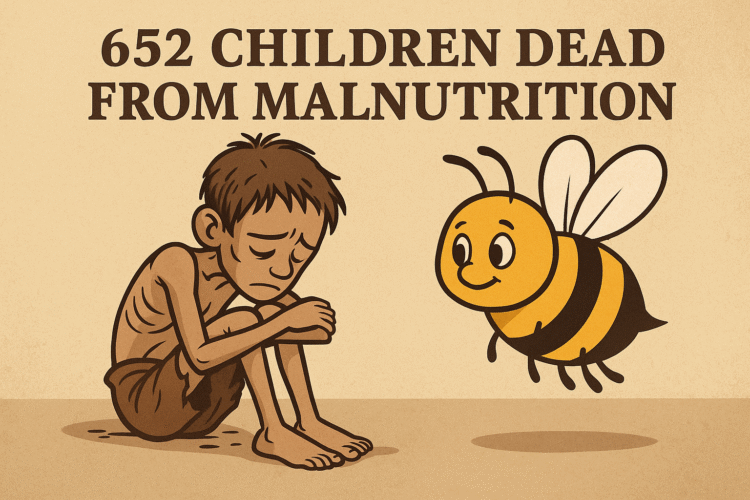
This week, the free market claimed another quiet victory as reports emerged that 652 Nigerian children have died of malnutrition—an achievement brought to you by the miracle of international funding cuts and the global community’s ongoing commitment to staring directly into a fire and commenting on the smoke.
Doctors Without Borders, the organization still laboring under the quaint notion that saving lives is worth the cost of a cappuccino per donor, broke the news. Their staff on the ground described “a catastrophic nutritional emergency.” Most world leaders described “a scheduling conflict.”
But don’t worry—statements of deep concern have been issued. Hashtags have been considered. And somewhere in a marble-lined building, someone is organizing a gala themed “Hope for Tomorrow” while today collapses quietly in the background.
Let Them Eat Budget Projections
The deaths of 652 children weren’t caused by a famine. They were caused by math—specifically, the kind of math that reallocates billions toward border walls, drone fleets, and climate change conferences with caviar buffets, but finds child nutrition programs a bit too “fiscally unsustainable.”
“We have to make tough choices,” said one European minister, while adjusting the silk lining of his climate delegation blazer. “You can’t save everyone. Especially when the optics aren’t great for Q3.”
Malnutrition is now the leading cause of death for children in Nigeria. But in policy memos, it’s translated into something softer—“funding gap,” “resource constraint,” “stability risk.” It’s amazing how sterile death becomes when converted into PowerPoint.
Hunger as a Line Item
The funding in question wasn’t vast. Just enough to provide ready-to-eat therapeutic food to the most severely malnourished children—those with protruding ribs, sunken eyes, and weight so low their bodies begin to consume themselves. In short: a treatable condition made fatal by cost-benefit analysis.
But when budgets tighten, empathy is the first to go. Some NGOs were forced to pull out entirely, citing “lack of donor interest.” As if starving children were a discontinued product line.
“We’re doing our best with what we have,” said one aid coordinator. “But what we have is less than what one G7 executive spent on last year’s retreat venue security deposit.”
The International Community Responds, Gently
After the story broke, leaders across the globe issued reactions best described as “empathetic performance art.”
The EU pledged to “reevaluate its humanitarian priorities,” which in plain English means “we’ll get back to you once the news cycle moves on.” The U.S. expressed “deep sadness” and then quietly approved a $400 million weapons shipment to a country that considers starvation a security strategy.
Meanwhile, celebrities tweeted “heartbroken” next to black-and-white images of children they could not name, followed by a link to their own skincare lines.
“We must do better,” said one UN official from a podium that cost more than an entire month’s supply of nutritional supplements.
A Masterclass in Invisible Death
The most efficient thing about malnutrition is how little noise it makes. Unlike airstrikes, there are no explosions. Unlike pandemics, there’s no global panic. Hunger kills quietly. No sirens. No breaking news graphics. Just bones dissolving beneath stretched skin, in silence.
652 is not a large enough number to trend. It’s not small enough to be intimate. It lives in that perfect bureaucratic sweet spot—too many to personalize, too few to politicize.
If they had died in a bus crash, we’d call it tragic.
If they’d died in a war zone, we’d call it collateral.
But malnutrition? We call it unfortunate—and move on.
What We’re Actually Saying
We’re not just saying that saving these children was too expensive. We’re saying it was too boring. Too predictable. Too far away. We’re saying their deaths are acceptable background noise so long as we get to maintain our inboxes, elections, and faith in a system designed to fail the poor.
We’re saying that empathy now comes with terms and conditions. That suffering must be urgent and aesthetically compelling to qualify for attention. That dying of hunger in a resource-rich world is less of a tragedy and more of a paperwork issue.
Final Thought:
Starvation is not an accident. It’s a decision—spread out across policy memos, funding formulas, and the passive voice of press releases. And somewhere in Nigeria, a mother is holding the body of her child while donors cite market volatility.
The global budget balanced itself.
And 652 children paid the invoice.