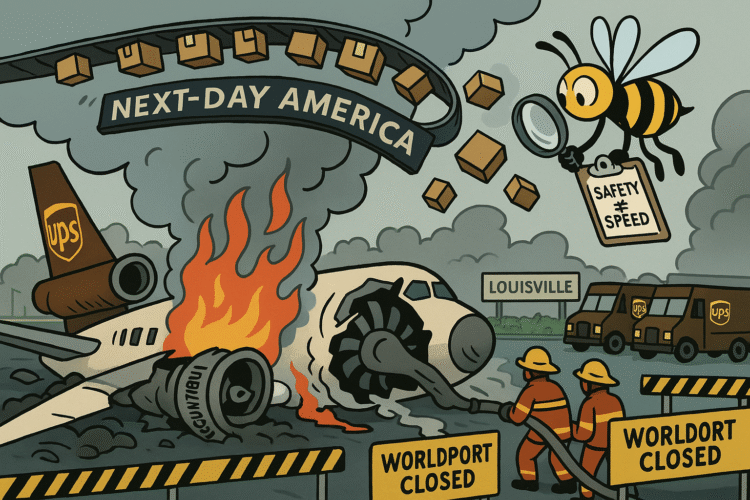
There is a peculiar silence that follows an explosion. It’s the sound of disbelief catching its breath, the half-second before the mind decides what it just saw was real. On a gray Kentucky afternoon, that silence fell over Louisville when a UPS Airlines MD-11 freighter lifted from runway 17R, caught fire, and came apart mid-climb. What followed was not just tragedy but a portrait of what happens when routine meets risk and the machinery of global commerce drops out of the sky.
Witnesses saw the left engine burst into flame minutes after takeoff. The aircraft, nearly 35 years old, tilted left, lost altitude, and slammed into the industrial corridor south of the airport. Seven people are dead, including all three crew members and at least four on the ground. Eleven more were injured. The impact tore through buildings, ignited a petroleum recycling facility, and forced a five-mile shelter-in-place order as smoke and jet fuel turned daylight into something chemical. Firefighters fought for hours while the city’s signature skyline pulsed orange.
It’s one thing to read about an aviation accident; it’s another when it interrupts the bloodstream of the national supply chain. Louisville’s airport isn’t just any airport—it’s UPS’s Worldport hub, a 24-hour artery that keeps packages and payrolls circulating. When the runway closed, so did a fraction of the American economy. Inside logistics control rooms, the math began: diverted flights, delayed cargo, ripples across every retail brand that counts on next-day delivery to stay alive.
For a company that prides itself on efficiency, this is the one scenario no algorithm can optimize. You can’t reroute grief.
The Anatomy of a Catastrophe
Investigators now move with ritual precision. The NTSB has taken control of the scene, assisted by the FAA, local fire marshals, and airport authorities. They’ll dig for the cockpit voice recorder, the flight data recorder, and whatever is left of the left-engine pylon. The first whispers from witnesses and ground radar suggest an uncontained engine failure—possibly even full engine separation within minutes of rotation. If confirmed, it would place the event squarely inside the nightmare category of aviation: catastrophic mechanical breakup.
The MD-11 has lived a long, complicated life. Once the pride of passenger airlines in the early 1990s, it was gradually demoted to freight duty, where older jets go to work until they die of metal fatigue. UPS has flown this model since the mid-2000s, retrofitted for cargo, refitted for cost efficiency. What you can’t retrofit is time. Every component, every bolt, every inspection cycle exists on borrowed hours. FAA airworthiness directives have chased this plane’s weaknesses for decades—engine mount fatigue, pylon cracks, control-surface sensitivity. Each fix buys compliance, not immortality.
Part 121 operations, the rulebook governing major U.S. air carriers, mandates inspection intervals so detailed they read like scripture. And yet, accidents remind us that rules are only as good as adherence, and adherence only as good as economics.
The NTSB will take months to confirm the chain of failure. But the outlines are already visible: a 30-plus-year-old airframe, an engine problem that went from flame to separation in seconds, a fuel-fed fireball that turned an industrial zone into an inferno, and a city forced to stay indoors while toxic smoke drifted through neighborhoods that never asked to become part of a case file.
The Cost of Continuity
Worldport’s temporary closure feels like a coronary. Hundreds of workers were evacuated. Flights bound for Honolulu, Dallas, Chicago, and Anchorage diverted. Conveyor belts stopped. Local employees sent home without knowing if “home” would still be within the shelter radius. For small businesses clustered around the airport—machine shops, warehouse contractors, and truckers—the closure means idle trucks, spoiled shipments, and a long wait for reimbursement.
Louisville’s mayor held a press briefing in the glow of still-smoldering buildings, promising aid, air-quality testing, and a family-assistance center for the bereaved. The governor pledged coordination and invoked “resilience,” the most overworked word in modern America. But resilience doesn’t replace a parent, a pilot, or a paycheck. It’s what officials say when there’s nothing left to fix but feelings.
Inside UPS’s corporate communications bunker, the tone was sterile. “We are cooperating fully with investigators.” “Safety is our top priority.” “There were no hazardous materials onboard.” The statements were true, which is the problem. Truth without context feels like paperwork. A 90,000-gallon fuel fire doesn’t need a press release—it needs accountability.
The Ghost of the MD-11
The MD-11 is the aviation equivalent of a veteran athlete past his prime—capable, respected, but running on tendons that have been taped too many times. Its accident record is checkered: hard landings, unstable approaches, structural fatigue. Airlines that once flew it commercially phased it out years ago. Cargo carriers inherited it because freight doesn’t complain.
But metal does. Metal remembers. Every pressurization cycle stretches its molecules, every vibration loosens a fastener, every landing re-teaches it gravity. Aviation maintenance is the art of managing that memory. If the NTSB confirms that an uncontained engine failure ripped through the wing root, that art failed—whether from fatigue, oversight, or economics.
The Politics of Smoke
No disaster stays apolitical for long. Kentucky officials are already fielding questions about zoning—why a petroleum recycling facility sat within the blast radius of an active runway. Environmental groups are calling for plume data and soil tests. OSHA is on standby for workplace casualty reviews. Insurers whisper about liability caps. Somewhere in Washington, the FAA’s legal division is preparing talking points about “compliance culture.” The air is still gray, and already everyone is writing memos.
Cable networks loop the explosion footage in slow motion, treating physics as pornography. Anchors describe the “orange glow over Louisville” as if it were a holiday. The national appetite for tragedy always exceeds its attention span. In a week, this will be replaced by something shinier, maybe political scandal or celebrity divorce. Families will still be waiting for the NTSB’s first factual update, which, if history holds, will confirm the obvious: something broke that should not have.
The Human Supply Chain
Every story about aviation becomes, eventually, a story about labor. The pilots who died were not names on a roster but veterans of the midnight circuit—those who fly when the rest of us sleep so our coffee makers, medicines, and impulse purchases arrive on time. Cargo pilots work under a rhythm that measures nights by timezone crossings and bodies by caffeine.
On the ground, UPS’s Louisville workforce will feel the loss differently. The hub is its own city—tens of thousands of workers, security checkpoints, cafeterias, conveyor belts, union stewards, fatigue reports. For many, this wasn’t just an accident at an airport; it was a rupture in their daily geography. The workers who sorted those very packages will now help clean the debris.
The city itself is learning what dependency looks like when it burns. Louisville’s industrial belt has long been both employer and hazard zone. The mix of warehouses, refineries, and freight corridors means that when disaster strikes, it strikes plural. The shelter-in-place order blanketed neighborhoods that had nothing to do with aviation, proving again that industry and community share the same air, literally.
The Legal Altitude
When the flames cool, the lawsuits begin. UPS’s liability will extend in multiple directions—families of the crew, residents of damaged properties, employees of the impacted industrial sites. Insurers will dissect whether the crash qualifies as “act of God” or “act of maintenance.” OSHA will investigate worker deaths and exposures. The FAA will issue an emergency airworthiness directive if early metallurgical tests find evidence of design or fatigue flaws in MD-11 pylons.
Part 121 operators must demonstrate “continuous airworthiness,” a phrase that now sounds both technical and absurd. Continuous implies unbroken. Airworthiness implies safe. The combination assumes an infinite promise that machinery can never quite keep.
The Next 48 Hours
The NTSB’s go-team will issue its first on-scene summary within two days. The cockpit and flight data recorders will go to Washington for analysis. Metallurgical labs will examine turbine and pylon fragments for fracture patterns that show whether the engine broke off clean or exploded outward. Environmental scientists will sample air and soil to determine when residents can stop breathing through filters. UPS will likely announce a temporary inspection program across its MD-11 fleet to assure customers—and itself—that this was anomaly, not omen.
In that time, the media will pivot from shock to speculation, from “what happened” to “who’s to blame.” They’ll get half of it right. The real work will happen in hangars and labs, in spreadsheets of part numbers, in the quiet fury of engineers who still believe safety is a verb.
The Price of Motion
Every civilization has its monuments. Ours has logistics. The ability to ship a package anywhere in 24 hours is the secular miracle of our age. We rarely question what it costs to keep that promise: aging jets, overworked crews, marginal oversight, warehouses built beside fuel tanks. When those systems fail, the crash site becomes both memorial and mirror.
Flight 2976 was a cargo plane, but its story is human. It carried not just parcels but lives, not just commerce but consequence. Its fall exposed the invisible web that binds consumer convenience to industrial risk. Louisville is now living inside that revelation, its skyline smudged by proof.
Coda for a Republic in Transit
The runway will reopen soon. UPS will issue new safety pledges. Packages will fly again. Louisville will clean the soot and resume production. That’s how systems work—they survive themselves. But every box that moves through Worldport now carries a ghost of the one that didn’t make it.
Somewhere in a government lab, investigators will piece together turbine fragments under sterile light. Somewhere in Kentucky, families will wait for words like “mechanical failure” or “crew response.” Somewhere inside a boardroom, executives will discuss “operational continuity.” The phrases will be clinical because that’s how corporations mourn.
And the rest of us will go back to tracking packages, unaware that the promise of next-day delivery still runs on the oldest law of all: gravity.