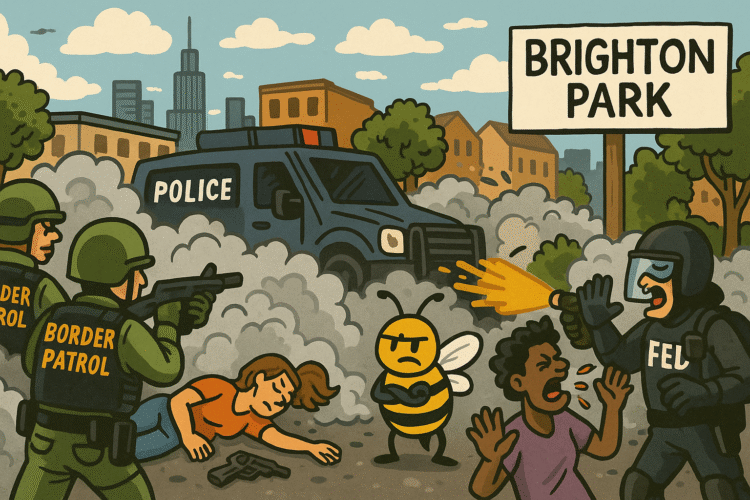
The city was promised patrols, deterrence, maybe a few stern traffic stops. What it got instead was a rolling combat scene: Border Patrol convoys pinned in, a U.S. citizen shot, a neighborhood suffocated in tear gas, and a shutdown government still finding time to flex its muscle in Brighton Park. It is the latest installment in America’s longest-running franchise, “Border Security Theater,” now playing not on the Rio Grande but at West 39th and Kedzie, where residents learned the hard way what “force protection” really means.
This is a reconstruction of what happened, what is claimed, what is unverified, and what it means when the border comes to Chicago.
The Collision That Started It All
The official script begins with a convoy of DHS agents—Border Patrol and ICE—moving through Brighton Park. According to federal accounts, a cluster of civilian vehicles, roughly ten in number, boxed the convoy in and rammed their trucks. DHS says it was a coordinated act of aggression. Witnesses are less sure: some recall a traffic snarl, others a chaotic pileup, but the agency insists its vehicles were targeted.
Minutes later, amid the crunch of metal and the whine of brakes, shots rang out. DHS states the woman who was shot had a semi-automatic weapon, that she presented a threat, and that agents fired defensively. What is uncontested is that she was struck, collapsed on the pavement, and was taken to a hospital alive.
Unverified details multiply: did she brandish the gun or simply hold it? Did she fire first, or at all? Federal spokespeople caveat their statements: this is preliminary, under review, subject to change. Reporters on the ground mark the gaps with caution. What is certain is that a U.S. citizen was gunned down in her own city block, and the justification is still being stitched together.
The Neighborhood Turns Into a Standoff
Chicago Police were quick to stress they were not leading the investigation. Their role, they said, was to direct traffic, manage crowds, and prevent further chaos. But chaos came anyway.
Within an hour, protesters massed. They formed lines, shouted for medics, braced against volleys of pepper balls. Tear gas drifted over residential blocks. Street medics crouched by hydrants and buckets, rinsing eyes and faces. Helicopter rotors cut the sky. Parents pulled children inside as the sound of canisters cracking echoed through alleys.
Federal officers held their perimeter in military posture. FBI evidence teams arrived, taking photographs of shell casings, mapping vehicle damage, gathering body-cam and dashcam footage. By then, the block was unrecognizable: not a neighborhood street but a theater of confrontation, the border zone reborn in a Midwestern zip code.
The Broader Context
The Brighton Park clash is not an isolated headline; it is the crescendo of a weeklong score. Since late September, DHS has stationed patrol boats on the Chicago River, agents on Michigan Avenue, officers prowling shopping corridors. The message has been less about law enforcement than about omnipresence.
When Border Patrol commander Gregory Bovino defended his unit’s criteria for stops—“how they look”—the backlash was immediate. Civil rights groups called it profiling codified into federal practice. Gov. J. B. Pritzker and Mayor Brandon Johnson condemned it outright, warning that the federal presence was criminalizing appearance itself.
At the same time, word leaked that the White House had asked Illinois to prepare up to a hundred Guard troops for “force protection.” The phrase is deliberately slippery, suggesting defense but implying escalation. Meanwhile, protests across the city have reported rubber bullets, CS gas, and kettling tactics. By the time the Brighton Park shooting occurred, the city was already steeped in confrontation.
What Investigators Now Must Confront
The forensic to-do list is long and politically radioactive:
- Ballistics: Whose bullets struck the woman, from what angle, and under what conditions?
- Vehicle forensics: Did ten civilian cars ram federal vehicles, or was it a collision spun as an assault?
- Footage: Body-cams, dashcams, drones—all must be synchronized to reconstruct the minutes.
- Warrant logs: Were any arrests tied to the alleged ramming supported by warrants?
- Injury reports: How many civilians and agents were hurt, and how were those injuries sustained?
Each of these answers must survive the scrutiny of independent review, or the official account will collapse under the weight of distrust.
What the City Will Demand
City leaders have already hinted at the terms: transparency or nothing. They will want release of stop criteria, public accounting of crowd-control policies, disclosure of use-of-force reviews, and timelines for independent oversight.
Because the stakes are more than one shooting. The stakes are whether Chicagoans can walk their streets without wondering if federal agents will treat them as suspects. Whether businesses can keep doors open when protests and gas clouds choke the neighborhood. Whether communities trust their own police when their role is reduced to traffic cones while outsiders fire weapons.
The Stakes for Residents and Businesses
Brighton Park is not a border town. It is a residential neighborhood with corner stores, bus routes, schools, and families who expect policing to be municipal, accountable, and proportional. What they witnessed instead was federal power operating as though the Fourth Amendment were suspended, as though the Antideficiency Act had been re-written to permit crowd control with tear gas rather than governance with budgets.
Shops on Kedzie shuttered. Delivery vans rerouted. Parents kept children home. The economic ripple will be immediate: lost sales, canceled shifts, reputational damage to a neighborhood now associated with confrontation. For residents, the psychological toll is heavier still: a fear that the government no longer distinguishes between migrant caravans and citizen commuters, between smugglers and soccer moms.
Satire in the Absurdity
The irony is inescapable. A shutdown government that cannot pay its own workers finds resources to deploy armed convoys into Brighton Park. Agencies that furloughed clerks who process passports somehow afford tear gas canisters on city blocks. Commanders who decry “fat troops” now order lean patrols through shopping corridors. A president who rails against “cancel culture” now practices it on constitutional protections.
The theater of enforcement has always been about optics more than outcomes. This time, the optics include a wounded woman, tear-stained streets, and a city told to accept that “defensive fire” is the same as accountability. The satire writes itself: a federal government that cannot govern deciding to perform security cosplay in the middle of a neighborhood.
Where It Ends
It ends, perhaps, in courtrooms—where ballistics, footage, and warrant logs are parsed for fact versus spin. It ends in city halls—where leaders must decide whether to tolerate federal encroachment or demand withdrawal. It ends in neighborhoods—where trust is fragile, businesses teeter, and residents wonder if the line between law enforcement and occupation has already been crossed.
And if none of that happens, if transparency is delayed and evidence withheld, then it ends in something darker: a normalization of occupation as policy, a border forever moving inward, a democracy that governs by perimeter rather than by consent.
Brighton Park: A Border Brought Home
The Brighton Park shooting is not an accident; it is a symptom. A symptom of federal ambition colliding with constitutional restraint. A symptom of a government that treats neighborhoods as training grounds. A symptom of power exercised not at the edge of sovereignty but at the heart of civic life.
Chicago is learning what border towns have long known: when Washington sends troops instead of transparency, the line between safety and subjugation is drawn not at the border, but at your front door.