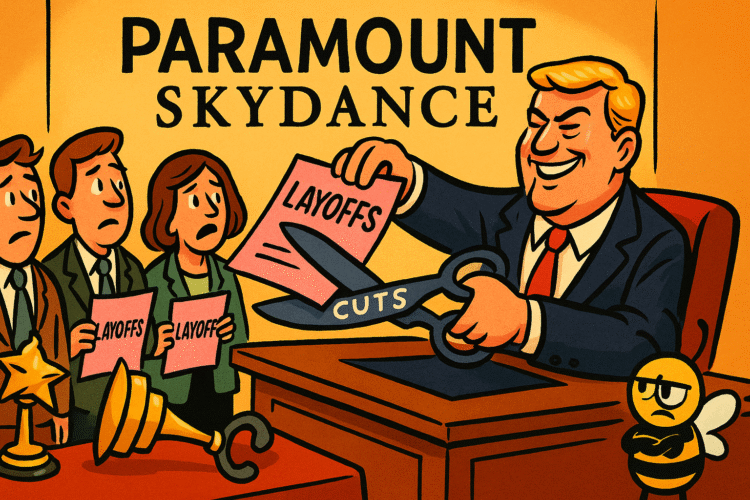
There’s a certain elegance to corporate cruelty when it’s delivered in PowerPoint. The font is soothing, the charts are blue, and the word “transformation” is used at least three times before anyone says “job cuts.” Paramount Skydance, the newly merged media hydra now helmed by David Ellison, has decided that the best way to impress Wall Street is to fire roughly 2,000 Americans before the leaves finish falling. The memo calls it a “$2 billion cost-takeout initiative.” Translation: the pink-slip printer is jam-resistant, and the executive floor wants to show blood before earnings day.
The company’s headcount, already shredded by a 15 percent cull last year and another 3.5 percent this spring, will shrink again by late October. Sports isn’t safe, Paramount+ isn’t safe, even CBS Sports—the house that built the brand—isn’t safe. Because when debt covenants and streaming losses collide, no amount of loyalty can offset the phrase “one-time charge.”
“Focus on Core Priorities,” a.k.a. Fire Everyone Who Isn’t a Core Priority
The internal talking points are so predictable you could run them through a teleprompter: focus on core priorities, unlock shareholder value, align resources to strategic growth. It’s the corporate rosary for mass unemployment. Employees call it what it is—restructuring fatigue with better branding.
CBS Sports employees, who once prided themselves on never missing a feed, now refresh Slack wondering if they’ll be assigned to a “synergy pod.” Translation: you’ll do three jobs under a new logo. The memo says “we love our world-class live rights,” which is CEO-speak for “your weeknight crew is redundant.”
The real trick isn’t in how they say it, but what they don’t say: that even “core priorities” need humans to run them. Rights packages don’t produce themselves. A “leaner content ecosystem” sounds great until no one’s left to upload the highlight reel.
The Sports Division Will Be Fine, Except It Won’t
Executives like to claim that sports is recession-proof. They’re half right: people always want to watch the game. But they don’t want to watch the game in 720p on an app that lags behind Twitter, and that’s what happens when your truck ops and digital editors are all “cost savings.”
CBS Sports lives under the same roof as Paramount+ and the broadcast network. That means when the knives come out, there’s no safe floor. Even the divisions that make money get trimmed, because nothing terrifies Wall Street like payroll. The line you’ll hear in the next press release: We remain committed to our premium live-rights strategy. The line that never makes print: We just won’t pay the people who make it premium.
Imagine a Super Bowl produced by two overworked editors and an algorithm. It’ll stream, technically. It just won’t sparkle.
Synergy: The Word That Means Everyone’s About to Lose Their Job
Synergy once meant cooperation. Now it’s the preamble to execution. The Paramount–Skydance merger was sold as a way to “unify legacy assets with digital innovation.” In plain language, that means finding duplicate departments and feeding one to the other. Marketing overlaps? Consolidate. HR redundancy? Automate. Newsroom too chatty? Silence.
What gets lost is the connective tissue—the teams that make the operation run. The people who clear rights on viral clips, who fix audio drift mid-broadcast, who notice a replay angle that changes the entire highlight. You can’t replace those instincts with cost-cutting software. You can only pretend it won’t matter until it does.
“One-Time Charges” That Happen Every Quarter
Executives love to call layoffs a “one-time expense.” It sounds final, like a purge that brings closure. But this is Paramount’s third “one-time charge” in eighteen months. At this rate, the exception is the new normal. Every cycle repeats the same ritual:
- Announce layoffs.
- Blame the economy.
- Pocket the stock bump.
- Forget who made the company valuable in the first place.
By Q4, another memo will arrive about “efficiency gains.” The markets will cheer. The newsroom will go quiet. And someone will notice that the same typo made it to air three nights in a row because the copy desk no longer exists.
The Glamour of the Guillotine
You can feel the absurdity in every corporate hall: workers in L.A., New York, and Nashville trying to produce award-season coverage while HR sends calendar invites titled “Update on Company Realignment.” Behind every click-bait headline about cost synergy is a person who has to pack up their badge and their half-finished show outline.
Inside the sports division, producers joke that the next slogan should be Paramount: Brought to You by Whoever’s Still Left. The dark humor hides real fear. This isn’t pruning—it’s strip-mining.
And yet, to investors, it’s rational. “Discipline.” “Focus.” “Alignment.” Words that sound virtuous in earnings reports but feel like eulogies in break rooms.
The Domino Effect
When you gut a media house of its technicians, you don’t just shrink the payroll—you destabilize an entire ecosystem. Freelancers lose anchor clients. Small colleges lose coverage. Local sponsors lose airtime. ESPN and Fox quietly prepare to poach the survivors.
There’s no spreadsheet cell for the human cost. The invisible expertise that makes live TV seamless vanishes into LinkedIn purgatory. When the layoffs hit, it won’t just be names on a list—it’ll be the person who kept the highlight server from crashing five minutes before tip-off. The one who knew which replay feed was clean. The person who caught the legal risk buried in a sponsor segment. You never see them, but you feel their absence.
That absence will echo in broadcast quality, in the timing of the next viral clip that never gets cut, in the glitches you’ll notice but never understand.
The “Do More With Less” Comedy Tour
After every culling comes the pep talk. A glossy all-hands meeting full of phrases like empowered creativity and ownership mindset. You know the drill: “We’re all in this together.” Except half of “this” just got escorted out.
The survivors are given more tasks, fewer resources, and a standing desk as consolation. They’ll be asked to field-produce three feeds with two people, then sit through a webinar about “resilience.” The irony is unbearable enough to be art. The new performance metric will quietly change from “excellence” to “survival.”
The Death of the Mid-Week Miracle
Layoffs don’t just eliminate headcount; they erase the spontaneous brilliance that makes live media human. The clever lower-third graphic. The halftime montage that nails the emotional beat. The last-minute correction that saves a broadcast. These are the mid-week miracles—the small, invisible acts that keep a billion-dollar industry from looking like public-access TV.
When you cut deep enough, those miracles die first. The show still airs, but it feels off. A second slower, a little cheaper, a lot emptier. Viewers drift. Ratings dip. The executives wonder why “audience engagement” fell 9 percent. They’ll hire consultants to explain the obvious: quality left with the people you fired.
The Reckoning Behind the Curtain
What makes this round especially bitter is that it follows a merger sold as salvation. Skydance promised innovation, fresh capital, tech integration. Paramount promised stability and legacy. Together they’ve delivered the modern media hybrid: a studio that bleeds staff to impress the algorithm.
The merger created one of the largest entertainment portfolios in the world, but its first shared act was to prove it could make cuts faster than competitors. That’s not synergy—it’s self-cannibalism disguised as efficiency. The “Day One” culture speech will talk about vision. But if you listen closely, you’ll hear the subtext humming like a bad fluorescent light: everyone is expendable until the stock stabilizes.
The Final Reel
There’s a haunting inevitability to this story. A century ago, Paramount built the Hollywood mythos; now it’s building a spreadsheet. The people who gave its brand humanity—camera ops, editors, researchers, digital producers—will vanish into LinkedIn posts that end with “#OpenToWork.” The executives will call it “strategic realignment.” The markets will reward it. And the next time you open the app to watch your favorite show buffer at halftime, you’ll see the price of efficiency rendered in pixels.
Because that’s the part no earnings call will admit: you can’t spreadsheet your way into loyalty. You can’t algorithm your way into craftsmanship. When you cut the humans, you cut the quality. And when the product feels hollow, so does the brand.
Paramount Skydance may hit its $2 billion target, but it’ll never recover what it just sold—trust, care, and the illusion that anyone left in charge still loves television.
Closing Reflection: The Invisible Payroll of Excellence
The irony of “cost savings” is that they always cost more later. When the footage glitches, when the sponsor sues, when the audience drifts, the repair bills dwarf the payroll you cut. But by then, the executives will have moved on—bonuses secured, headlines forgotten.
What remains are the ghosts of a craft once fueled by pride. The people who made miracles at midnight. The unseen labor that turned chaos into culture. The next time a CEO says focus on core priorities, remember: what they really mean is we’re cutting the people who make this worth watching.