Read the book · Amazon Author Page
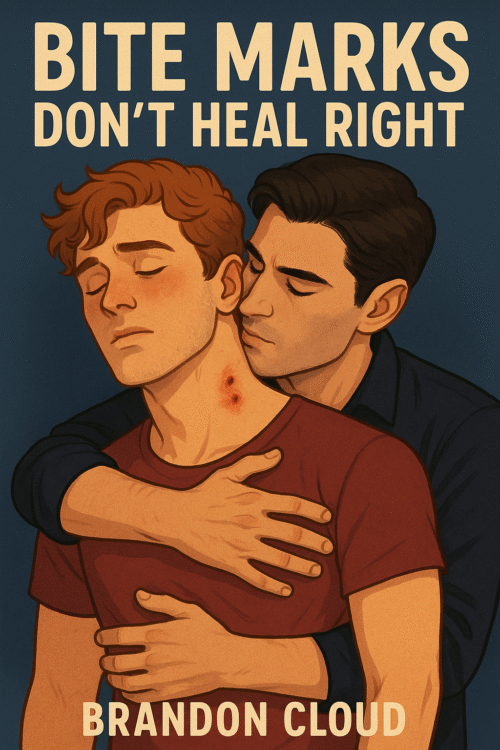
It doesn’t start with a bite. It starts with a cough.
In Bite Marks Don’t Heal Right, we don’t meet a vampire seducing a mortal under moonlight. We meet a man—the kind who’s outlived revolutions and lovers and his own ability to feel surprised—watching a terminal patient smoke a cigarette out of a hospital window like he’s daring God to intervene. One of them hasn’t aged in three centuries. The other can’t go two weeks without a new lesion.
They are not opposites. They are not metaphors. They are simply inconveniently timed.
And that, more than anything else, is what Bite Marks Don’t Heal Right is about. Not death. Not eternity. But what happens when two people try to occupy the same emotional space and one of them keeps disappearing.
“I’ve been dying for weeks. You just started watching.”
Why This Story Exists
I don’t write vampire stories. I write grief stories dressed in metaphor. And this one came clawing out of me like a memory I hadn’t earned. It isn’t about blood—it’s about what we take from each other without meaning to. How love can feel like care, and care can feel like obligation, and obligation can suffocate even the best intentions.
There’s a pattern in everything I write: trauma as foundation, queerness as the wallpaper. It’s not the headline. It’s the room these characters move through. You feel it in the way they speak. In the way they don’t.
This book began as a question: What happens when someone who’s lived forever meets someone who refuses to go quietly? The answer is not romantic. It’s not tragic. It’s complicated. And intimate. And exhausting. The kind of love that sits heavy in your chest for weeks, because nobody ever says the thing they’re really afraid of out loud.
“You don’t want to save me. You want to survive loving me.”
The Vampire as Coward
He doesn’t stalk. He doesn’t charm. He lingers. Uninvited. He’s not interested in conquest. He’s interested in postponement. He drinks blood like a chore. He’s lonely, but not desperate. He thinks watching someone die is safer than joining them.
What he doesn’t expect is that the human isn’t asking to be saved. He’s asking to be seen. As he is: messy, clinging to joy like a feral thing, terrified of being remembered only as a diagnosis.
“I want to live so badly it makes people uncomfortable.”
Their love doesn’t ignite. It interrupts. Mid-sentence. Mid-breath. It embarrasses itself. It arrives in the form of errands no one asked for and unsolicited porch repairs and a refusal to leave when things get gross. It’s not glamorous. It’s proximity. It’s persistence.
The Dying Man as Spark
He isn’t noble. He isn’t here to teach a lesson about seizing the day. He has opinions about hospice food and he’s pissed he doesn’t get to outlive his landlord. He uses gallows humor like a weapon and flinches every time someone says the word “miracle.”
And yet—he radiates something the vampire can’t identify: the desire to stay. Not to be remembered. Not to be worshipped. Just… to be.
“You could have anyone.”
“I don’t want anyone. I want the person who makes me angry I don’t have time.”
There’s a moment—early, small, half-overheard—where he says, “You don’t have to fix it. Just don’t leave the room.” It gutted me to write that. Because that’s what intimacy is, isn’t it? Not the fixing. The staying.
The Metaphor Everyone Misses
People assume the vampire is the metaphor. But in this story, the dying man is the one who haunts.
He is proof that life isn’t about time. It’s about how hard you fight to keep loving when you know you’re losing. He’s not immortal. But he refuses to vanish. And the vampire—the one who’s seen generations come and go—has never felt so endangered.
This is not a book about how love conquers death. It’s about how love complicates it.
“You don’t need to live forever to ruin someone.”
What This Book Is For
This book is for people who’ve loved someone with an expiration date and resented the ticking clock.
For people who’ve whispered “I’m fine” while hiding their third bottle of pain meds.
For those who’ve watched someone beautiful shrink. And stayed anyway.
This is a story for the days after the diagnosis but before the planning. For the night when someone you love finally lets you see the ugliest part of what’s coming. For the silence after the joke no one laughs at.
And somehow—despite all of that—it’s still a love story.
“Every time you look at me, I forget to be afraid.”
Final Thought:
Bite Marks Don’t Heal Right isn’t about immortality. It’s about presence.
Not being remembered. Being witnessed. Mid-panic. Mid-symptom. Mid-breakdown.
And if you’ve ever loved someone who didn’t get forever, you know this much: bite marks don’t heal right. But maybe that’s the point.
Let me know if you’d like matching social captions, banner art, or audio snippets drawn from this voice.