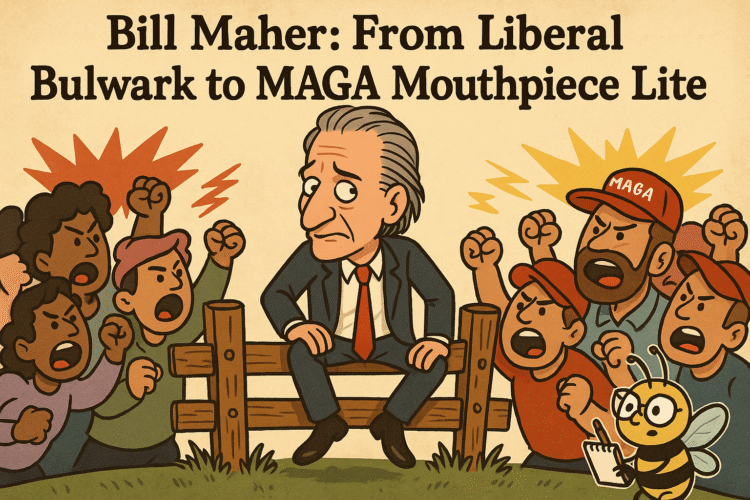
Bill Maher: The Liberal Bulwark Who Fell in Love with His Own Contrarianism
For a long time, Bill Maher was the voice I wanted in the room. He was brash, unapologetic, smarter than most of his guests, and willing to say the things the polite class of liberal pundits wouldn’t touch. In the Bush years, Maher felt indispensable. He was a one-man wrecking crew against the Iraq War, Fox News spin, and the suffocating orthodoxy of post-9/11 politics. He was the late-night guy who didn’t just joke about politicians—he gutted them.
But somewhere along the way, Maher’s independence calcified into reflexive contrarianism. His HBO pulpit, once a haven for liberal catharsis, has turned into a showcase of cranky tirades about “wokeness,” vaccine mandates, and why young people supposedly can’t take a joke. He hasn’t just lost the plot—he’s become part of the noise.
What’s worse, in his eagerness to offend everyone, he’s drifted into territory that makes him sound less like the sharp critic of power he once was and more like a part-time MAGA uncle at Thanksgiving. He still insists he’s a liberal. He probably believes it. But the truth is more painful: Bill Maher went from being a bulwark for liberal justice to someone who doesn’t make either side happy—and often seems proud of it.
The Maher I Loved
Maher was never subtle. He didn’t need to be. His comedy thrived on bluntness. When the mainstream press swallowed Bush’s WMD lies whole, Maher shredded them. When politicians wrapped themselves in patriotism, he ripped off the flag to show the rot underneath. His cancellation from Politically Incorrect in 2002 made him a folk hero to free speech absolutists before that phrase got co-opted by professional trolls.
For liberals who were sick of watching milquetoast Democrats play nice while Republicans bulldozed norms, Maher was a release valve. He spoke with rage, he joked with cruelty, and he made the left feel like maybe—just maybe—someone out there was as pissed off as they were.
The Slow Drift
But then came Trump. And then came COVID. And suddenly Maher’s edginess didn’t feel like bravery anymore—it felt like bitterness. He wasn’t skewering the powerful; he was mocking activists, scientists, and marginalized groups who were already under siege.
His obsession with “woke culture” turned him into a parody of himself. Every monologue circled back to how kids on campuses were fragile, how progressives were policing jokes, how pronouns were ruining comedy. The guy who once roasted religious zealotry with surgical precision now spends endless airtime obsessing over language used by 20-year-olds.
And vaccines—God, the vaccines. Maher hedged, doubted, and smirked his way through the pandemic like skepticism itself was enlightenment. He wasn’t an outright denier, but he gave just enough oxygen to anti-vaxxers to make himself useful to them. In the middle of a public health crisis, he wielded his platform not to clarify but to blur.
The Islam Problem
Let’s be honest: Maher’s problematic streak didn’t begin with “woke” jokes. His hostility toward Islam has been a throughline for years. Long before Trump discovered Muslim bans, Maher was describing Islam as “the motherlode of bad ideas.” He repeated it like a mantra: sure, not all Muslims are terrorists, but the religion itself was fundamentally broken.
He never allowed for nuance, never differentiated between extremists and the everyday Muslims who simply wanted to live their lives. For a man who prided himself on intellectual honesty, it was stunningly lazy rhetoric. It reduced nearly two billion people into a caricature of extremism and conveniently ignored the violent histories of Christianity, Judaism, or any other faith.
It wasn’t comedy. It was bigotry dressed as bravery. And when challenged, Maher did what he always does: doubled down, sneered at critics, and claimed he was the only one with the guts to say it.
Cruelty as a Habit
It’s not just Islam or vaccines. Maher has a habit of mistaking cruelty for clarity. His rants about obesity, for instance, are less social commentary and more playground taunts. He couches it in “tough love,” insisting America’s weight problem is a health crisis. But his jokes about fat people drip with disdain, not concern. They’re not about sparking change—they’re about getting a laugh at someone else’s expense.
The same goes for his digs at trans people. He’ll claim he’s just “asking questions” about sports or puberty blockers, but the effect is always the same: reinforcing skepticism, minimizing lived realities, and punching down at people who already endure relentless attacks. Maher frames it as resisting dogma. But it plays like bullying.
Comedy vs. Cop-Out
Maher would argue that all of this—Islam rants, fat jokes, vaccine hedging, woke-bashing—is just comedy. That comedians are supposed to push buttons, test limits, offend sensibilities. And that’s true, to a point. But comedy isn’t just about offense. It’s about clarity of target.
Who is the butt of the joke? What power structure is being exposed? In his prime, Maher punched up. He mocked presidents, generals, priests, and pundits. Now, too often, he punches down: at young activists, at marginalized identities, at people navigating systems bigger than themselves. That’s not bravery. That’s boredom disguised as rebellion.
The Illusion of Independence
Maher insists he’s not conservative. He insists he hasn’t changed. He insists the left just “went crazy” without him. But independence isn’t the same as wisdom. Contrarianism for its own sake is just as hollow as partisanship.
The right still hates him for being Hollywood elite. The left has grown tired of his obsession with wokeness. Centrists see him as cranky. The result? Maher is now politically homeless, not because he’s bravely independent, but because he’s worn out his welcome everywhere.
The Nostalgia Factor
Maybe this disappointment is partly on me. Maybe I miss the Maher of the Bush years, the one who went for the jugular against power and propaganda. Maybe I expected too much, projecting onto him a role he never wanted: liberal conscience.
But there’s a reason his recent turn stings. He was one of the few comedians who mattered, who genuinely shaped political discourse. And now he’s a caricature of a contrarian, a man whose every take sounds preloaded for viral backlash rather than genuine insight.
The Crank on the Fence
The tragedy of Bill Maher is that he no longer makes either side happy. Conservatives see him as a smug liberal elitist. Liberals see him as an out-of-touch contrarian. Independents see him as irrelevant.
But Maher seems to revel in this misery. He frames it as proof that he’s still the only honest broker in a world of sycophants. In reality, it’s proof that he’s drifted into the sad middle: a man once vital to the conversation, now shouting at both sides and amusing neither.
Closing Argument
I loved Bill Maher. I admired his fearlessness, his clarity, his ability to slice through hypocrisy with a joke sharper than most op-eds. But I can’t ignore what he’s become: a man whose Islamophobia, vaccine contrarianism, fat-shaming, and trans-hostile digs outweigh the brilliance that remains.
He’s still capable of cutting insight. He still skewers Trumpism with more wit than most late-night hosts. But those moments are fleeting, buried under rants that feel less like truth-telling and more like reflexive contrarianism.
Bill Maher hasn’t become a conservative. But he has become a parody of independence, proof that if you fight too hard to belong to no one, you risk standing alone, smirking on a stage where the applause grows thinner every year.