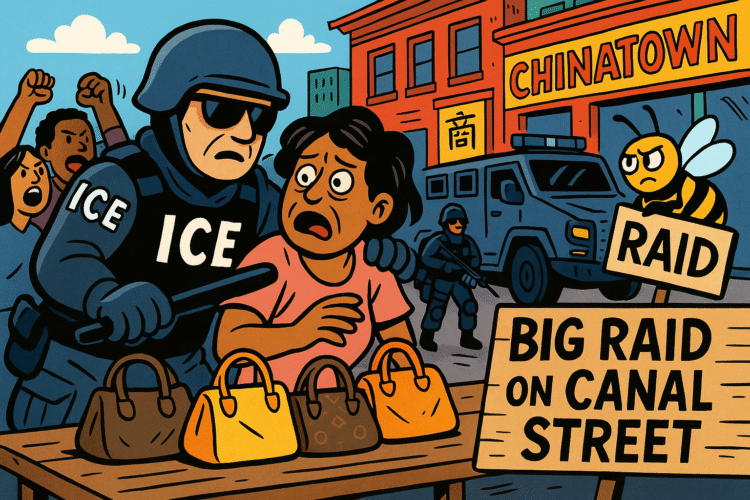
There’s something disquieting about seeing dozens of federal agents—batons, rifles, zip-ties, armored vehicles—rolling onto a stretch of Manhattan known for knock-off handbags and street vendors, rather than insurgents. On October 21, 2025, in an operation that looked less like “intelligence-driven enforcement” and more like “military parade meets commerce,” ICE and a coalition of federal agencies descended on Canal Street in Chinatown. They came for counterfeit goods, but they left with something else: a massive theatrical show of force that ignited protests, chilled immigrant neighborhoods, and raised urgent questions about how far “transit from ordinance to occupation” can go before the city loses its soul.
Here’s the sharp, ugly truth: if you think this was just a sting operation to catch fake Rolexes, you missed the second act. The broader performance was federal muscle flexed in a sanctuary-city arena, and the people paying the price weren’t the cartels but the vulnerable. Communities that should be safe started seeing the badge as an invitation to fear.
The Raid That Marched In Like a Parade
At roughly 4 p.m., federal enforcement teams—including ICE, HSI, FBI, DEA, ATF, IRS-CI and CBP—rolled into Canal Street between Lafayette and Centre. They targeted vendors selling counterfeit goods: bags, watches, phone cases. Nothing novel. What was novel: the armored vehicles blocking traffic, bystanders clashing with agents, shouts of “ICE out of New York!” and federal officers brandishing batons and pepper-spray threats.
City officials were swift to distance themselves: the NYPD said it had no involvement, and Mayor Eric Adams repeated: New York does not cooperate with civil-immigration enforcement.
But the optics were irreversible: federal agents in tactical gear corralled vendors, traffic jammed, crowds rose, protest, arrests, van-loading detainees. And we were told the mission was just counterfeit goods.
Surveillance, Stop-And-Frisk for Commerce, Chilled Trust
Here’s the civic harm they didn’t air-log: when you conduct a raid like this in a primarily immigrant zone, you send the message: Your street = federal turf; your vendor table = hostile ground. Whether or not the targets broke laws, the collateral damage is trust. Witnesses freeze. Families close the roll-down gates. Crime incidents stop being reported—who wants to invite the leash-clickers?
Immigrant-rights organizations and Chinatown merchants didn’t call this a bounty raid—they called it intimidation theater timed to the Trump-era posture against sanctuary cities. One merchant told reporters, “We’ve never seen them like this. Tanks on Canal Street… for bags?”
Local officials warned this could crack the foundation of community safety. If the badge is now the count agent, the beat becomes a trap. If you’re watching neighborhoods as ecosystems of cooperation, this operation drained air out of the system.
The Split-Screen Narrative: Enforcement vs. Escalation
Here’s how the tape reads in compressed form:
Federal Version: “Targeted, intelligence-driven enforcement focusing on counterfeit goods.”
Street View: “Armored vehicles, batons, collars, protest shouts, bystanders shoved, van-loads of people carted off.”
Both can’t be entirely true. Either the threat justified the show or the show amplified the threat. When federal-law rhetoric meets street-fear footage, you get litigation risk: viewpoint discrimination (why vendors, why this neighborhood), proportionality (is tactical gear justified for knock-offs), jurisdiction (why not NYPD), and community consent (belief in public safety collapses).
The Financial, Retail and Political Fallout
Keep your eye on these check-points:
- Will DHS/ICE release a breakdown: how many arrested? Counterfeit goods seized? Immigration status checked? Charges filed? So far: silence.
- Will the City of New York pursue formal oversight or civil-rights investigation? Will Chinatown vendors sue for wrongful detainment?
- Will retail-trade groups (who hate knock-offs) support or distance themselves from a show-raid that looked like posturing more than protection?
- Will the White House double-down on spectacle raids even as cities say: We don’t consent to your PR-parade?
Because the deeper question: is this enforcement—or is it branding? Law and order on display. But without community buy-in, law becomes performance, order becomes optics, and both cost more than they save.
The No-Follow-Through Problem
If this operation was only about counterfeit goods, why this cast of thousands? Why the tactical gear? Why detaining bystanders? Why the policy spectacle rather than quiet working cases? The workaday task of intellectual-property enforcement typically doesn’t involve riot shields. Yet here they were.
That discrepancy matters because when you use heavy-military tools for low-level infractions, you shift the baseline: minor vendor → major raid. Minor complaint → mass show of force. The pattern becomes: if you sell fake bags, you might trigger tanks. That shift is not incremental—it is systemic.
Community Policing Becomes Federal Policing
Understand this: community policing rests on trust. You know your cop. Your neighborhood eats lunch. You collaborate. You call them for help. That tapestry breaks when you see agencies you don’t know, didn’t invite, patrol streets you walk, in neighborhoods you live.
Chinatown doesn’t just sell handbags; it houses families, seniors, workers. If the badge is now alien, you stop calling. You stay silent. You leave. The next loud noise won’t draw help—it’ll draw a raid. That’s the feedback loop of distrust.
One Chinatown vendor told reporters: “We saw vans. They didn’t ask us politely. They told us. We froze.” Fear leaves no shrapnel—it just obliterates the rendezvous of cooperation.
Final Reflection: When the Raid Outruns the Mission
The dialogue now: “It’s about counterfeit goods.” Meanwhile the show of force shouted: It’s about fear. Reconciling the two is impossible because they move in different frames. One is narrow. One is sweeping. One rebuilds markets. The other rebuilds mythology.
Cities are not narrative props. They’re ecosystems of consent. If enforcement overrides that, you don’t gain compliance—you induce withdrawal. Silence reigns. Reports vanish. Witnesses disappear. That isn’t public safety—it’s a vacuum.
Maybe in New York’s next retail boom the knock-offs vanish. But what will replace them? The guarantee of trust? Or the sound of armored wheels on downtown blocks? One stands in the light. The other stands in hyper-visibility. For all the cheerleaders of spectacle, big enforcement numbers don’t replace quiet accountability. They eclipse it.
The Haunting Truth
The raid on Canal Street wasn’t just operational—it was symbolic. Its message: the federal government can deploy troops over commerce, for a neighborhood, for vendors, for optics. That message echoes: your local rights are optional when national priorities demand theatre.
And now we’ll watch: will the numbers match the narrative? Will Chinatown trust its city or its barricades? Will the federal agencies release arrest data—or fade into fade-plays? Will trade groups support the vendors— or the spectacle? Will the White House treat this as a blueprint or a blunder?
Because if this becomes the blueprint, every city with immigrant vendors and retail margins becomes staging ground. Every protest zone becomes a façade for federal muscle. Every community becomes a target in the show of force.
If you believe in communities, you believe they govern themselves—not just by statute but by consent. And if you see the badge as both protector and occupier, you know the difference. In this case, Chinatown watched and judged. The verdict will take years to surface—not in headlines, but in calls not made, witnesses not talking, and trust not given.
When the line between enforcement and occupation is so thin it disappears, what remains is only one thing: Law and Disorder.