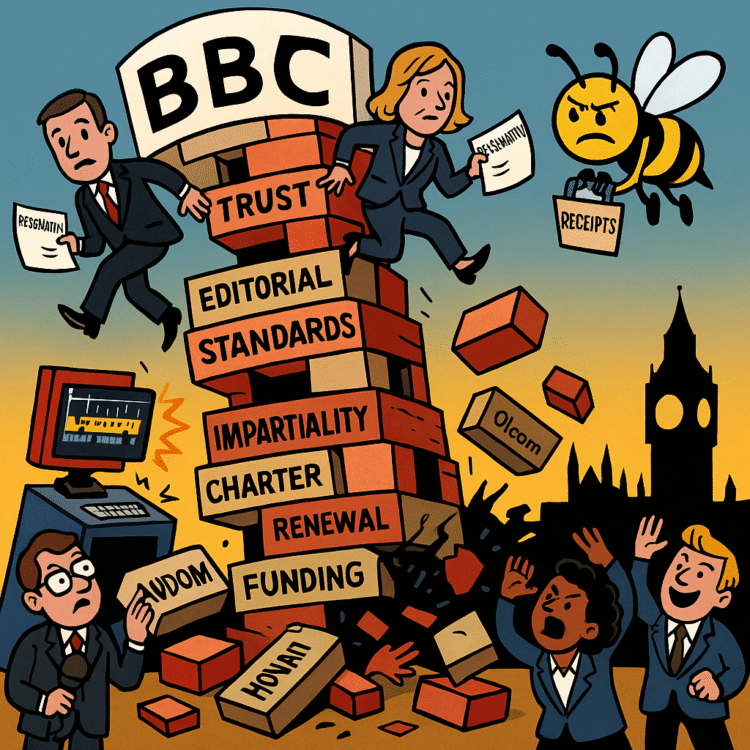
There is a particular sound the British establishment makes when something goes wrong. It is not a gasp, or a groan, or even the gentle clatter of a teacup as it trembles in the saucer of constitutional decorum. It is the muffled thud of two top executives leaping overboard at the same time, followed by a calm, practiced announcement that everything is fine, thank you for your concern, please do not look at the smoke billowing from Broadcasting House.
And so we begin the week the BBC misplaced its leadership because of an edit. Not a coup. Not a blackout. Not a budget meltdown. An edit.
Verified reporting shows that the BBC’s director general Tim Davie and BBC News chief Deborah Turness resigned after an edited segment in a Panorama episode cut Donald Trump’s January 6 speech in a way that was deemed misleading. One whistleblower memo later, courtesy of Michael Prescott, and the most iconic public broadcaster on the planet was suddenly behaving like a Victorian family dealing with an embarrassing cousin. The official line: a painful but necessary act of accountability. The unofficial energy: whatever you do, do not touch anything, we have no idea which part of the building is structurally sound.
Let us build the ledger from the top. Because satire without receipts is just tweeting.
The Timeline: How a Mangled Clip Toppled a Giant
The sequence matters. First, the leak. A document makes its way to a newspaper well practiced in the sport of amplifying grievance. The claim: an edit inside Panorama made Trump’s January 6 speech appear more incendiary than the original. In America this would be called Tuesday. In the United Kingdom it is called an existential crisis for the national broadcaster.
Next came the internal reviews. BBC editorial standards officers scrambled to determine what was cut, who cut it, why it was cut, and whether the cut had been cut in accordance with the proper guidelines for cutting. Meetings were convened. Statements were drafted. Lawyers made the sound lawyers make when they sense incoming parliamentary inquiries.
Then the political overlay arrived. The leaked memo did not stay confined to Trump speech edits. Quickly, it was folded into wider accusations: bias on Gaza coverage. Bias on trans coverage. Bias on any coverage adjacent to any topic with even a faint whiff of polarization. The narrative began to spread that this one editorial breach was not a breach at all, but proof of a much larger rot.
By the end of the week Davie and Turness had resigned. Their statements were almost poetic in their avoidance of naming anyone or anything that had caused their downfall. It was accountability, they said. It was the right time, they said. It was a moment of reflection, they said. Translation: the walls were vibrating and they found the nearest exit.
The Civics and the Stakes: A Public Broadcaster in a Political Vice
To understand why this matters, anchor it in the structural reality of the BBC. It is not just a broadcaster. It is a civic institution tied to Ofcom oversight, a charter that must be renewed, and a license fee that survives only because British voters have yet to fully accept how expensive it is to pay for television without it.
Right now, with the director general and the head of news gone, the BBC enters its next charter renewal cycle like a knight walking into battle after handing his opponents the sword. A headless BBC is a tempting target for politicians who already consider the corporation partial, outdated, or too powerful. Rivals who have tried and failed to replicate the BBC’s reach can now make the argument that the entire institution is compromised and due for replacement.
Board chair Samir Shah is left holding a damp bundle of political dynamite while trying to keep the public broadcaster’s reputation intact. Because make no mistake. This incident is not about one edit. It is about whether a public broadcaster can survive the modern political economy where politicians use accusations of bias as cudgels and media rivals thrive on teardown narratives.
What Was Edited, What Was Apologized For, and Why It Exploded
The documentary in question aired under a Panorama title that now feels like cosmic irony. Inside it, Trump’s January 6 speech was edited in a way critics argued sharpened the impression that he specifically incited the crowd. Panorama issued a correction. An apology was posted. The BBC clarified what was removed and why.
Normally, this is where a story ends. But because the BBC is a public broadcaster, because Donald Trump continues to operate as a global political accelerant, and because trust in institutions functions at the same temperature as lukewarm milk, this incident became a narrative weapon.
Trump world celebrated the resignations as proof that the global press finally acknowledged its bias. Downing Street offered careful concern, the kind that signals awareness of political opportunity without committing to anything too explicit. BBC unions demanded full transparency and independent review. Veteran journalists warned that editorial caution should not become editorial fear.
Meanwhile critics on all sides began attaching their grievances to the incident. Gaza coverage. Trans rights debates. Whether guests on certain shows were platformed too much or not enough. A single flawed edit became the large cardboard box into which every UK media complaint was dumped.
The Vulnerability of a Public Broadcaster
This episode underscores a simple truth. Public broadcasters become vulnerable to political cudgels the moment they appear weakened. It does not matter if the weakness is real. It matters that it can be framed.
And with Davie and Turness gone, that framing writes itself. A mis-edited documentary can now be described as a sign of systemic collapse. A charter renewal can be framed as a referendum on trustworthiness. A license fee debate can become a debate about whether taxpayers should fund an institution opponents claim is biased beyond repair.
If the BBC were a private company, this would be a weeklong embarrassment. But because it is the BBC, it becomes a constitutional stress test.
Names, Numbers, and What Comes Next
The next part of the ledger offers a fuller picture. The BBC must now appoint interim leaders in both news and the top job. Editorial standards protocols will inevitably be revised. The independent review that has been promised must publish its methodology, scope, and findings in a way that satisfies both the journalism community and elected officials who are hungry for leverage.
Ofcom may demand hearings. Parliament may ask for documentation. Trump world will declare victory no matter what. Free press advocates will warn about political interference. Rival outlets will sharpen their knives and continue to write stories in the tone of property developers touring a distressed building.
Meanwhile, the BBC must continue covering Gaza. And trans issues. And the American election. And the British election. And the multitude of stories where the BBC’s credibility is not an accessory, but the entire point. This is the fragility of a public broadcaster. It must be both a government funded institution and a watchdog for that same government.
Checkpoints for the Next Several Weeks
To separate accountability from capture, the public should watch for:
- The independent review’s methodology. Does it include all internal communications, editorial chains, and decision routes. Or is it a narrow technical analysis that avoids uncomfortable findings.
- Whether Ofcom or Parliament demand hearings. Political scrutiny can be constructive or punitive. The questions asked will reveal which path elected officials intend.
- Who is chosen as interim leadership. A caretaker who protects independence signals strength. A caretaker who pleases politicians signals capture.
- Whether editorial standards are clarified or chilled. A newsroom that becomes timid to avoid risk is as compromised as one that becomes partisan.
- What happens to future difficult coverage. Gaza. Trans issues. American politics. If coverage becomes bland to avoid criticism, the public loses.
- Whether body camera style transparency arrives. If the BBC publishes clearer sourcing, edit logs, and decision notes, it may rebuild trust. If it hides behind PR, the cycle will repeat.
The Plain English Truth
Here is the part the press rarely prints plainly. A public broadcaster does not fall because it edited one documentary poorly. It falls because political actors decide to use that edit as proof of systemic rot. A misstep becomes a weapon. A correction becomes an admission. A resignation becomes an invitation.
The BBC is now in the most precarious position a civic institution can occupy: between a charter renewal cycle and a political class that sees strategic advantage in bruising it.
Accountability is necessary. But accountability without context becomes capitulation.
And if this incident becomes the defining narrative for the BBC’s future, it will not be because the edit was wrong. It will be because the loudest voices discovered that a single mangled cut can be sold as an entire failing institution. And because a headless broadcaster is much easier to push than one standing upright.
The next chapter will not be written in the resignation letters. It will be written in what the BBC does now. Whether it stands up. Whether it speaks clearly. Whether it makes decisions based on journalism instead of fear.
Because the truth is simple. Public broadcasters are only as strong as their ability to withstand political pressure. And right now, the BBC has never looked more like a target.