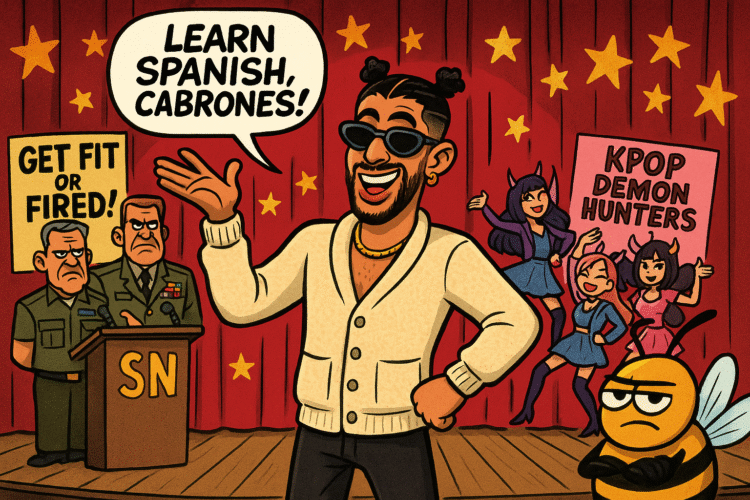
The moment Saturday Night Live returned for Season 51, it felt like an updated version of a political reset button. A bilingual monologue, a defense of art in a politically fracturing country, and a cold open so sharp it felt like glass in the face. Against the backdrop of shutdown fights, Pentagon sermons, and presidential lever-pulling, SNL chose to pedal into the storm—with Bad Bunny as its host, Doja Cat as musical guest, and a show that acknowledged the absurdity while refusing to bow beneath it.
It was, in sum, a victory lap: for Bad Bunny, for irreverent satire, for SNL itself. It said: we’re not just back. We’re back in the fight.
The Monologue, the Mix, and the Message
Bad Bunny opened with swagger and linguistic calibration. His monologue was partly Spanish, partly English—a dance between domains. He acknowledged the press around his upcoming Spanish-language Super Bowl halftime show: “If you didn’t understand what I just said, you have four months to learn.” The line landed not just as tease but as challenge: inclusion is not concession.
He skeined jokes about fame, identity, reactionary backlash—all while speaking truth to power in two languages. It’s one thing to host a comedy show, another to host a cultural mirror.
His guests arriving—from Jon Hamm to Benicio Del Toro—added Broadway shine, but the spine of the evening came through politically keyed sketches. The SNL writers staged a spectacular cold open that skewered Defense Secretary Pete Hegseth’s Quantico address: they riffed on “fat troops/fat generals,” overzealous cultural-war jargon, recruitment posters screaming “Get Fit or Get Fired.” For once, satire met Pentagon theater in a way that felt urgent, not ancillary.
Other sketches threaded the boundary between absurdity and commentary: Inventing Spanish (the language as western expansion), Jeopardy With Bad Bunny (where correct answers are protests), and KPop Demon Hunters (a mash-up of fandom, corporate control, and aesthetic obsession). Weekend Update leaned hard—each headline became a tally of shutdown scars, institutional collapse, and presidential spin.
Doja Cat’s performances balanced spectacle with command: she opened with “Aaahh Men!”, later entered “Gorgeous” backed by dancers whose energy underscored chaos as choreography. The musical booking felt less novelty and more statement: the show could court mainstream pop and speak to the cultural moment.
Behind the scenes, the production was meticulous. Promo shoots on September 30 and October 2 indicated they believed in the impact. Stage direction, transitions, live editing—every beat tested whether satire could survive prime time in a presidency that views satire as opposition.
The audience’s reception was electric: laughter, applause, occasional gasps. The in-studio crowd seemed to sense that this was more than entertainment—it was a signal. Ratings surged. Streaming spike alerts trended on Peacock. The industry whispers already say: SNL is no longer just late-night fodder. It is weekly referendum.
Why It Mattered, Why It Hurts
Saturday Night Live has always been America’s pressure valve. Its lamp to privilege, lamp to power. But in 2025, the stakes are higher. The country locked in budget wars, agency purges, military rhetorics against “political correctness.” Institutions are under pressure—how much satire, how much dissent, how much irreverence will survive when executives and bureaucrats treat government as a theater of force?
Bad Bunny’s hosting signaled that SNL has moved beyond a primarily English-speaking space. It embraces multiplicity not as concession but as currency. It affirmed that bilingual satire is not fringe—it is essential in a country where politics speak in two languages.
The sketches didn’t coast on capsules of outraged references. They actively stitched Pentagon posturing into parody. The choice to lampoon a recent general-summit address wasn’t random. It was precise. SNL is positioning itself as an ongoing check—not just a lampoon, but a weekly institutional countermeasure.
Meanwhile, the cast adjustments signal new life. The infusion of fresh faces (Tommy Brennan, Jeremy Culhane, Kam Patterson, Veronika Slowikowska, Ben Marshall) next to veterans (Kenan, Jost, Che, Mikey Day, Chloe Fineman) gives flexibility. Comedy, like power, must evolve—or else fester.
Doja Cat’s performances, strategically placed, make sure the show isn’t just political noise. It is culture. It is spectacle with backbone.
In ratings, SNL already claims a win. Its broadcast numbers spiked. Peacock streams after midnight surged. Media criticism pivoted: this is a premiere that matters. It sets SNL as voice, not relic.
Closing Thought: Four Months to Language, Forever Stage
Bad Bunny demanded four months—learn the language. What SNL demanded was more: that the country remember how to laugh when power forgets humility, that representation isn’t tokenism but pulse, that satire is not fluff but backbone. They re-premiered SNL not as nostalgia, but as revolt. Season 51 is not a new chapter—it feels like a new constitution of cultural commentary.
Because if satire doesn’t bite harder when power thrashes, then what is its purpose? Let the show run. Watch the audience listen. And measure the temperature when Washington hears the laughter.