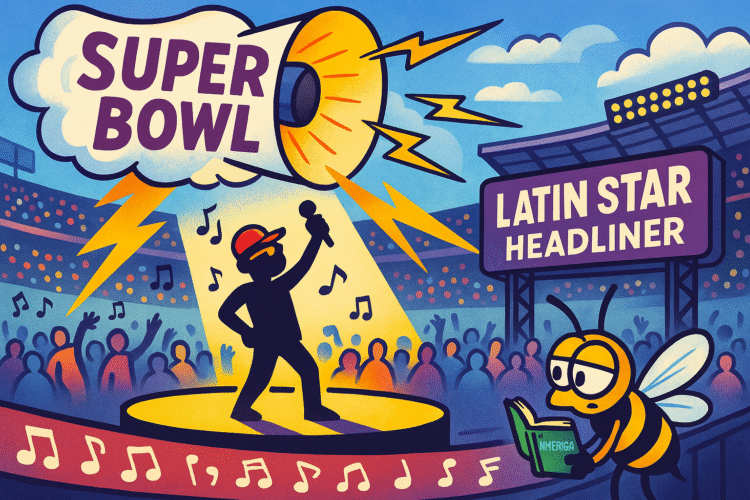
Late one Sunday night, when millions were stretching out their wings and yelling at referees, the NFL, Apple Music, and Roc Nation dropped a bomb: Bad Bunny—Benito Antonio Martínez Ocasio—will headline the Apple Music Super Bowl LX Halftime Show at Levi’s Stadium. Yes, the Puerto Rican icon will take the solo spotlight on February 8, 2026—the first time he’s done so, though many still remember his cameo with Shakira and Jennifer Lopez in the 2020 show. What that cameo was, this is: transformation, not accessory.
The announcement, framed as a cultural watershed, declared that this was not just a performance but a statement. Bad Bunny said this is for his people, his culture, their history. Jay-Z celebrated his global reach. Production will be run by Roc Nation, with veteran live-TV director Hamish Hamilton and producer Jesse Collins. NBC will carry it in the U.S. The whole spectacle is being pitched as a moment when Latin music takes the biggest stage yet in the American spectacle machine.
This is not just about reggaeton, or trap, or Spanish-language hooks. It’s about who gets to be our national soundtrack, who gets to claim the center at halftime, and what it means for pop to be, at last, multilingual.
Halfway Down the Halftime Timeline
To situate the significance: the Super Bowl Halftime Show has been a musical highlight, a ratings generator, a branding goldmine. In recent years we’ve seen:
- Kendrick Lamar (2025) stepping in with a socially conscious, gripping set
- Usher (2024) bringing sleek R&B and pop nostalgia
- Rihanna (2023) who summoned global fandom despite on- and off-stage complications
Each headliner comes with expectations: spectacle, pacing, surprise guests, audio-visual wizardry, sponsors lining their pockets. The Super Bowl is the world’s largest stage, and every act is auditioning not just for the halftime slot, but for cultural permanence.
Bad Bunny’s selection is not a random swing—it’s a signal. NFL and Apple Music are betting the world wants Latin flavor, not just as an insert, but as the main dish.
What’s at Stake: Viewers, Bucks, Branding
The Super Bowl is a revenue behemoth: broadcast rights, ads that sell for insane CPMs (cost per thousand viewers), sponsorships, merchandise, streaming tie-ins. Apple Music’s involvement adds a streaming halo: “watch the halftime show, stream the albums, buy the merch.”
For the NFL, it’s about remaining culturally relevant, expanding into Latino markets, and pouring salt into the wounds of critics who say football is as stale as its aging male fan base. For Roc Nation and Bad Bunny, it’s the conversion of mainstream visibility into legitimacy at scale.
The Bay Area outdoor venue, Levi’s Stadium, brings its own challenges. Weather, acoustics, crowd control, staging rigging—all must be tuned to perfection. And safety logistics for such an event already carry nightmare potential. Sponsors, lighting rigs, pyrotechnics, instant replay, backup power—all must dance together. One misstep and viral critique, lawsuit risk, or sound failure becomes the headline.
Speculation Hour: Set List, Guests, and Fireworks
We cannot yet confirm the songs, but if I were writing a bet, I’d include:
- “Safaera” or “Titi Me Preguntó”, for adrenaline and crowd command
- A deep cut, or a slowed ballad, to make listeners weep
- Possibly a guest rodeo: J Balvin, Rosalía, or maybe even a surprise English crossover
- A moment of cultural homage—maybe a medley sampling salsa, bomba, plena, or classic Latin pop
- Moments built for cinematic visuals: fireworks, drones forming Puerto Rican flag, LED waves across the stadium
And if Roc Nation’s team is wise, they’ll drop a tie-in EP, merchandise bundles, one-off recordings of the halftime set, or even limited vinyl pressings that become collector myths. Every eyeball in that stadium is a promotional asset.
Bad Bunny’s Career Arc: From Trap Rebel to Super Bowl Headliner
Bad Bunny is no overnight sensation. He’s repeatedly shattered streaming records, sold out arenas, turned controversy into commentary, and pushed Spanish-language trap and reggaeton into new strata. His catalog spans swagger, heartbreak, protest, introspection, pop. He’s won awards, topped billboard charts across the world, collaborated with everyone from rock to rap.
He’s also leaned socially: songs that critique machismo, that uplift Latin identity, that carry Q&A in Spanish—and he’s never apologized for accent, audience, or authenticity. For someone who once was part of the underground, now standing on the world stage, this is a homecoming.
By booking him, the NFL and Apple are not just making a cultural bow—they are aligning with someone who shaped the culture already. The move feels overdue, not experimental.
Latin Visibility, but Not Sympathy
A stage so massive helps visibility—but it doesn’t guarantee empathy or equality. A Spanish line in a song, a reggaeton beat, a Puerto Rican flag projection—those are visible tokens, not structural solidarity. There’s always the risk of reduction: Latin music reduced to “rhythm breaks,” Latin identity reduced to dancers and flags rather than depth. Will the mainstream media talk about his arms, his attire, his “localness”? Will critics dissect his pronunciation? Will critics say “too Latin for America, too English for Puerto Rico”?
Bad Bunny’s presence can’t just open doors—it must force them open, reshape who’s booked next, change the expectation that halftime is for English pop or blockbuster nostalgia. If one Spanish-language set can compete head to head with Bruno Mars or Beyoncé, then the playbook changes.
Who Deserves the Mic—and Who Gets It
This moment is not just about music. It’s about who we collectively say belongs in the middle of our biggest spectacle. For years, non-English, non-pop artists have been tokened as “cultural diversions.” Bad Bunny’s headlining means that Latin excellence isn’t a sidebar—it’s the main act.
But we must also ask: who else should be headlining but still isn’t given space? Artists from Africa, Asia, Indigenous communities—how many more “firsts” will we celebrate before they stop being novelty? Are we saying “only one Latin act per Super Bowl,” or “any artist who moves the globe can get the mic”? That tension will define whether this is milestone or window dressing.
The Double-Edged Sword of Spectacle
In spectacle, control is illusory. Even the biggest, slickest halftime show is vulnerable to acoustics, weather, power glitches, camera misfires, crowd energy. If Bad Bunny’s show falters, critics will frame it as “too risky” or “cultural gamble.” If it succeeds, they’ll say he earned it. But those critics often forget that for White acts, “successful spectacle” is expected baseline, not exception.
Meanwhile, the NFL will push for continuity. Sponsors will want safety, brand alignment, minimal controversy. That can mean pressure to censor, to sanitize. Will Bad Bunny be pressured to pull political lyrics? To mute bilingual statements? To avoid controversial social commentary? His true test isn’t the stage—it’s how free he remains.
The Final Verse
When the lights dim on Levi’s Stadium, when the first note reaches tens of millions, when the flags, cameras, drones, and speakers converge—Bad Bunny will stand in the middle. For his people. For his culture. For the history of artists who’ve never had the stage this big. But the biggest reveal won’t be what he sings. It’ll be how the world listens.
The halftime slot is a statement: if the world is going to keep playing Anglophone pop as default, then letting a Spanish-language superstar headlining the Super Bowl is not just representation. It is disruption.
The question isn’t whether Bad Bunny deserves it. The question is whether America is ready enough not to treat him as a novelty, but as overdue headliner. Because he’s not doing America a favor by accepting the slot. America is doing him one by giving it—finally.