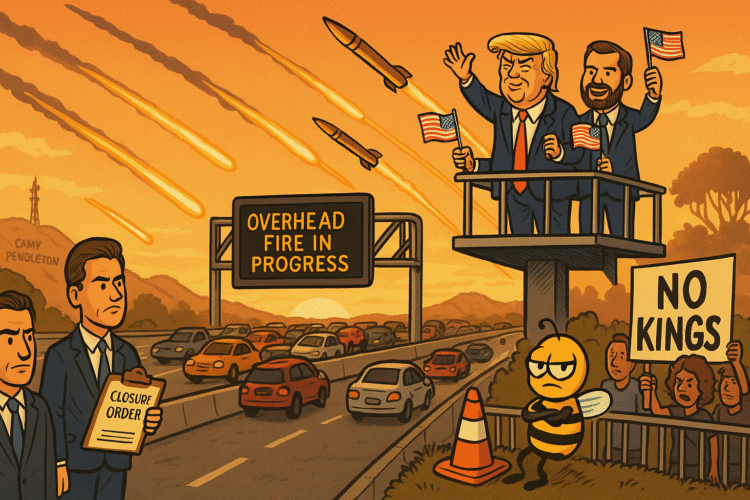
There’s something quintessentially American about the sight of artillery fire streaking across a highway full of Teslas. It’s not just the juxtaposition of power and paralysis, of steel ambition and rubberized helplessness—it’s that we managed to turn an interstate into a battlefield metaphor without even noticing. On October 18, 2025, California drivers got front-row seats to the new American pageant: governance by spectacle.
Somewhere between Oceanside and Basilone Road, a column of SUVs idled as 155mm shells traced luminous arcs over Interstate 5. On the reviewing stand, President Donald Trump, Vice President JD Vance, and Defense Secretary Pete Hegseth applauded the show like proud uncles at a fireworks display. Below them, 80,000 commuters and $94 million worth of freight sat immobilized in detours and disbelief. The White House called it “a celebration of Marine readiness.” The State of California called it “a life-safety risk.” Everyone else called it Friday.
The event had all the trimmings of the new American aesthetic—grand, performative, logistically absurd. The Marine Corps’ 250th anniversary live-fire demonstration was meant to be a tribute to discipline, valor, and history. It instead became a cinematic mashup of Top Gun: Maverick and Caltrans traffic advisory.
Governor Gavin Newsom, alarmed by the idea of “overhead fire in progress” signs blinking above family minivans, ordered a seventeen-mile stretch of I-5 closed. The Marines insisted it wasn’t their idea. The Pentagon insisted everything was safe. The White House insisted it was necessary. Everyone insisted someone else had planned it. In the middle of all this insisting, the freeway fell silent, and the sound of artillery became the soundtrack of America’s newest culture war: who owns the boom?
It’s easy to lose sight of how surreal it is that a sitting president watched live artillery soar over a public highway while his staff issued press passes like concert wristbands. But this is the era of governing through optics. A military exercise is no longer a test of readiness; it’s a set piece in a campaign reel. Every flash, every echo, every plume of smoke becomes a frame in the movie of national strength. The Marines called it a “routine demonstration.” The White House called it “an opportunity.” California called it “a lawsuit waiting to happen.”
When history looks back on this week, it might not remember the exact number of rounds fired or the tonnage of diverted freight. It’ll remember the metaphor—America firing live ammunition over its own citizens to make a point about readiness.
JD Vance, beaming in his dress blues, told reporters that “this is what leadership looks like.” He didn’t clarify whether he meant the howitzer crew or the freeway patrol officers rerouting minivans through side streets in Camp Pendleton’s shadow. Pete Hegseth, never one to waste a patriotic tableau, called it “a beautiful reminder of who keeps us safe.” One imagines him later describing the traffic jam as a “symbol of American perseverance.”
Even the signage betrayed the absurdity. “Overhead fire in progress,” read the digital boards that usually warn of lane closures and tire debris. Drivers took photos, posted them on Threads, and added captions like “Just your average commute.” Somewhere, a social media intern in the Pentagon must have nodded approvingly.
The Marines deserve some sympathy. Their intention, reportedly, was to mark 250 years of service with precision drills and ceremonial fire—on a closed range. Then came the White House, whose taste for grandeur rivals its allergy to boundaries. Suddenly, the plan expanded: invite the president, invite the cameras, expand the blast radius of patriotism.
California, predictably, panicked. The state’s emergency operations team flagged the obvious: exploding shells over Interstate 5 could distract drivers, damage infrastructure, or, in a worst-case scenario, endanger lives. But Washington brushed off those concerns with the confidence of people who won’t be stuck in the traffic they cause.
Newsom’s order to close the highway was both prudent and performative. The governor got to play the adult in the room while scoring a free optics war against Trump. His statement—“Safety first, politics last”—landed somewhere between moral stance and campaign slogan. The closure worked: no injuries, no incidents, and a clean political split-screen. On one side, Trump framed by thunderous cannons; on the other, Newsom framed by brake lights.
For the commuters, the experience was less symbolic. Freight drivers stared at GPS reroutes that turned seventy-minute hauls into four-hour detours. Rail service halted. Gas stations emptied. Local diners filled with stranded travelers swapping theories: alien invasion, film shoot, war. A man in a Padres cap told a reporter, “It’s like they declared martial law on my lunch break.”
Meanwhile, protesters waving “No Kings” banners gathered near Harbor Drive, their chants muffled by the thud of artillery. The irony was lost on no one: a country founded on rebellion now staging military pageants to flatter its rulers.
By dusk, the southbound lanes reopened early, a mercy in California time. The Marines congratulated themselves on a “safe and successful event.” The White House released a statement about “the strength of our great nation.” The State of California quietly tallied the economic cost and prepared for the next round of press conferences.
The legal questions, like shrapnel, scattered wide. Could a state legally close a federal highway to protect civilians from a federally led event? Who decides the threshold of “safe” when the federal government and the state government both claim jurisdiction? Constitutional scholars scrambled for precedents and came up empty. The best anyone could find was a 1972 case about flood control during the Nixon administration, which, while less explosive, shared the same theme: when in doubt, Washington floods the states with consequences.
Transportation economists estimated that the shutdown cost roughly $20 million in delays and lost freight productivity. Political strategists called it priceless television.
If there’s a moral to this tableau, it’s that America has perfected the art of confusing performance for purpose. The spectacle of artillery over the I-5 wasn’t about training or safety or logistics. It was about emotional choreography—creating a feeling of power, awe, and inevitability.
The problem with theater, of course, is that it eventually requires an audience reaction. And reactions, unlike artillery shells, don’t follow predictable trajectories. Some Americans saw courage. Others saw madness. Most saw brake lights.
Even the optics of the president standing at Camp Pendleton with smoke curling behind him felt like a parody of empire. It’s one thing to project strength. It’s another to rehearse it like a halftime show. When the commander in chief needs live ammunition to appear commanding, the line between governance and cosplay blurs beyond recognition.
This is how democracies drift into self-caricature: one televised explosion at a time. The same citizens who once questioned how authoritarianism took root in Europe now sit in traffic beneath its echo. Not because they agree with it, but because there’s nowhere else to go.
Each time the machinery of government repurposes itself into stagecraft, the audience grows a little more numb. The cost of participation becomes tolerable—after all, it’s just another delay, another detour, another Friday. The noise fades into normalcy. And somewhere between exit 54 and exit 72, the republic hums along to the rhythm of its own absurdity.
By Monday, the headlines will move on. The White House will call it a “successful tribute.” The Pentagon will release grainy footage set to swelling orchestral music. California will count the cost and promise “better coordination next time.” The drivers will still be late. And the next administration—whichever one it is—will learn that nothing rallies the base quite like the smell of cordite and inconvenience.
The deeper danger isn’t the artillery; it’s the desensitization. The idea that power can commandeer civilian space whenever it wants, and that ordinary people will adjust because they always do. It’s the same principle behind curfews, surveillance, and executive orders that arrive at midnight. Make the spectacle frequent enough, and the outrage dulls to background noise.
For the White House, the calculus was simple: a booming image of strength is worth a day of chaos. For California, the lesson was clearer: safety must occasionally perform its own theater to compete. For everyone else, the reality is that the freeway—our most democratic space—isn’t exempt from the empire’s script.
Closing Section: The Sound That Stays
Long after the lanes reopened and the headlines scrolled away, a faint echo lingered in the air over Oceanside. Not the echo of artillery, but the sound of something quieter and more dangerous: acceptance.
You could hear it in the way commuters shrugged off the ordeal, in the way talking heads described it as “just politics,” in the way the military called it “routine.” Acceptance is the sound a democracy makes when it forgets to be startled.
The Marine Corps turned 250 that day, but it was America that looked old. Tired of its own arguments, addicted to its own drama, desperate for any noise that still feels like unity. The fireworks ended, the traffic moved, the cameras packed up, and yet the feeling remained—that our leaders no longer need to lead when they can simply perform.
Somewhere between the smoke trails and the brake lights, a lesson arced overhead, unclaimed and unlearned: the moment a republic starts aiming its celebrations at itself, it’s no longer sure which side of the blast zone it’s standing on.