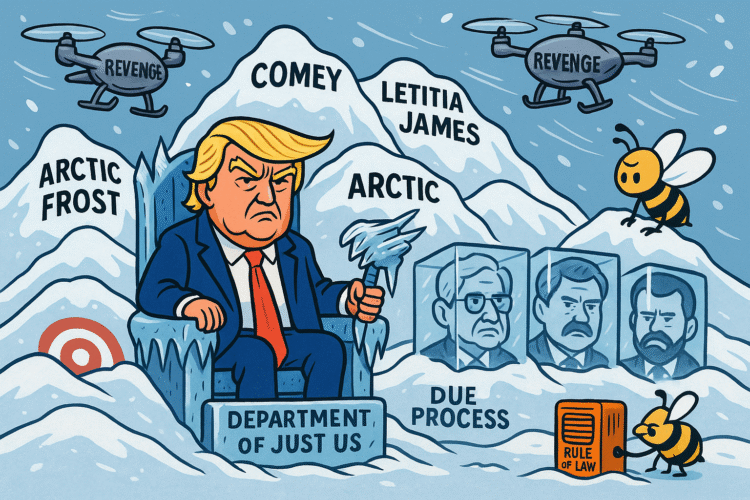
Some scandals melt under scrutiny. Others freeze time itself—like Operation Arctic Frost, the FBI’s now-infamous 2022 election-interference investigation that asked a few telecom companies for call logs and somehow got rebranded as the new Watergate. The facts were simple enough: the Bureau, approved at senior levels by Merrick Garland, Christopher Wray, and Lisa Monaco, used a judicially authorized process to obtain non-content metadata—dates, times, and phone numbers—for nine Republican lawmakers who had flirted with overturning the 2020 election. No recordings, no wiretaps, no men in sunglasses chewing gum outside Senator Grassley’s cul-de-sac. Just the invisible ink of law enforcement doing its job.
But simplicity doesn’t trend, and “judicially authorized” doesn’t sell hats. So the right, led by Donald Trump, took one look at the grand jury paperwork and decided it was time to resurrect the Deep State disco. Overnight, “metadata subpoena” became “illegal spying,” and “court order” became “coup.” Trump demanded prosecutions of Garland, Wray, Monaco, and Special Counsel Jack Smith, because in his cosmology, accountability is treason and revenge is due process.
That was the spark. The fire came later, when the Justice Department—now fully restaffed with loyalists who think Mar-a-Lago is the new Monticello—decided to test-drive its own version of “equal justice.” Suddenly, headlines announced the prosecutions of former FBI Director James Comey and New York Attorney General Letitia James. The charges were murky; the intent was not. This was payback masquerading as policy, retaliation written in legalese.
From Frost to Fire: A Timeline of Institutional Rot
It started with Arctic Frost in 2022, a textbook counterintelligence operation that looked at possible coordination between sitting lawmakers and election-fraud conspirators. It was supervised, authorized, and reviewed. The investigation quietly merged into Jack Smith’s broader special counsel work in 2023, producing grand jury subpoenas that targeted metadata, not the Constitution.
Then 2024 arrived—the electoral iceberg that capsized the ship. Trump’s reelection campaign ran on grievance and vengeance, promising to “drain the swamp with indictments.” Once back in office, the storm reversed course: the hunter became the hunted, and the Justice Department became a tool of score-settling performance art.
Within months, Garland and Smith were labeled “traitors.” Congressional Republicans held hearings accusing the DOJ of “spying on conservatives.” Fox News chyroned “Worse Than Watergate” like a weather alert. And in the background, as predictable as snow in Siberia, the new Trump DOJ began “reviewing” the “criminal conduct” of—who else—Trump’s old enemies.
James Comey, the man who first tangled with Trump in 2017. Letitia James, the New York Attorney General who once sued the Trump Organization for fraud. Two Jameses, one vendetta.
Revenge Is a Growth Industry
The playbook is pure Trumpian logic: if you accuse me of weaponizing justice, I’ll weaponize justice harder and call it even.
Operation Arctic Frost gave the administration its talking point: They spied on Republicans. Never mind that the “spying” was a routine metadata request signed by a judge under 18 U.S.C. § 2703(d). Never mind that it targeted people under legitimate investigation for trying to overturn democracy. The facts didn’t matter; the feelings did.
So now, revenge wears a badge.
James Comey’s prosecution was announced with cinematic flair—press conferences, flags, a podium lined with lawyers who looked like they’d just binge-watched House of Cards and taken notes. The charges? “Abuse of power” for actions taken during the Russia probe nearly a decade ago. The evidence? Internal memos already cleared by the Inspector General in 2019. The message? Crystal clear: loyalty isn’t optional, it’s retroactive.
Then came Letitia James. Her crime, apparently, was prosecuting the wrong billionaire at the wrong time. The new DOJ accused her of “political misuse of state authority,” a phrase that should have self-destructed from irony. State prosecutors investigating corruption were now being federally investigated for investigating corruption. It’s the legal equivalent of a snake suing its own reflection.
The Constitution as Mood Lighting
Meanwhile, Trump’s loyalists have decided that the Fourth Amendment, separation of powers, and the basic principle of equal protection are now optional if the defendant’s name offends them. Under their interpretation, the executive branch doesn’t just enforce the law—it edits the script.
Take Arctic Frost. Under the Stored Communications Act, federal investigators needed a § 2703(d) order showing “specific and articulable facts” that the data was relevant to a legitimate investigation. A judge signed off. That’s how due process works. But when the new regime took over, it declared that due process itself was political. “The process was rigged,” they said. “Therefore, our process is justice.”
It’s not law enforcement anymore; it’s ritual purification.
And so the “weaponization” narrative flipped inside out. When the Trump DOJ prosecutes rivals, it’s “accountability.” When the previous DOJ investigates crimes, it’s “spying.” When metadata subpoenas target insurrection-adjacent phone numbers, it’s tyranny. When revenge indictments target critics, it’s restoration.
This isn’t government—it’s grievance cosplay in uniform.
The Arctic Theater of Political Thermodynamics
The brilliance—if you can call it that—lies in how the outrage feeds itself.
Step one: Misrepresent a technical process.
Step two: Claim persecution.
Step three: Use the same system you discredited to persecute your accusers.
Step four: Call that balance.
Trump didn’t invent this pattern; he industrialized it. Every complaint becomes justification for retaliation. Every procedural safeguard becomes a weapon. When the FBI follows the law, he calls it treason. When his DOJ breaks it, he calls it reform.
The result is an infinite feedback loop of vendetta disguised as vigilance. Arctic Frost is just the prequel—the origin myth for a presidency built on the fantasy of personal redemption through public prosecution.
The Congressional Snow Circus
The Senate, of course, couldn’t resist joining the show. Chuck Grassley called Arctic Frost “a betrayal of the American people.” John Kennedy, between folksy quips about crawfish, declared it “spying worse than Watergate.”
They have since demanded subpoenas for Merrick Garland and Christopher Wray, as if congressional oversight were a substitute for reading comprehension. Expect hours of televised outrage where the words “Fourth Amendment” and “privacy” are used interchangeably with “my feelings.”
Meanwhile, Democrats and actual legal experts patiently explain that metadata subpoenas are not surveillance. That grand juries are secret for a reason. That the whole process was judicially authorized and fully lawful. But no one listens, because procedural accuracy is kryptonite to political theater.
By the time fact-checkers confirm that Arctic Frost was standard practice, the hearings will have gone viral, and the fundraising emails will have gone out. The narrative doesn’t need to be true—it just needs to fit on a mug.
The Chilling Effect
The real danger isn’t in the prosecutions themselves—it’s in what they normalize. When the DOJ becomes a weapon of personal vengeance, every future administration inherits a loaded gun. The chilling effect isn’t metaphorical; it’s measurable.
Journalists think twice before publishing leaks. Career prosecutors hesitate to pursue politically sensitive cases. Inspectors general weigh whether truth is worth unemployment. This is how accountability dies—not with an edict, but with exhaustion.
And at the core of it all sits a president who believes justice is personal property and law a loyalty oath.
The New Meaning of “Weaponization”
“Weaponization” used to mean using state power to target political enemies. Under Trump 2.0, it means not doing that. The administration has redefined justice the way authoritarian regimes redefine peace: by subtraction.
James Comey’s prosecution is vengeance disguised as restoration. Letitia James’s prosecution is punishment for audacity. The Arctic Frost panic is camouflage—an excuse to invert reality and call it balance.
The Department of Justice, now renamed in spirit if not signage, no longer investigates crime; it manufactures it. It doesn’t uphold precedent; it erases it.
And in this frozen moral climate, every act of revenge is sold as reform, every abuse as equilibrium.
The Metadata of Hypocrisy
Let’s return, for a moment, to the small, boring truth that started all this. Operation Arctic Frost didn’t “tap phones.” It didn’t record conversations. It didn’t spy. It asked for call logs, under court supervision, to determine whether lawmakers involved in January 6 coordination were also coordinating with external actors.
That’s it. A judge signed an order. The data came back. The investigation proceeded. And later, when Jack Smith’s election-interference case was dismissed for jurisdictional reasons, it ended quietly—like every responsible case should.
But boredom is fatal in politics. So the right invented a drama, and Trump turned it into an alibi.
The Snowball Strategy
Now the snowball rolls downhill, gathering everything in its path—Garland, Wray, Monaco, Smith, Comey, Letitia James—into one frosty narrative of persecution. The facts are irrelevant; the theme is irresistible: They came for me; now I come for them.
It’s not governance; it’s grievance management. The administration doesn’t need to win in court. It only needs to convince enough people that revenge is justice, and that the DOJ, like a casino, only works when the house wins.
The consequences? Congressional subpoenas to the DOJ and telecoms. Potential civil suits from wronged targets. Maybe even a few suppression motions from prosecutors trying to prove they still exist. But the real cost will be measured later, when every future president inherits a precedent that says law can serve power instead of restraining it.
The Last Freeze Before the Thaw
America has entered its revenge era, and Operation Arctic Frost was just the weather forecast. The prosecutions of Comey and Letitia James are the main event—an ice sculpture of justice carved with spite. The Fourth Amendment, 18 U.S.C. § 2703(d), grand jury secrecy—these are now just decorations in a frozen democracy where accountability is seasonal.
The truth remains buried under the permafrost of propaganda: Arctic Frost was lawful. The prosecutions are not. But by the time the thaw comes, it may not matter. The crowd has moved on, chanting slogans about freedom while cheering the criminalization of its defenders.
The weaponization isn’t new—it’s perfected. The DOJ has become a mirror, reflecting not justice but the vengeance of whoever stares longest into it. And the rest of us? We’re just the reflection’s collateral damage.