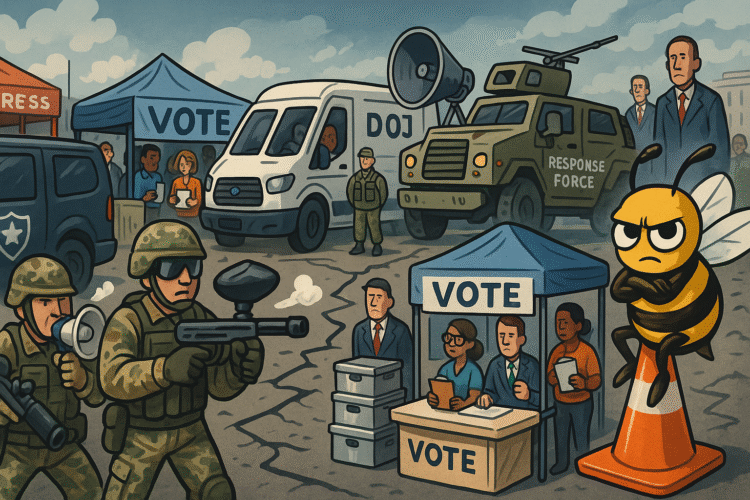
There’s a special kind of genius in bureaucratic evil—the kind that hides a revolution inside a memo. The latest leak out of the Pentagon reads less like a defense directive and more like a stage direction for an authoritarian dress rehearsal: by April 1, 2026, every state’s National Guard must have a rapid “Response Force” ready for crowd control. Pepper-ball launchers, foam rounds, LRADs—the whole “nonlethal” orchestra, conveniently tuned just in time for the midterms.
The order was framed as “standard readiness.” Which is like calling a bonfire a candle.
At the October 23 Pentagon briefing, Defense Secretary Pete Hegseth played sphinx—refusing to confirm, deny, or even emote—citing “planning under existing authorities.” Translation: we found the loopholes, we’re driving trucks through them, and we dare you to notice.
The Quiet Federalization of Fear
On paper, the plan sounds “routine.” States get federal training dollars to prepare Guardsmen for “domestic contingencies.” In practice, it’s a creeping rebrand of the National Guard—from disaster relief and flood rescues to crowd control and “election security.”
Remember Portland. Remember Chicago. Both were test runs for this new model: federalize soldiers under the guise of protecting “federal property,” then stretch that perimeter until the “property” is the whole city.
Now, they’re normalizing it nationwide.
This is not a conspiracy—it’s a conversion.
The difference between “protection” and “policing” is semantics when the same camouflaged boots show up at a ballot drop box.
How to Make a Soldier Look Like a Cop
Step one: say the magic words—Title 32 authorization. It sounds dry and harmless, like a footnote in a civics textbook. In reality, it lets the federal government train state Guard units for domestic operations while pretending they’re still “under state control.”
Step two: cite 10 U.S.C. § 12406, which allows the president to “federalize” Guardsmen to “suppress insurrections” or “execute federal law.” Conveniently, no one defines what counts as an insurrection anymore—because once you call a protest a riot, and a riot a rebellion, you’ve opened the door.
Step three: add a press release full of soothing bureaucratic hymns.
Words like de-escalation posture and graduated response matrix drift from podiums, disguising kettling tactics and mass arrests. Each phrase is written by a lawyer, rehearsed by a soldier, and sold to a public that just wants to believe “nonlethal” means “safe.”
But you don’t have to kill a democracy to end it. You just have to make enough citizens too afraid to show up for it.
The Paper Shield We Pretend Still Works
The Posse Comitatus Act (18 U.S.C. § 1385) is supposed to be the line: no using federal troops as domestic police. But that wall is full of doors—the Insurrection Act, Title 32, “support to civil authorities,” “federal property protection.”
Each clause is a hinge waiting to be jiggled.
And once those hinges swing, it’s open season on the First Amendment.
The Voting Rights Act’s anti-intimidation section (52 U.S.C. § 10307(b)) forbids coercion near elections. The Civil Rights Act and criminal statutes (18 U.S.C. §§ 241, 242, 594, 595) criminalize voter intimidation. But the law only works after the damage is done—after the crowds have been dispersed, the ballots cast in fear, the footage already edited into campaign ads about “restoring order.”
The courts, meanwhile, hide behind the Purcell principle—a judicial superstition that says we shouldn’t “change election rules close to an election.” Translation: even when the rule itself is the threat, judges prefer to wait until next time.
Every authoritarian knows this rhythm: act fast, litigate slow, and let the rule of law show up late to its own funeral.
The Field Manual for Democracy Management
The leaked directive reads like a dystopian IKEA catalog.
- Governors “voluntold” to build rapid crowd-control units with federal funds.
- Quiet MOUs promising to “protect federal property,” later stretched to justify perimeters around city centers.
- Joint Task Forces with press kits that talk about “graduated responses,” which means the rubber bullets will arrive after the loudspeakers.
- ICE vans “staged for support” outside immigrant-heavy precincts, their engines idling like threats.
- DOJ “chain-of-custody escorts” who insert themselves between local canvassing boards and county tabulators, transforming ballot transfers into federal handoffs.
The comms strategy is pre-loaded: call critics “anarchists” one day, “alarmists” the next. Leak enough memos, float enough trial balloons, and the country will mistake authoritarian prep for administrative housekeeping.
It’s not about one order. It’s about normalization by repetition.
The uniforms arrive slowly, like wallpaper—until one day you realize the whole house has been redecorated in camouflage.
History’s Warning Labels Are Peeling Off
This playbook isn’t new; it’s just dressed in better lighting.
1877: Federal troops crush the Great Railroad Strike.
1968: Chicago’s DNC protests meet bayonets and tear gas.
2020: Lafayette Square cleared with “nonlethals” for a photo op.
Every time, the justification is the same—order, safety, patriotism. Every time, the result is predictable: bruises, lawsuits, and a shrinking circle of civic courage.
You don’t erase democracy in one night. You bruise it until it stops showing up.
The Optics War Disguised as “Readiness”
The administration’s defenders call the new Guard plan “contingency preparedness.” Critics call it what it is: the militarization of optics.
The goal isn’t to fight unrest; it’s to perform control.
A Humvee parked by a protest line sends a message long before anyone fires a pepper ball. An LRAD speaker humming at a ballot site tells you who owns the noise. A federal “escort” for local ballots tells you who owns the count.
And when the footage airs that night—calm commanders, disciplined troops, a scrolling chyron about “stability”—the story will sound less like democracy and more like a commercial for managed dissent.
The Larger Project: Order by Design
The “Response Force” isn’t a standalone scheme; it’s the next tile in a mosaic.
You can’t deploy troops to “secure elections” unless you’ve first:
- Gerrymandered districts past parody.
- Purged election boards of professionals.
- Gutted early-voting days and mail-ballot rules.
- Passed “protest permit reforms” that criminalize spontaneous assembly.
- Turned “federal property protection” into a synonym for “control the streets.”
Once that groundwork is laid, soldiers become the punctuation mark at the end of a long sentence about obedience.
And make no mistake—this administration loves punctuation. Everything ends in a period, not a question mark.
The Legal Firewall (If Anyone Uses It)
So what happens when uniforms start shadowing precincts?
There are still weapons sharper than rubber bullets:
- State constitutions and courts that still police partisan maps and prohibit armed presence near polls.
- Attorneys General who can file for emergency TROs the moment a Guardsman crosses the 100-foot line.
- Section 11(b) of the VRA, which allows lawsuits for intimidation without proving intent—perfect for stopping “we were just following orders” before it metastasizes.
- Consent decrees and monitor programs that embed civil-rights lawyers where the cameras don’t go.
- Mutual-aid de-escalation networks that teach communities to resist violence with visibility.
- Rapid-response hotlines that make intimidation go viral in minutes, not months.
It’s not romantic. It’s paperwork. But paperwork wins wars.
The Civic Counteroffensive
What terrifies authoritarians most isn’t violence—it’s visibility.
They rely on fatigue. On people giving up, tuning out, or staying home.
The antidote is boring civic persistence:
- Voter-education drives that teach people their rights inside and outside the 100-foot line.
- Legal clinics that prep volunteers to document and challenge “security deployments.”
- Journalists publishing the MOUs before they’re used.
- Churches, unions, and local organizers turning “crowd control” drills into community-monitoring networks.
- Citizens demanding that governors define—publicly—what “support” means before a single Guardsman leaves the barracks.
The plan only works if the public accepts uniforms at rallies as normal. Don’t.
The Soundtrack of a Managed Democracy
When soldiers become set dressing for elections, the soundtrack shifts.
Instead of the roar of free citizens, we get the low mechanical hum of readiness. Instead of applause, the snap of zip ties. Instead of messy, spontaneous democracy, a curated feed of “safe” civic expression approved by the same people who choreographed the fear.
That’s what “Never Again 2020” really means. Not never another stolen election—but never another election they might lose.
The republic won’t end with a coup. It’ll end with a checklist.
The Real Response Force
The leaked directive imagines soldiers with batons. The real “response force” has to be us—with pens, lawsuits, cameras, and courage.
Show up. Law up. Don’t let anyone rebrand intimidation as “contingency planning.”
Because the only thing standing between democracy and pageantry is participation.
And the only sound that should echo on Election Day isn’t the pop of “less-than-lethal” rounds—it’s the sound of millions of ballots hitting the box.
Final note:
If uniforms at rallies become as normal as campaign hats, we’ll wake up one morning to find that the loudest sound in America isn’t the people’s voice—it’s the thud of “public safety” against the First Amendment.
And the saddest part? It’ll all be under existing authorities.