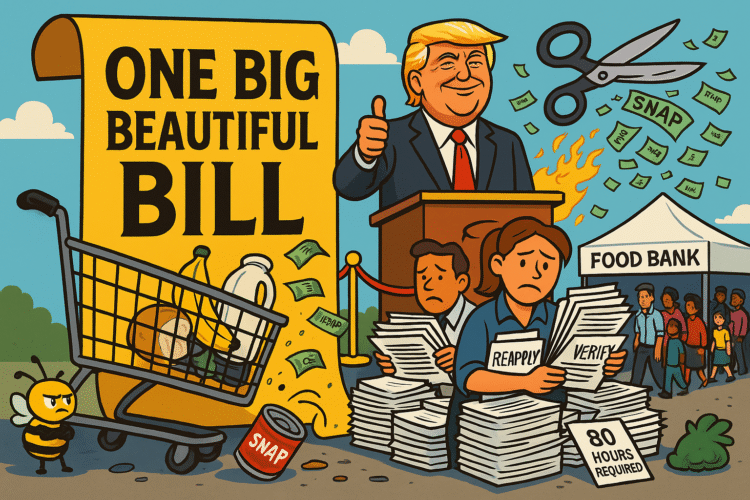
Trump calls it “One Big Beautiful Bill,” but the only thing getting beautified is the balance sheet Congress cares about more than hungry families.
The thing about austerity is that it never arrives dressed as cruelty. It shows up in a blazer, smiles politely, talks about discipline, and promises to fix the books. It nods solemnly while explaining that everyone must tighten their belts, carefully avoiding the detail that some people no longer own belts because they pawned them to afford rent last month. And that is how we arrive at the newly christened “One Big Beautiful Bill,” Trump’s legislative brainchild that promises fiscal elegance while quietly carving $186 billion out of food assistance over the next decade.
If you squint hard enough, you can almost see the beauty. The beauty of fewer groceries. The beauty of more paperwork. The beauty of austerity draped in pearls. The beauty of a government asking people earning poverty level wages to prove, every month, that they deserve to not starve.
Politico laid out the numbers with the kind of clinical restraint that makes the reality even more bleak. Nearly 42 million Americans rely on SNAP benefits. The average recipient gets less than six dollars a day. That is already not eating. That is strategic nibbling. That is survival through coupons, prayer, and canned beans. Yet Trump, Congress, and the new Agriculture Secretary Brooke Rollins have presented these cuts as a triumph of responsibility. A responsible government limits vitamins and calories to balance the books so it can keep the real priorities funded: tax cuts, immigration crackdowns, and a political machine that runs on resentment like a NASCAR frame runs on gasoline.
Under the new rules, adults from eighteen to sixty four must log at least eighty hours of work a month. The hours must be verified, documented, and auditable, a bureaucratic ritual that pretends the biggest issue in America’s economy is unemployed poors lounging on chaise longues while nibbling government funded bonbons. Meanwhile, states with high error rates will now shoulder up to seventy five percent of the cost of their mistakes. These errors are rarely fraud. More often, they are caseworkers overwhelmed by impossible caseloads, software systems older than the children of the people applying for food stamps, and the nightmare mathematics of trying to keep track of millions of people living in chronic instability.
The punishment is not aimed at fraudsters. It is aimed at human beings. And the people imposing it know that.
The most revealing detail is Rollins’ plan to make every recipient reapply for SNAP and hand over expansive personal data. Not just income and household size, but an entire autobiography of vulnerability. Bank information. Work documentation. Medical details. Anything that might help the government construct a comprehensive portrait of poverty that can be audited, penalized, and trimmed down.
All this in the name of rooting out fraud that, according to repeated federal analyses, is relatively rare. It is the same logic used to justify voter ID laws, welfare crackdowns, drug testing for unemployed people, and the installation of cameras in classrooms. It is the same strategy: invent a threat, inflate the threat, and then design policies that punish millions for the misdeeds of a fraction of a fraction.
And this would be disastrous under normal circumstances. But we are not in normal circumstances. We are weeks removed from a record government shutdown that delayed or sliced November benefits. Families who were hanging on by their fingernails found those nails snapping under the weight. State agencies had to improvise crisis response like they were trying to build an airplane mid flight. Food banks saw surges that exceeded holiday demand. And now those same agencies are expected to reprogram their IT systems, rewrite their eligibility handbooks, and hire entire platoons of caseworkers in time to implement an overhaul that Congress passed without bothering to include funding for implementation.
That is the national version of handing someone a twenty pound boulder and asking them to juggle it.
The cruel genius of the bill is that every pain point is outsourced. Congress gets to brag about balancing budgets. Trump gets to tweet about discipline. The Agriculture Secretary gets to hold press conferences about fraud prevention. And states get stuck with the bill, the infrastructure crisis, the human suffering, the political fallout, and the task of explaining to millions of terrified families why the country’s definition of patriotism now includes mandatory hunger.
The mechanics of this shift are breathtaking in their cynicism. The bill expands work requirements while shrinking the administrative tools used to verify eligibility. It demands precision from agencies drowning in chaos. It threatens financial penalties for mistakes that are mathematically unavoidable. It weaponizes error rates. It ties state budgets to federal compliance metrics designed to be impossible. It is a bureaucratic booby trap wrapped in the language of fiscal responsibility.
You can almost admire the engineering of it. If this were a thriller, the protagonist would be defusing this kind of device in a warehouse. Instead, caseworkers in Kansas are trying to navigate it with a Lenovo laptop, a five year old printer, and a rolling chair that squeaks louder than their salary.
Meanwhile, food banks across the country are preparing for a tsunami. They already operate like shadow welfare agencies, filling in gaps the government leaves behind. Now they will be asked to fill the Mariana Trench. Donations will surge during the holidays then evaporate in January. Volunteers will burn out. Pantries will run out of shelf stable goods because when SNAP collapses, the emergency food infrastructure usually collapses next.
Anti hunger advocates are begging Congress to reconsider. They warn that what Trump celebrates as fiscal discipline is, in practice, a nationwide stress test on poor families’ ability to eat without collapsing into medical crisis. Kids will go hungry. Seniors will skip meals. Diabetics will ration food until their insulin becomes useless. Pregnant mothers will face choices that should not exist in any functioning society. And all of this is foreseeable. All of it is preventable. And none of it is accidental.
Trump’s rhetoric frames the bill as a masterpiece. Big. Beautiful. Tremendous. The words he uses when he wants to obscure the fine print. And the fine print reveals exactly what it always reveals: the costs are not disappearing. They are being transferred. From Congress to states. From states to agencies. From agencies to families. From families to food banks. From food banks to communities that are already stretched so thin that one missed paycheck can produce a crisis that ripples outward for months.
The irony is structural. The cruelty is structural. The hunger is structural.
This is failure redesigned as policy.
There is something almost medieval about insisting that poor Americans must work more hours for less food while the wealthiest citizens enjoy tax cuts so large they could fund an entire supermarket aisle. It is not accidental that the bill arrives in the shadow of other enforcement crackdowns. The state knows what it is doing. It is creating pressure points. Financial pressure. Administrative pressure. Psychological pressure. And then standing back to admire the chaos while bragging about the art of the deal.
The moral rot at the center of this legislation is not subtle. The government’s function is not to protect the vulnerable but to discipline them. Poverty is recast as misbehavior. Hunger is recast as consequence. Survival becomes a test of compliance. And compliance becomes the only acceptable virtue.
It is not surprising that Trump describes the bill as beautiful. He has always conflated beauty with dominance. A border wall is beautiful. A tax cut is beautiful. A crackdown is beautiful. An austerity measure is beautiful. Beauty, in Trump’s political vocabulary, has nothing to do with aesthetics or ethics. It has everything to do with control.
This bill is control in legislative form. And while the people writing the press releases pretend they are tightening loopholes, the people who will feel the impact are tightening their belts because they no longer have any other option.
There is no universe in which six dollars a day constitutes luxury. There is no universe in which mandatory reapplication requirements prevent fraud instead of erecting barriers. There is no universe in which starving the poor funds the future. There is only the universe where the government has decided its priorities, and the bottom of the pyramid is asked to carry the top.
What Happens When the Grocery Budget Becomes the Battleground
When historians look back at this moment, they will not marvel at the legislative strategy or the budget calculations. They will marvel at the audacity of slashing food assistance while millions were already living through a shutdown induced food crisis. They will marvel at the indifference required to call this bill beautiful. They will marvel at a political system that decided the most expendable line item in the national budget was the grocery money for families already barely getting by. And they will marvel at how easily cruelty becomes policy once people convince themselves it is patriotic to let their neighbors go hungry in the name of fiscal discipline.