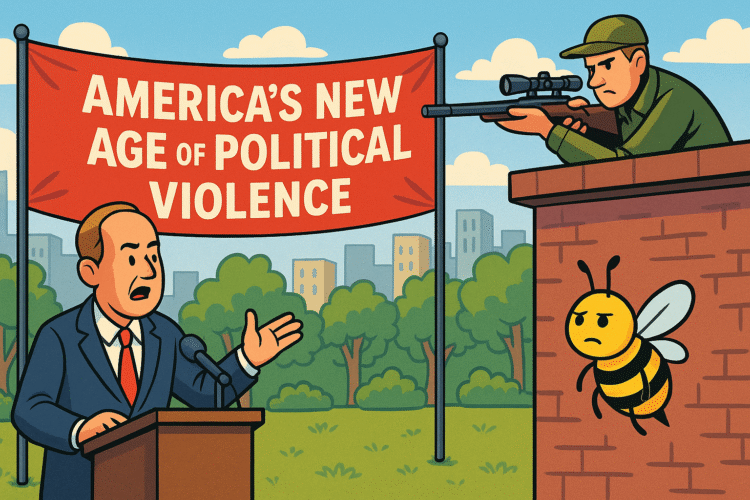
The Washington Post says we’ve entered “a new age of political violence.” How quaint of them to suggest there was ever an old age that ended. The difference, perhaps, is that now we livestream it, brand it with hashtags, and serve it to audiences like a Netflix series that never gets canceled. The latest episode came on September 10, when Charlie Kirk, the 31-year-old founder of Turning Point USA, was assassinated mid-event at Utah Valley University—one rifle shot from a rooftop cutting through the noise of speeches, applause, and culture-war theater.
By the following morning, the Post’s headline put words to what most of us have been pretending not to notice: the temperature is boiling, the rhetoric is toxic, and the violence is no longer exceptional—it’s expected.
The Scene
Investigators say the shooter remains at large. They found a high-powered bolt-action rifle, a weapon chosen not for chaos but for precision. Authorities released rooftop video and photos of a person of interest. The FBI dangled a $100,000 reward, an incentive large enough to make even your nosy neighbor with binoculars start scrolling through their camera roll.
The statements from law enforcement, predictably, contradicted each other. First they had a suspect, then they didn’t. First there was clarity, then there wasn’t. The one certainty is that Kirk is dead, and the ripples are already reshaping the landscape.
The Bipartisan Alarm
The reaction across the aisle was swift and predictable. Republicans thundered that conservative voices are under attack, Democrats warned that all political violence is unacceptable, and both sides issued statements about unity while quietly drafting new fundraising emails. The unity lasted precisely as long as it took for the first think piece to blame “the other side.”
Bipartisan alarm is not the same thing as bipartisan action. Alarm is easy—it’s cheap, performative, and comes with a ready-made press release. Action would require asking: who benefits from the temperature rising? Who profits from outrage, clicks, fear, and division? That conversation is harder, which is why no one has it.
The Experts We Keep Ignoring
Robert Pape, the political violence scholar, says escalating rhetoric is fueling measurable increases in attacks and attempts. William Braniff, who studies extremism, says the same. They warn that unless leaders cool the temperature, we’ll see more incidents like this. These men are Cassandra with tenure: doomed to keep predicting disaster while the city ignores them.
The warnings are as repetitive as they are ignored. Violence, they argue, is not random; it’s cultivated. It grows in the soil of dehumanizing rhetoric, fertilized by media amplification, watered by social media algorithms, and harvested by unstable individuals looking for a stage. It’s not lone wolves—it’s wolf packs radicalized by the culture of endless war, political and otherwise.
The Irony of Rhetoric
Dehumanizing rhetoric works because it feels good. It’s easier to say your opponent is a traitor, a fascist, a terrorist, or a pedophile than it is to argue policy. It feels righteous to scream “enemy of America” into a microphone, easier to chant than to compromise. The irony is that both sides claim they’re defending democracy while using language that makes democracy impossible.
When you strip opponents of humanity, you strip them of safety. And someone out there is always listening. Someone always takes the rhetoric literally. That’s the absurdity: political leaders stoke flames for attention, then act shocked when someone else decides to play firefighter with a rifle.
The Digital Amplifier
Social media is gasoline on this fire. The algorithms reward rage, outrage, conflict, and fear. A call for nuance sinks into the void, while a dehumanizing meme hits a million shares by lunch. Politicians play to this system because it works; media plays to it because it pays. Everyone profits—except the people in the crosshairs.
Charlie Kirk built his brand on exactly this ecosystem, wielding outrage as both shield and sword. That doesn’t make his assassination justified; it makes it tragically predictable. When outrage is the lingua franca, violence becomes inevitable punctuation.
America’s Self-Inflicted Satire
The satire here is structural: America treats rhetoric like entertainment and violence like an unfortunate twist in the plot. We are so addicted to the adrenaline rush of political combat that we can’t imagine cooling down. Our leaders are performers, our citizens are audience members, and our institutions are stagehands tasked with sweeping up the blood between acts.
The FBI can offer $100,000 rewards, but they can’t stop the show from running. Investigators can collect rifles and rooftop footage, but they can’t disrupt the culture that produced the shooter. Politicians can condemn the violence while tweeting new insults at their rivals before the body is cold.
The Unity That Never Lasts
After tragedies, unity is always promised and rarely delivered. After 9/11, we had weeks of solidarity before it dissolved into war profiteering and surveillance. After mass shootings, we have days of bipartisan sorrow before it collapses into gridlock. After Kirk’s assassination, we had hours of unity before social media timelines turned the death into partisan football.
The lesson we refuse to learn is that unity isn’t a reflex—it’s a discipline. It requires choosing not to exploit tragedy for gain, not to feed the outrage machine, not to weaponize grief. And we are terrible at discipline.
What the Rifle Represents
The recovered bolt-action rifle is more than evidence—it’s metaphor. It represents precision violence born of imprecise rhetoric. It represents the leap from words to bullets, the thin line between hyperbole and homicide. It represents the absurdity of a culture where individuals are radicalized not by manifestos but by memes.
That rifle on the rooftop is the endpoint of every careless word shouted into a microphone, every conspiracy theory amplified, every insult dehumanizing an opponent. And there are always more rifles.
The Experts Are Right (And That’s the Problem)
Pape and Braniff warn of escalation, but their warnings are dismissed as academic fretting. Leaders insist it’s just rhetoric, just words, just politics. But words shape reality, and politics is not theater when people bleed. We dismiss the experts until we need their sound bites, then ignore them again.
The real problem is that they’re right. Violence will escalate. More attempts will come. The temperature will not cool, because cooling requires accountability, and accountability is bad for ratings.
The Age of Violence Is the Age of Us
The Post calls it a new age of political violence, but it’s not new—it’s just evolved. Violence has always shadowed politics; the difference now is the scale of amplification. Every assassination, every attack, every attempt is fed into a machine that monetizes tragedy. We are all complicit, scrolling, clicking, sharing, arguing.
The shooter is at large, but the real culprits are not hiding. They’re in our feeds, our headlines, our microphones. They are us, if we’re honest, because we are the audience that keeps paying for the show.
Summary of a Rifle and a Microphone
Charlie Kirk’s assassination is not an isolated act but a symptom of a culture that thrives on dehumanization, outrage, and fear. Authorities found a rifle, a rooftop, and a person of interest, but the real weapon was rhetoric, amplified by social media and rewarded by politics. Experts warn violence will escalate unless leaders cool the temperature, but leaders won’t—because outrage is profitable, fear is addictive, and unity is boring. America didn’t just enter an age of political violence on September 10. We chose it long ago, and we continue to rehearse it every day, one careless word at a time.