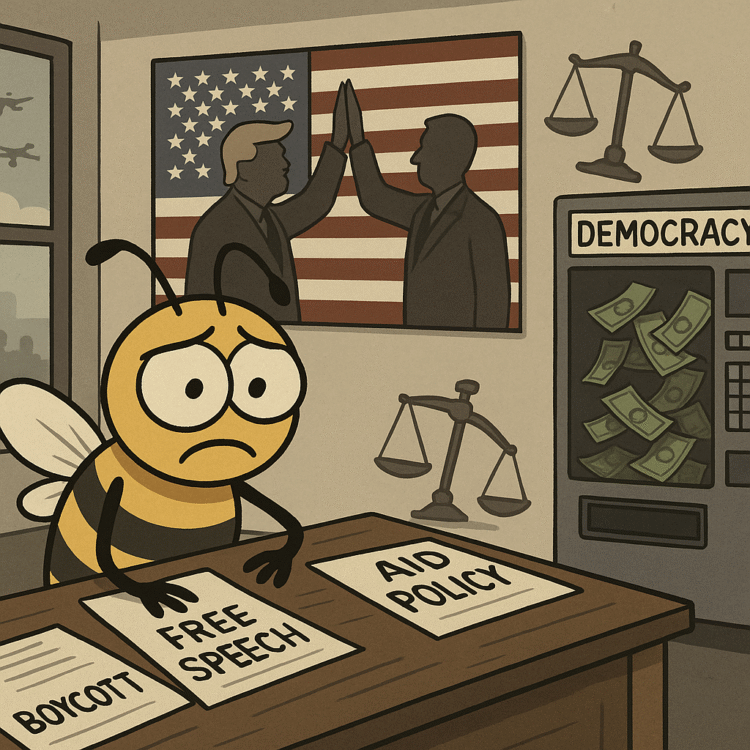
Somewhere between the overturned classified documents and the overturned convictions, the Trump administration (yes, that one again) decided to quietly reverse a decades-old policy that withheld federal aid from states that penalized individuals or companies for not participating in Israel boycotts.
Don’t worry if you missed it—most people were too busy photoshopping mugshots onto T-shirts or debating whether a gold-plated Bible counts as campaign merch. But while you were rage-scrolling, the administration decided that punishing Americans for not supporting a foreign government was suddenly unpatriotic. Because nothing says “freedom” quite like mandatory economic loyalty to a nation you don’t live in.
To be clear: this wasn’t about diplomacy. This was about vibes.
And the vibe? Corporate fealty, with a side of performative nationalism.
For those unfamiliar with the plot twist, here’s the recap:
There’s a long and winding history of Americans, particularly on the left, supporting the right to boycott foreign governments—especially when those governments are doing things like displacing entire populations or conducting military campaigns with all the subtlety of a Michael Bay film. The Boycott, Divestment, and Sanctions (BDS) movement—formed to protest Israel’s policies toward Palestinians—has been controversial for years. So controversial, in fact, that nearly three dozen U.S. states passed laws saying: if you boycott Israel, we might boycott you.
In other words, a boycott of a boycott.
Which feels like the political version of two Karens trying to out-review each other on Yelp.
But then, under Trump 2.0: The Sequel No One Asked For, the federal government reversed course. No more punishing states for punishing citizens. The federal aid can keep flowing like unregulated oil through the Permian Basin, even if that state has decided to financially ghost anyone who opts out of Israeli investment.
Because apparently, the First Amendment is just a suggestion now.
Like turn signals.
Or ethics.
Now, let’s be clear. This isn’t really about Israel. Not only. It’s about the U.S. government turning civil disobedience into a customer service complaint. About reducing international human rights debates to a checkbox on a loyalty card.
Did you march in protest?
Swipe left.
Did you divest from a tech company that supplies surveillance gear in occupied territories?
No soup for you.
Did you quietly decide you didn’t want your retirement account funding drone parts?
Enjoy watching your tax dollars hand-deliver the same drone parts anyway.
The irony is almost too rich.
This is the same administration that screams about cancel culture every time a billionaire is asked a question that makes them sweat.
But when a private citizen makes an economic choice about how they spend their own money?
Suddenly it’s “economic sabotage.”
Boycotts, it turns out, are only noble when they’re aimed at drag shows or books about race.
Not at multi-billion-dollar defense contracts.
And while we’re here—let’s talk about the word boycott.
It used to mean something.
Gandhi did it.
Rosa Parks did it.
Jesus flipped a table and called it a day.
Now, it’s a Homeland Security talking point.
A risk factor.
An economic red flag that gets you flagged as “potentially anti-American,” even if your idea of rebellion is just buying hummus from a different brand.
But this isn’t just about policy. It’s about precedent.
Because once the government gets comfy deciding what ideologies you’re allowed to not financially support, the floodgates don’t open—they’re installed.
Today it’s Israel. Tomorrow it’s Halliburton.
Next week, maybe it’s whatever company makes those weirdly aggressive thin blue line flags for lifted pickup trucks.
Of course, none of this is being debated in public.
There was no national town hall. No major press conference. Just a quiet policy reversal tucked into a press release, like a backhanded compliment at a funeral.
Because the goal isn’t clarity—it’s plausible deniability.
And if you’re not paying attention, you might miss the fact that your freedom to protest just got rerouted through a corporate credit check.
The Trump administration’s logic, as usual, isn’t logic at all—it’s performance.
Support for Israel isn’t about diplomacy. It’s about loyalty signaling.
It’s about looking “tough” in the Middle East while selling T-shirts that say “Moses Was MAGA.”
It’s about painting any critique as a threat.
And then pretending the Constitution said “free speech, but only if it doesn’t make a donor uncomfortable.”
Final Thought:
The right to boycott is older than this administration. Older than the Evangelical lobby. Older, even, than the idea that democracy should survive mass marketing.
When the state tells you who you can oppose—with your voice, your money, or your silence—it’s not protecting freedom. It’s branding it.
And if you’re not careful, you’ll wake up with a government-issued loyalty punch card and no idea how many stamps it takes to cash out your rights.