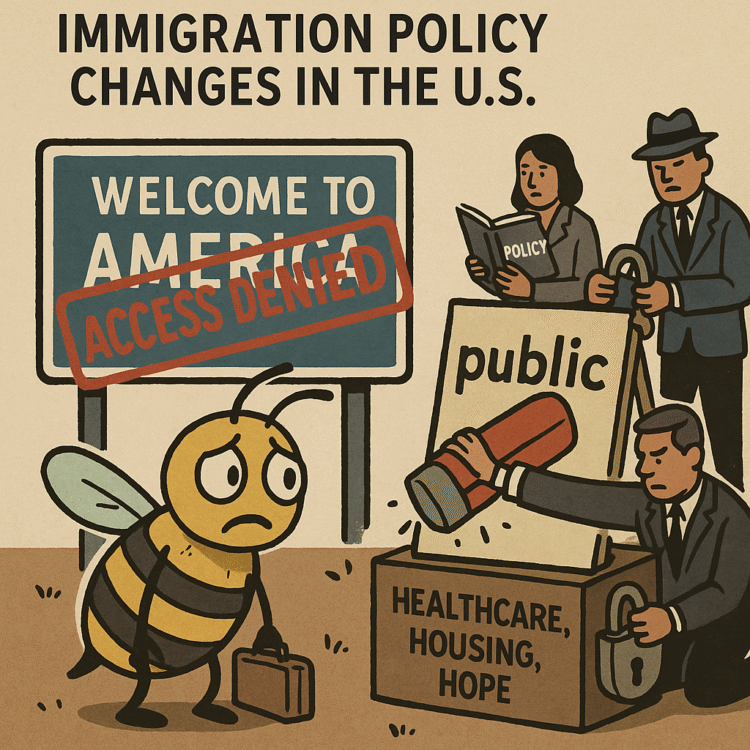
This week, the U.S. government took a long, squinting look at the phrase “public benefits” and said, “What if… we didn’t?”
In a move so bureaucratically cruel it could’ve been dreamed up by a focus group trapped in a DMV at gunpoint, the Department of Health and Human Services (HHS) has officially expanded the definition of “federal public benefits”—which, in practice, means contracting who gets them. Because nothing screams American efficiency like making “benefit” a theoretical concept and “public” a gated community.
The new rule quietly ensures that many lawfully present immigrants—and certainly most undocumented ones—will now find themselves ineligible for basic services like Medicaid, CHIP, food assistance, and other programs that used to be considered, you know, “moral obligations.” Now they’re “budgetary liabilities,” or in Washington dialect: security threats with paperwork.
Let’s translate that into plain language:
America has officially updated its immigration welcome mat from “Give us your tired, your poor…” to “We hope you brought a lunch, some gauze, and your own oxygen.”
What Even Is a Public Benefit Anymore?
According to HHS, a “public benefit” now includes:
- Healthcare programs
- Food support
- Housing aid
- Any shred of empathy that isn’t monetizable by Q4
But only if you’re not from “the wrong part of the world,” didn’t arrive “the wrong way,” or aren’t currently “married to an eligible voter in a swing state.”
Gone are the days when “lawfully present” meant you could access basic care. Now it means, “Congratulations on surviving the asylum maze. Here’s your consolation prize: a pamphlet, a cold stare, and directions to the nearest emergency room that won’t treat you.”
But Why, Though?
According to officials, the policy is “intended to safeguard taxpayer dollars and ensure resources go to those fully eligible.”
Translation: we’re saving money by letting people suffer quietly.
It’s austerity chic—with a xenophobic twist.
One HHS spokesperson explained the change with the dead-eyed sincerity of a bureaucrat slowly detaching from their soul:
“This clarification helps streamline service delivery and prevents improper access to federal funds.”
Right. Like when you streamline a dinner party by uninviting half your guests mid-appetizer and bolting the door. Very efficient.
Who’s Affected?
Oh, just a few million people.
- Undocumented immigrants: Now officially recognized as both “essential workers” and “expendable liabilities,” depending on whether it’s an election year.
- Lawfully present immigrants: Because even when you do it “the right way,” the goalposts move like they’re trying to cross the border themselves.
- Children: Particularly heartbreaking, since CHIP—designed to provide healthcare for kids—is now more exclusive than a Malibu preschool.
What Happens Next?
The answer, of course, is: absolutely nothing useful.
Immigration advocates will file lawsuits. Republican governors will write tweets in all caps. Moderate Democrats will say, “This is deeply concerning,” before voting to fund a new border fence made of drone-mounted iPads.
And meanwhile, the immigrants this rule targets will keep working in restaurants, hospitals, fields, and care homes—silently propping up the economy of a country that just told them:
“Sorry, we’re full. Please try not to cough.”
Final Thoughts from the Immigration Department’s Vibe Committee
To celebrate this humanitarian regression, we recommend replacing Ellis Island’s iconic plaque with something more honest. Perhaps:
“We were founded by immigrants. We just didn’t think you’d be next.”
Because if 2025 has taught us anything, it’s that in America, public benefits are only public if you’re lucky enough to be pre-approved for empathy.