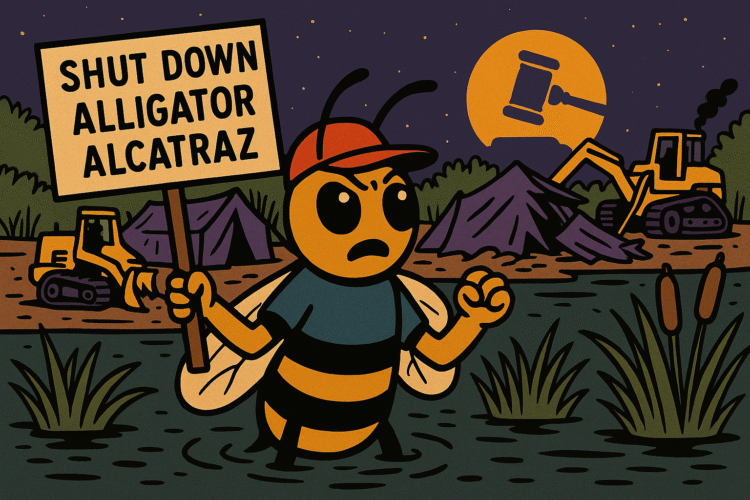
America has a long history of building things fast and regretting them faster. The Hindenburg. The Edsel. Every single Trump casino. Add to that ignominious list “Alligator Alcatraz,” the Everglades detention camp that sprouted this summer like a fungal growth on the swamp’s edge—hastily erected in eight days and now ordered dismantled in sixty.
On August 21, 2025, U.S. District Judge Kathleen Williams dropped an 82-page judicial anvil on the Trump administration’s swamp experiment, ruling that the tent city at Dade-Collier Training and Transition Airport violated both the ecosystem’s fragile balance and the spirit of decades of bipartisan promises to actually protect the Everglades. Translation: you cannot bulldoze endangered marshland, pitch some tents, and call it border security. At least, not without someone in a robe saying no.
The order gives ICE and Florida sixty days to tear down the camp—no new detainees, no expansion, and a mandatory clean-up of fences, generators, and whatever else is now sinking into the muck. For environmentalists and Native tribes, it’s a landmark win. For Florida’s Department of Emergency Management, which operated the site, it’s another chance to file an appeal and insist that wetland destruction is patriotic. For the detainees—hundreds of whom had no criminal records—it’s liberation by court order. For the rest of us, it’s a reminder that nothing embodies American immigration policy quite like a collapsing tent city in a swamp.
Part I: Jail by Speedrun
“Alligator Alcatraz” was the detention equivalent of an eight-day home makeover show. Bulldozers flattened marshland, fences sprouted overnight, and within a week the site was “housing” (read: corralling) up to 1,400 migrants. The official story was speed, efficiency, and toughness. The unofficial reality: raw sewage, diesel fumes, alligators reclaiming perimeter ditches, and a mosquito population so fierce it should qualify for its own congressional seat.
It’s one thing to build a shed in your backyard in eight days. It’s another to build a prison camp. But then, Trump’s White House has always approached governance like an HGTV challenge: Can you deregulate, detain, and destroy an ecosystem all before the commercial break?
Part II: The Bureaucracy of Cruelty
Florida operated the camp “on behalf of ICE,” because what’s federalism if not a game of hot potato with human lives? The facility held about 700 detainees recently, many of them with no criminal record whatsoever. People who crossed borders in desperation found themselves penned inside a swamp, listening to alligators slap the water at night.
DHS insisted it was “temporary.” Which is how America defines all of its cruelties. Temporary family separations. Temporary cages. Temporary bans. Temporary status for migrants that expires only when a federal judge remembers the Constitution exists. “Temporary” is the fig leaf. The reality is indefinite limbo until courts intervene.
Part III: The Judge Reads the Room
Judge Williams didn’t just issue a restraining order. She wrote an 82-page sermon about environmental devastation and human dignity. Her opinion noted that the camp caused “severe, irreparable damage” to the Everglades, undoing decades of bipartisan restoration work. Remember, Democrats and Republicans had actually managed to agree on one thing: don’t pave paradise. And yet, in 2025, here we were, paving paradise and filling it with barbed wire.
The ruling also emphasized due process violations: you cannot stick people in tents with no access to counsel, no clear hearings, and no timeline for release. Unless, of course, you want your detention policy to collapse in court. Which apparently, Florida and Trump did.
Part IV: The Environmental Plot Twist
Environmentalists call it a “landmark victory.” Friends of the Everglades practically threw a swamp party. For once, the courts remembered that humans and ecosystems are linked—that you can’t poison one without poisoning the other. The alligators, of course, remain neutral. They’ve always been nonpartisan, preferring snacks over politics.
But the irony is inescapable. The Everglades has survived drainage schemes, sugar barons, oil exploration, and every “reclamation” plan since Teddy Roosevelt. What finally pushed a federal judge to act wasn’t just environmental loss—it was environmental loss tethered to human suffering. Migrants plus marshes equals leverage. The swamp itself had to sue for recognition.
Part V: Florida’s Next Trick
Florida, led by Ron DeSantis, is appealing, because of course it is. Losing in court isn’t failure—it’s strategy. Every appeal buys time. Every delay means more headlines about “fighting the woke swamp lobby.” And just in case “Alligator Alcatraz” doesn’t survive, DeSantis has already proposed building a second immigration jail at a disused prison near Gainesville. Why ruin one ecosystem when you can ruin two?
This is Florida governance in 2025: move fast, break wetlands, blame the judge, and promise voters an even bigger cage next time.
Part VI: Tent Cities as American Tradition
“Alligator Alcatraz” is not an aberration. Tent cities are the American improvisation of choice whenever cruelty needs a pop-up venue. Hurricane survivors? Tent city. Migrants? Tent city. Protesters? Tent city. The flimsy walls are part of the message: you don’t deserve permanence. You deserve plastic roofs that collapse in a thunderstorm and cots lined like luggage in a warehouse.
We build tent cities not because we lack resources, but because they visually telegraph precarity. They say: you’re disposable. You’re temporary. You’re here until we can find a better excuse.
Part VII: Bureaucracy of Mercy
Judge Williams gave the administration sixty days to dismantle the camp. Sixty days, after erecting it in eight. That’s the bureaucracy of mercy: cruelty is fast, justice is glacial. You can build a prison in a week but need two months to take it apart, because restoration always requires more paperwork than destruction.
This is the American ratio: one week to harm, eight weeks to undo, decades to repair.
Part VIII: Migrants as Background Characters
Lost in the headlines are the detainees themselves. Hundreds of people shuffled through the swamp in July and August, many of whom have U.S. citizen relatives, asylum claims, or simply the bad luck of existing in an era where desperation is a crime. They became background characters in a drama about wetlands, governors, and federal judges.
When historians look back, they’ll write about the “landmark victory” for the Everglades. The humans inside will remain footnotes, like ghosts haunting an environmental law textbook. That’s the deepest tragedy: we only stopped the cruelty because the swamp itself cried foul.
Part IX: America’s Addiction to Optics
The Trump administration built “Alligator Alcatraz” for optics. Tents in a swamp scream toughness, deterrence, and frontier grit. It’s politics by set design: the visuals matter more than the legality. Never mind the Everglades ecosystem collapsing under diesel runoff; never mind the due process violations. The swamp looked mean on camera, and that was the point.
The shutdown, too, is optics. Environmental groups claim victory. Native tribes claim recognition. Judges claim integrity. Everyone gets a headline. Meanwhile, 700 people wait in limbo, transferred like packages from one cage to another. The cruelty continues—just with better PR.
Part X: The Sting in the Tail
So what do we call this? A win? A delay? A reminder that American justice occasionally takes a stand between barbed wire and wetlands? Maybe. But it’s also proof that our system treats human dignity as negotiable, ecosystems as bargaining chips, and cruelty as an administrative default.
“Alligator Alcatraz” was never about immigration. It was about showing voters the government could make a swamp meaner. That’s the joke. That’s the tragedy. That’s the brand.
And when it falls apart, as it now has, the response isn’t: stop building cruelty. It’s: build it somewhere else.
Final Observation
Every empire has its monuments. Rome had the Colosseum. France had the Bastille. America has “Alligator Alcatraz”—a tent city in a swamp, shuttered not because it was cruel, but because it was inconvenient.
That’s the lesson here. In 2025, cruelty collapses not when it’s recognized as wrong, but when it violates the zoning code.