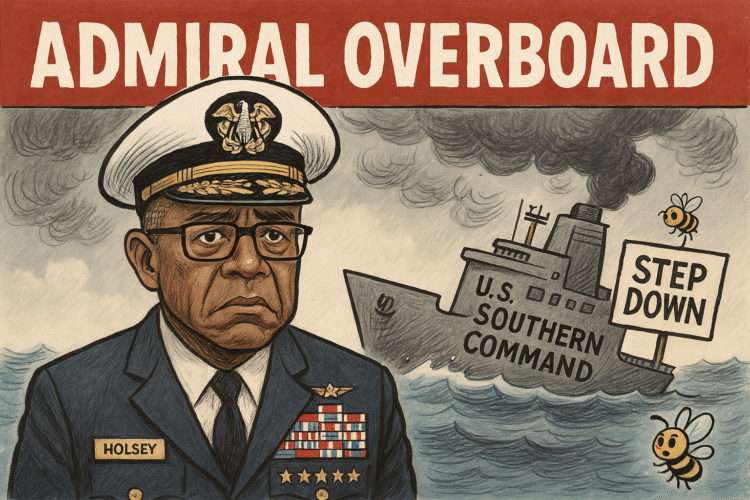
Admiral Alvin Holsey’s early retirement announcement landed with the subtlety of a depth charge. The commander of U.S. Southern Command—one of the most experienced and respected flag officers in the Navy—is stepping down two years early, just as the Caribbean simmers with covert operations, disputed maritime strikes, and the growing sense that the United States is about to stumble into a war it hasn’t even bothered to name. The Pentagon calls this “continuity of command.” Most reasonable observers would call it a warning.
Defense Secretary Pete Hegseth, a man whose résumé reads like a Facebook comment thread given flesh, assured the press that everything is fine. The administration, he explained, has “a strong bench.” But benches are where you put people who aren’t allowed to play, and if this administration’s first-term military theater taught us anything, it’s that Hegseth views the armed forces as a set piece for personal branding. He is the first defense secretary in modern history to treat a global combatant command as an unruly production meeting. Admiral Holsey, it seems, refused to hit his marks.
Holsey is no snowflake. He’s a career sailor, one of the few Black four-stars in U.S. history, and by every account a steady hand in a storm. But there’s only so long a professional can endure being micromanaged by a man who confuses “rules of engagement” with “content strategy.” Friction reportedly began over how to describe ongoing maritime strikes against “targets of opportunity” in the Caribbean—strikes that have produced fatalities and diplomatic panic in equal measure. Holsey wanted precision and accountability. Hegseth wanted headlines and swagger.
In classic Trump-era fashion, the chain of command has become a feedback loop: the White House issues slogans, the Pentagon translates them into PowerPoint, and the CIA quietly does whatever it wants in the shadows. The result is a geopolitical clown car—except this one’s armed and floating through international waters.
The administration’s justification for expanding operations southward is familiar: “counterterrorism,” “narcotics interdiction,” and “regional stability.” But the pattern is unmistakable. Each new “defensive posture” brings additional ships, new authorizations, and fewer legal guardrails. Reuters reports that the White House has now granted the CIA covert authorities inside Venezuela, a move that blurs the already threadbare line between intelligence support and paramilitary engagement. The Maduro government has responded with threats to take the issue to the UN. That, of course, will do nothing except give the State Department another reason to release a statement insisting that nothing we’re doing counts as an invasion.
Meanwhile, foreign ministries across the hemisphere are reading between the lines. From Port of Spain to Bogotá, officials are wondering whether the U.S. has quietly shifted from counternarcotics to undeclared conflict. The evidence is hard to ignore: troop rotations under “training missions,” expanded surveillance flights, and aid deliveries that come with more hardware than medicine. You can call it deterrence if you like, but to the countries living under those drones, it looks like preparation.
Holsey’s resignation lands right in the middle of this mess. The official story—“personal reasons”—insults everyone’s intelligence. This is not a man leaving to spend more time with his family; this is a man leaving before the subpoena arrives. When a four-star bails mid-tour, it’s not for the golf. It’s because the mission and the leadership have diverged beyond repair.
The timing couldn’t be worse. Congress is already at war with itself, the government is lurching through another shutdown, and the Pentagon press corps is on strike over new “authorized information” rules that would make Pravda blush. Reporters have literally surrendered their badges rather than sign nondisclosure agreements to attend briefings. This is the defense department of a reality show president—a place where “classified” means “inconvenient,” and “transparency” means whatever fits in a 90-second clip.
Senator Jack Reed called the shake-up “destabilizing.” That’s putting it mildly. The Southern Command is not a ceremonial job; it’s the nerve center for operations spanning 30 nations, multiple intelligence agencies, and several active crises. Removing its commander midstream while expanding kinetic activity in contested waters is the geopolitical equivalent of taking the pilot out of the cockpit mid-flight because the copilot wants to try karaoke.
It’s also a reminder that professionalism has become the enemy of this administration. Every adult who refuses to play along with the fantasy gets replaced by someone who will. First came the scientists, then the diplomats, then the prosecutors. Now, it’s the admirals. The lesson is simple: loyalty beats competence, and obedience outranks integrity.
Holsey’s departure highlights something deeper than bureaucratic dysfunction—it exposes the moral corrosion that happens when politics colonizes every institution. The Trump-Hegseth Pentagon operates on an emotional algorithm: outrage generates attention, attention justifies power, and power is its own defense. In that logic, Holsey’s insistence on measured engagement and clear legal authority wasn’t prudence; it was weakness. The same reflex that leads Trump to praise strongmen—Orbán, Erdoğan, even Maduro himself when it’s convenient—demands that his generals perform strength, not strategy.
The parallels with history are uncomfortable. When President Truman fired Douglas MacArthur, it was because the general tried to wage his own foreign policy. Today’s firings happen for the opposite reason—because the generals won’t. The civilian leadership is not restraining military adventurism; it’s demanding more of it, faster, louder, and with fewer questions. We’re not at risk of military overreach. We’re at risk of military obedience.
The vacuum left by Holsey’s exit will be filled quickly, but not wisely. Whoever replaces him will either be a compliant loyalist or an unknown chosen precisely for their lack of profile. Either way, the message will be clear: dissent quietly, or you’ll be next. The only thing worse than losing a war is fighting one under people who think it’s a branding exercise.
As for the operations themselves, they now drift into even murkier territory. The Pentagon insists the strikes are lawful. The White House insists they’re working. But neither can say what success looks like, or how long “temporary measures” can last without congressional authorization. If the plan is deterrence, it’s failing—Venezuelan patrol boats are shadowing U.S. ships, regional partners are pulling back cooperation, and local civilians are dying in “collateral incidents” that the administration won’t confirm or deny.
Even inside the ranks, frustration is boiling over. Officers complain anonymously about chaotic orders, unclear objectives, and daily revisions that come directly from political staffers. “We’re flying by tweet,” one officer reportedly said, which would be funny if it weren’t so close to literal truth. The president’s social media feed has become a parallel command structure, where tone dictates tempo.
The broader concern isn’t just operational chaos—it’s accountability collapse. Each new initiative arrives wrapped in patriotic language but tied to fewer legal strings. Oversight mechanisms have been bypassed or neutered. Congress can’t subpoena classified briefings that no longer exist. Inspectors general are muzzled or missing. What used to be a constitutional architecture has become a set of stage props, still standing but hollow inside.
And then there’s the optics. A Black four-star general resigns over ethics and legality while an all-white political team expands clandestine operations under cover of “national strength.” It’s a tableau as symbolic as it is cynical. The administration will spin it as another “deep state” figure exposed, another bureaucrat too weak for “real America’s toughness.” But the truth is uglier: this White House cannot coexist with competence. It treats experience as treachery, restraint as betrayal.
Abroad, allies are alarmed. Latin American governments that spent decades rebuilding trust after U.S. interventions now face the prospect of another shadow conflict with fewer rules and more hashtags. Even conservative leaders in Colombia and Brazil have issued veiled warnings about “destabilizing behavior.” Meanwhile, the State Department, once the voice of caution, has been reduced to issuing auto-generated statements that could double as disclaimers for an energy drink commercial.
Holsey’s exit doesn’t just weaken the command—it signals to every other officer watching that the only safe move is silence. The Pentagon’s message discipline is legendary, but this goes beyond loyalty; it’s existential. If you speak out about policy missteps, you risk your career. If you stay quiet, you risk complicity. The moral geometry of service has collapsed into a binary: obey, or disappear.
Senator Reed’s call for hearings will go nowhere. The Judiciary Committee is paralyzed by shutdown politics. The Armed Services Committee is too busy fighting over procedural trivia to demand real answers. By the time anyone schedules a hearing, the next crisis will have swallowed this one whole. The administration understands this rhythm perfectly. Scandal fatigue isn’t a bug—it’s the system.
The only question left is what comes after. Will Holsey’s successor steer toward de-escalation, or double down on adventurism? Will Congress claw back authority, or let executive momentum turn covert operations into open-ended occupations? And will anyone remember, six months from now, that the man who tried to hold the line walked away before the line vanished altogether?
Because this isn’t just about one admiral’s resignation. It’s about the corrosion of professional governance under a regime that confuses loyalty with leadership. It’s about how institutions crumble—not through coups, but through exhaustion. Every headline about “friction” and “early retirement” is a euphemism for something much simpler: the good people are leaving, and the reckless ones are staying.
When future historians trace the origins of whatever disaster unfolds next in the Caribbean, they’ll find this moment. A steady, capable commander refused to play soldier in someone else’s propaganda film and stepped off the set. What comes next will be more chaotic, less lawful, and infinitely more dangerous.
The lights at Southern Command will stay on. The operations will continue. The press releases will promise “resolve.” But anyone who’s ever served knows what this means. When the admiral goes overboard, it’s not because he couldn’t handle the storm. It’s because the ship is steering straight into it.