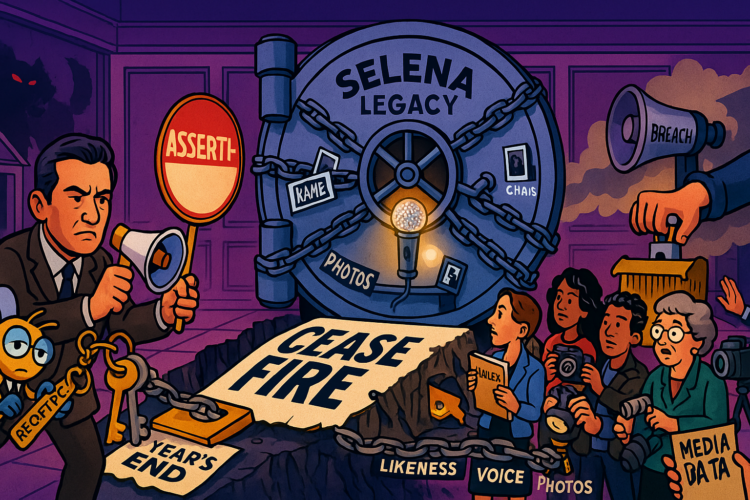
Abraham Isaac Quintanilla Jr. was the architect, the gatekeeper, the father, the manager, and the human perimeter fence around Selena’s life, and now that he’s gone, the argument over protection versus possession will keep pacing the room.
Abraham Isaac Quintanilla Jr., Selena Quintanilla-Pérez’s father, longtime manager, and the engine behind Selena y Los Dinos, died at 86. If you grew up with Selena in your bones, or if you came to her later through the movie, the music, the series, the shirts, the candles, the TikToks, the constant cultural afterglow, then you already know his silhouette. He was not the star. He was the person who decided who got close enough to see the star without squinting. He was the force that turned a family band into a machine, and later turned grief into a guarded empire.
This is not a simple obituary. Nothing about Abraham Quintanilla was simple, because he lived in the most American contradiction there is: love expressed as control. He believed the world would chew up his daughter, and so he positioned himself as the first set of teeth. To his supporters, that is devotion. To his critics, that is domination. To anyone paying attention, it is both.
Selena’s story is always told in bright colors, big hair, rhinestones, and that impossible warmth she had on stage, the warmth that made whole crowds feel personally chosen. Abraham’s story is told in schedules, contracts, doors closed in faces, and a reputation for being stern enough that people in the industry learned to flinch politely. The coverage calls him the architect and gatekeeper, and that pairing is accurate. He built the ladder, then he guarded the rungs like they were classified documents.
The Family Band Grind and the Religion of Work
Long before Selena became Selena, Abraham was turning his kids into a working band. Selena y Los Dinos wasn’t born in a studio. It was built in restaurants, VFW halls, fairs, and the Tejano circuit, in the places where you don’t get discovered, you get tough. The grind was relentless because Abraham’s worldview was relentless. Talent was not enough. Love was not enough. Luck was not enough. You had to outwork the industry, outlast it, outmaneuver it, and never let it catch you unprotected.
This is where the stage-parent paradox begins. The same discipline that gave Selena a professional spine also took her childhood and put it in a suitcase labeled “later.” Families like this tell themselves it’s temporary. Just until the next gig. Just until the next record. Just until we break through. The problem is that “just until” is the kind of phrase that eats years like popcorn.
Abraham was pulling the levers. Rehearsals. Bookings. Travel. Branding. Selena’s image wasn’t just a byproduct of her talent. It was managed, curated, defended. Because in Abraham’s mind, he did not simply have a talented daughter. He had a once-in-a-generation asset, and the music business would chew her up if he didn’t bite first.
That sentence is cold. It is also the exact logic of survival in an industry that has eaten bright young artists for decades and called it a “lesson.” Abraham saw that machine and decided his family would not be fed into it without a fight.
But survival logic has a cost. When you frame your child as something that must be protected from the world, the temptation is to treat the world as permanent threat. The threat becomes the organizing principle. Everyone becomes suspect. Every invitation becomes a trap. Every relationship becomes a risk. The gate stays locked, and eventually you forget what it feels like to have the gate open.
Q Productions and the Vault Mindset
Abraham helped build Q Productions, and with it he built something more powerful than a record label. He built a fortress. Selena’s image was treated like a guarded vault. Access was controlled. Proximity was managed. Interviews were negotiated like treaties. If you wanted something from Selena’s world, you did not just ask Selena. You dealt with Abraham.
The coverage leans into his controlling reputation and the “Mr. Q” persona, the stern figure who decided who got access, who got interviews, who got proximity, and who got told to get lost. That kind of control creates two simultaneous realities. It can keep an artist safe from predators and opportunists. It can also suffocate, isolate, and breed resentment among collaborators, journalists, and industry people who feel they are being handled like potential thieves.
In the business of fame, everyone wants something. Abraham took that as proof that everyone should be treated like they are reaching for the cash register. Protectiveness becomes a way of thinking, then a way of living, then an identity. Once you become the gatekeeper, you can start to confuse the gate with the person behind it.
That’s the danger of loving someone by building walls. Eventually the walls become your legacy, and the person behind them becomes a symbol you manage, not a human you share.
Chris Pérez and the Love That Could Not Be Approved
The most famous personal conflict of Selena’s life is also the cleanest lens into Abraham’s worldview. His explosive opposition to her relationship with guitarist Chris Pérez was not just about a boyfriend. It was about control, image, and the terror that love would create a crack in the brand.
Selena and Chris had to date in secret, because in Abraham’s universe, intimacy was a threat to the machine. The conflict escalated into a firing and an elopement that forced him into eventual acceptance. That sequence alone tells you how intense the pressure was. Secret dating is not romantic when it’s driven by fear. It is a sign that the family system had no room for Selena to be an adult on her own terms.
Yet the story also contains the contradiction that made Abraham so complicated. He wasn’t opposing Chris simply because he wanted to be cruel. He was opposing him because he believed he was protecting Selena from the consequences of fame, from scandal, from distraction, from betrayal, from the narrative that could be spun around her. In his mind, he was defending his daughter’s future.
But when protection becomes absolute, it becomes possession. Selena’s love life became a management problem. Her heart became a PR risk. That is what the stage-parent paradox does. It turns normal human growth into a business threat.
Abraham did eventually accept Chris, but only after the elopement forced the issue. That’s the pattern. Control holds until reality breaks through the door.
After 1995: Grief as Public Stewardship, Control as Private Administration
Then came the murder. Selena’s 1995 killing by Yolanda Saldívar turned the family’s story into a national wound. It also turned Abraham into something else: the public steward of grief and the private administrator of a fast-growing commercial empire.
This is where the ethics get messy, because grief does not exist in a vacuum. Selena’s death created a tidal wave of attention, demand, and money. Posthumous releases, film and series projects, museum work, foundation work, licensing, and the ongoing management of her name and likeness all expanded. Abraham became the person who had to decide what happened next.
Supporters argue the family preserved Selena’s legacy and protected her from exploitation. Critics argue the family commodified her memory, made opaque choices, and controlled who got to tell her story. Abraham insisted the point was protection, not profit. The coverage highlights that tension and the accusations that followed, especially as licensing and projects continued to grow.
Here’s the truth no one likes. Both things can be true. You can protect someone’s legacy and monetize it. You can sincerely believe you are doing the right thing and still make choices that feel like ownership. Once there is money in the room, intentions become slippery. Everyone hears your decisions through the filter of incentives, because incentives are loud.
Fans want authenticity. Families want control. Studios want product. The public wants closure. Nobody gets exactly what they want, and the person with the legal rights gets blamed for all of it.
The 1995 Estate Agreement and the Lawsuit Years
The coverage also traces the later legal warfare, which is where Abraham’s gatekeeping moved from personality to paperwork. He used a 1995 estate agreement to assert exclusive rights over Selena’s name, likeness, voice, photographs, and story. That claim became the foundation for a long argument about who gets to speak for Selena.
In 2016, he sued Chris Pérez over plans tied to Pérez’s memoir and a proposed screen adaptation, and the dispute dragged through courts and public statements before being resolved years later. That conflict is not just about money. It’s about narrative ownership. It’s about whether the person who loved Selena gets to tell his version of the story, or whether the family’s control overrides the intimacy of lived experience.
To some, Abraham’s stance looks like necessary protection against opportunism. To others, it looks like a man continuing to police Selena’s life even after death, continuing to decide which stories are allowed to exist.
It’s hard to live with this truth, but it’s still true. When an artist becomes an icon, their story becomes contested property. Everyone who loved them feels entitled to speak. Everyone who profited from them feels entitled to manage. Fans feel entitled to access. The law chooses winners, and the winners are often the ones who were already closest to the gate.
That is not moral. It is procedural.
The Guilt and the Locks
One of the most emotionally raw contradictions highlighted in the coverage is that Abraham publicly owned the guilt of being the gatekeeper who “let the wolf into the chicken coop,” while still tightening the locks afterward. That is the kind of guilt that doesn’t heal. It metastasizes into control.
If you believe you failed to protect someone you loved, the natural instinct is to overcorrect. You build thicker walls. You guard harder. You monitor access like your life depends on it, because in your mind, the worst thing already happened and it happened on your watch. If you were already controlling before, grief does not soften you. It hardens you.
This is why Abraham’s legacy is inseparable from Selena’s rise and from the controversies that followed. He was the discipline that shaped her. He was the control that defined her public environment. He was the engine that built Selena y Los Dinos into something unstoppable. He was also the gatekeeper whose worldview made love into conflict and turned legacy into a contested vault.
Selena’s art lived in the open. Abraham’s love lived behind a locked door.
What People Will Argue About Now
Now that he has died, the arguments won’t stop. They will intensify, because death doesn’t settle a legacy when the legacy is still generating culture and money. People will argue about whether he saved Selena from exploitation or trapped her inside a machine. They will argue about whether his posthumous stewardship preserved her image or monetized her. They will argue about whether the lawsuits were protection or control. They will argue about who gets to tell Selena’s story next.
The left-leaning instinct here is not to treat Abraham like a cartoon villain or a saint. It’s to name the system that shaped him. The music industry is predatory. Fame is predatory. Capital is predatory. The American myth of stardom often requires a guardian who becomes a manager who becomes a gate. That doesn’t excuse control. It explains why control becomes tempting and why it becomes socially rewarded when it generates success.
But we still have to sit with the cost. Selena’s light was real, and it reached people because she was extraordinary. The machine that carried her also demanded obedience. The vault that protected her also limited her. Love and ownership tried to live in the same house, and they fought in the hallway.
Receipt Time Love, Control, and the Price of a Legacy
Abraham Isaac Quintanilla Jr. died at 86 after decades as Selena’s father, manager, and the driving architect behind Selena y Los Dinos, building her career through a relentless family-band grind and the creation of Q Productions while developing a controlling gatekeeper reputation that both protected Selena and generated resentment, shaping her most famous personal conflict through his explosive opposition to her relationship with Chris Pérez that led to secret dating, a firing, and an elopement before eventual acceptance, then intensifying after Selena’s 1995 murder by Yolanda Saldívar as he became the public steward of grief and the private administrator of a growing posthumous empire of releases, projects, museums, foundations, and licensing amid accusations of commodification that he answered as protection not profit, while asserting exclusive rights through a 1995 estate agreement and pursuing legal disputes including a 2016 lawsuit against Pérez over memoir-related plans that later resolved, leaving a legacy defined by the same contradiction he openly carried, guilt over letting the wolf into the chicken coop paired with tightening the locks afterward, making his story inseparable from Selena’s rise, her discipline, her love, and the ongoing fights over who owns her memory.