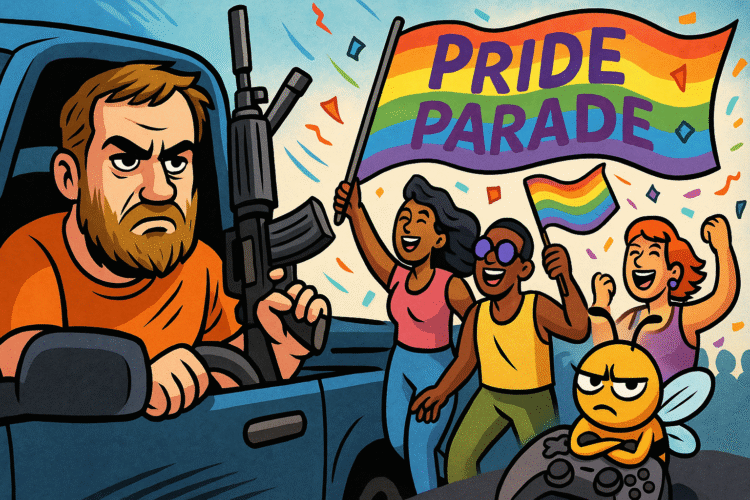
They say a threat is just a first draft of violence. Sometimes scribbled on social media, sometimes delivered with clicks and tags—but the message is the same: you are watched, you are vulnerable. In Abilene, Texas, one man apparently decided to turn that sentence into performance art, threatening LGBTQ+ parade participants only days before the event. The result: a federal arrest, a swirl of outrage, and the heavy question: when does speech cross into terror?
This is not about one unstable man. This is about the era we live in—a moment when threats are negotiated as strategy, and public events become tests of whether democracy still protects its weakest participants. Let’s walk through the timeline, the assertions, the public reaction, and what it might mean if we fail to draw a line between violent threat and protected speech.
The Timeline of Threats, Posts, and Arrest
It began quietly in the early hours before the parade. A man named Joshua Cole, 42, from Anson, Texas, allegedly posted to Facebook under an alias (something like “Jay Dubya”). On that platform, he typed words that would turn the local police into federal agents overnight:
“I say we lock and load and pay them back for taking out Charlie Kirk.”
“There’s only like 30 of them. We can send a clear message to the rest of them.”
“Come on bro, let’s go hunting fairies.”
Those messages weren’t vague. They were aimed, specific to participants of the local Pride parade, and delivered on the eve of the event. Authorities say these posts were made on September 18 (the day before the parade).
Local police were alerted. Federal agents joined the hunt. The next day, during a traffic stop, Cole was detained. In questioning, he admitted to operating the Facebook account, acknowledged owning a firearm, and conceded that his statements could be interpreted by a reasonable person as threats. He also claimed he had no intention of carrying out the violence—but that claim conflicted with the affidavit’s assessment: the threats were not conditional, they were targeted, and they were directed at a specific set of victims—those attending Pride.
The formal charge: a federal interstate threatening-communications offense. He faces possible years behind bars if convicted. A preliminary hearing placed him in custody pending further proceedings.
Throughout it all, Colleagues described Cole as a “hot head.” He had recently quit his job, stormed out of his workplace, and exhibited behavior that made his online declarations feel more than just untethered rage.
Local and National Reactions
Across Abilene and in LGBTQ+ circles, the atmosphere recoiled. The Abilene Pride Alliance went public quickly, emphasizing that safety was their top priority, that they had coordinated with law enforcement, and that the swift arrest underscored the seriousness of the threat. They urged community calm and solidarity, and committed to protecting the celebratory space of Pride.
City leaders, local police, and civic groups echoed the message: threats against marginalized communities are intolerable. The partnership among local, state, and federal agencies was praised; the response framed as a success of rapid coordination.
LGBTQ+ organizations, activists, and national civil-rights watchdogs used the opportunity to sound alarms—this was no isolated tantrum. It echoed a disturbing national pattern: when political violence becomes legitimized, rhetoric becomes arms dealer, and once-safe gatherings become war zones. They warned of chilling effects: who will show up at rallies, at pride, at schools, when the cost is a social-media post that might invite an armed response?
On the other side, certain conservative voices sought to relativize the threats. Some claimed it was “venting” or free speech. Some pointed at the murder of Charlie Kirk (a conservative activist who had recently been shot) as a triggering event, framing the response as “emotion turned dangerous.” But few defended Cole’s threat. The challenge was: if you allow coded violent rhetoric in the name of political reaction, where do you stop?
Legal scholars weighed in on how courts must draw fine lines: the difference between advocacy or criticism and true threat; the doctrine that law doesn’t punish ideas but protects against imminent violence. Some warned that if authorities under-prosecute, they signal impunity for ideologically motivated threats; if they overreach, they chill legitimate protest and political speech. It’s a tightrope in a minefield.
Speech, Threat, and the Triage of Violence
One of the essential questions this case raises: when is what you say dangerous enough to become a crime? Our free-speech tradition insists on wide buffer zones—political hyperbole, demeaning slurs, even calls for revolution are in the protected category—as long as they don’t cross over into targeted threats that a reasonable person would accept as credible.
In Cole’s case, his statements were specific, immediate, tied to a known event (the parade), and addressed to a particular group. The FBI affidavit describes that specificity plainly: not rhetorical bluster, but directed threat. That pushes it into the “true threat” domain, where speech loses immunity because it becomes a weapon.
The danger of refusing enforcement is too clear: if a threat of mass violence is reduced to hyperbole, public protest and minority gatherings become perpetual targets. Law enforcement triage cannot assume every post is violence, but it must reserve the authority to act when that post is built like a threat.
The other risk: overreach. If authorities see every angry post as a prosecutable offense, dissent and protest become criminalized. The balance must rest in recognizing that speech is powerful, but not every angry person is a mass shooter—and that threat must carry contextual weight, not be judged in isolation or by ideology.
Public Safety, Event Risk, and Symbolic Resonance
Pride parades, rallies, protests—these are public events meant to embody inclusion, joy, defiance. When the threat arrives, the meaning of attendance changes. Safety becomes strategy, presence becomes risk. The community sends money, raises volunteers, deploys security. They invite the police in—but the real defense is moral presence: sexual minorities declaring they belong in public space.
When someone threatens to “send them a clear message,” that message is: your bodies are not respected, your right to exist in public is conditional. When the law fails to respond, the message amplifies: the threats are tolerable, the targets are optional. The arrest of Cole was a vital affirmation—threats against vulnerable events must not be tolerated.
But the stakes go further. We are living in a moment when threats are not random. They are extension cords of national politics. When violence is rhetorically legitimized—when one shooting incites calls for countershooting—you enter cycles of escalation. The Charlie Kirk killing, the threats against Pride, the armies of social media all feed into a spiraling violence where every public gathering becomes vulnerable.
A Cry in the Public Square
Sometimes we ask: what is democracy? It is not just ballots, but the right to assemble, to march, to be seen without fear. When someone threatens that, the state has an obligation to respond not only legally, but symbolically: to enforce, to convict, to declare that certain boundaries remain inviolable.
If Cole’s threat had gone unchecked, it would have eroded the separation between violent ideology and everyday life. A man could type a threat, walk away, disappear into anonymity, and leave the parade vulnerable. That is not safety. That is consent by silence.
And so this moment is not simply about one man and one parade. It’s about whether the law still holds a boundary firm between hateful idea and executable violence. If that boundary collapses, we live in the permanent ambience of fear.
This is not just a threat — it’s a gauntlet thrown at public life. When communities gather, when parades march, when protestors speak, when minorities show up, they do so not because the threats have gone quiet but because light must exist where darkness intrudes. The law must respond with equal clarity: some speech is dangerous, some words demand accountability, and public safety is not optional.
If we lose that clarity, gatherings will shrink. Public life becomes enclaves. Protest retreats to whispered corners. And then the victory of threats is the silencing of society. That is the true cost.