The Pageant in Windsor
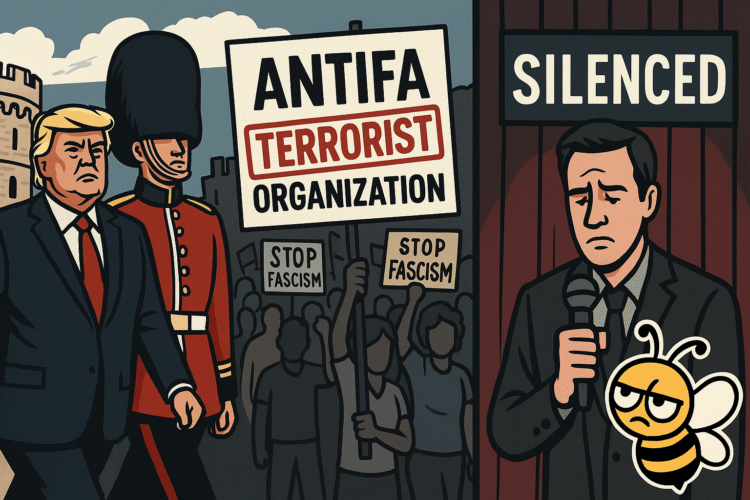
There’s no such thing as a small Trump visit. Not when the U.K. rolls out Windsor pomp for a man who treats Buckingham Palace like a casino floor. King Charles III, looking every bit the monarch who once had to weather tabloids about tampon fantasies, gamely escorted Donald Trump through ceremonial salutes and regimental brass. The images splashed across the New York Times’ live tracker looked like satire already: Trump, chest puffed, striding past Guardsmen in bearskins as though he was about to audition for a reboot of The Crown: Mar-a-Lago Edition.
Protesters did not miss the cue. Thousands filled London’s streets, waving placards that screamed “Not Our Guest” and “Dump Trump.” Organizers pegged the turnout in the five digits, while police estimated “several thousand,” which is how you describe a crowd big enough to clog Whitehall but small enough not to offend visiting heads of state.
Prime Minister Keir Starmer, hosting his first U.S. president in office, played the careful diplomat. He shook hands, smiled tightly, and spoke of “strong ties” while likely suppressing the urge to ask whether Trump knew that the House of Commons is not, in fact, a condo association.
Trump’s Truth Social Encore
Even amid Windsor pageantry, Trump stayed glued to his digital megaphone. On Truth Social he thundered that Antifa must be branded a “major terrorist organization,” a phrase that collapses under even the most elementary civics lesson. Antifa, for the thousandth time, is not an organization. It has no headquarters, no membership cards, no HR department issuing PTO slips. It’s an idea: anti-fascism. Which makes Trump’s demand a little like designating “gravity” as a terrorist network.
Legal analysts reminded anyone listening that U.S. law limits terrorist designations to foreign groups. FBI directors from Christopher Wray to the current line have testified that Antifa is not a cohesive entity but a loose ideological current. But in Trump’s worldview, legal limits are suggestions, like speed bumps or marital vows.
Republicans lined up to cheer the rhetoric, while civil-liberties lawyers warned of the obvious: if you can criminalize “being against fascism,” what’s next? Declaring “liking books” a subversive activity? Arresting blue-eyed sleeper cells?
The Kimmel Muzzle
As if the U.K. pageant and Antifa crusade weren’t enough for a single week, America’s culture industry decided to light itself on fire. Disney-owned ABC yanked Jimmy Kimmel Live! indefinitely after Kimmel made remarks about Charlie Kirk’s assassination that Nexstar Media Group affiliates called “offensive and insensitive.”
The numbers tell the story. Nexstar controls 32 ABC affiliates—more than enough leverage to spook Disney. FCC Chair Brendan Carr, a Trump loyalist, helpfully fanned the flames by threatening “remedies” if ABC didn’t act. So ABC pulled the plug with no return date, leaving late-night comedy gutted.
Andrew Alford, Nexstar’s broadcast president, called Kimmel’s words “deeply troubling.” Translation: advertisers were nervous, the FCC was circling, and the corporate parent preferred to sacrifice a host rather than risk fines or affiliate revolt.
The move came just days after Stephen Colbert’s cancellation, creating the impression that late-night itself is now collateral in a free-speech war.
The Numbers Game
- Windsor: Thousands of protesters, 1 royal handshake, 1 prime minister grimacing through it.
- Antifa: 0 actual organizations, 1 presidential proclamation, countless legal experts face-palming.
- Kimmel: 32 affiliates leaning on Disney, 1 FCC chair making threats, millions of viewers suddenly deprived of monologues about Trump’s tan.
Each arena—U.K. pomp, domestic terror rhetoric, late-night censorship—became data points in the same algorithm: power flexed as theater, grievance weaponized as governance, and free speech bartered for optics.
So, Why Now?
The through-line is timing. Kirk’s assassination created a grief-soaked pretext. Trump repackaged it as justification for declaring war on Antifa. Abroad, he wrapped himself in royal pageantry to project legitimacy. At home, allies used regulatory muscle to silence one of his sharpest comedic critics.
It’s less about policy than about narrative synchronization. Every headline funnels toward the same point: dissent is dangerous, criticism is punishable, and only one version of America gets the microphone.
The U.K. Optics
For Britain, the optics were almost too on the nose. Starmer, representing a Labour government trying to rebuild a fractured economy, had to stand beside Trump while Londoners protested in droves. King Charles, desperate for a monarchy that looks modern, had to host a man who mistakes ceremony for celebrity.
The irony: Britain’s leaders wanted to showcase transatlantic unity. Instead, the visit highlighted division—between protesters and protocol, between free speech and spectacle, between what diplomacy should be and what it has become: a backdrop for someone else’s campaign reel.
The Antifa Farce
Declaring Antifa a “major terrorist organization” is not just unconstitutional. It’s dangerous. It weaponizes the state against ideology, not action. It turns “being against fascism” into probable cause. And it invites reciprocity: if the U.S. can brand domestic ideas as terrorism, why can’t other countries do the same?
Imagine Beijing designating “democracy activists” as terrorists because they share an ideology. Imagine Moscow calling “pro-Ukraine” sentiment a terror network. Trump’s announcement may be legally toothless, but symbolically it signals a willingness to shred the line between thought and crime.
The Kimmel Precedent
The Kimmel cancellation might look like network skittishness, but the precedent is chilling. A comedian makes a controversial remark. Affiliates object. The FCC threatens action. The corporate parent caves. That’s not free enterprise—it’s state-adjacent censorship.
Disney could have defended its host. Instead, it chose survival. Nexstar flexed its muscle. Brendan Carr rattled his saber. And late-night, once the last refuge of political satire on broadcast television, fell silent.
Industry insiders reacted with alarm. Writers and producers warned that no joke is safe if affiliates can leverage federal pressure to yank shows. Advertisers whispered about “brand safety,” which is corporate-speak for “we’re afraid of angry senators.”
The broader implication: political humor on network television may be functionally dead.
Executive Power on Parade
Thread these elements together—royal pomp, terror designations, media crackdowns—and you see executive power on parade. Not the quiet, bureaucratic exercise of authority. The flamboyant, theatrical wielding of it.
Trump does not govern. He performs. Each act—the Windsor march, the Antifa decree, the Kimmel muzzling—is a scene in a pageant of dominance. It’s less about outcomes than about imagery. The president as king abroad, inquisitor at home, censor in the studio.
Industry Reactions
- Comedy Writers Guild: “If satire is terrorism, we’re all already guilty.”
- Civil Liberties Union: “Criminalizing ideology is unconstitutional. Silencing comedians under regulatory threat is authoritarian creep.”
- Media Analysts: “Disney’s capitulation shows that affiliates and regulators, not audiences, now dictate programming.”
- U.K. Papers: The Guardian headlined “Pomp and Protest: Trump’s Visit Splits London.” The Daily Mail went with “Trump Triumphs at Windsor.” Both were right, in their own ways.
The Protests as Chorus
The London protests mattered because they punctured the illusion. Trump can strut past Guardsmen, but he cannot silence thousands chanting outside Downing Street. He can post about Antifa, but he cannot stop lawyers from noting that ideology isn’t a crime. He can gloat about Kimmel, but he cannot erase the fact that millions noticed the censorship.
Protests, statements, op-eds—they form the chorus in this play. They remind us that beneath the theater, dissent survives.
The Long View
Why does this matter? Because these aren’t isolated incidents. They’re steps on a continuum. From pardoning January 6 rioters to threatening NGOs, from banning Pride flags to pulling comedians, the trajectory is consistent: normalize the use of state power to punish speech.
The Windsor pomp might fade. The Antifa decree may never hold up in court. The Kimmel silence may eventually be lifted. But each act chips away at the assumption that free speech, dissent, and satire are untouchable.
The Absurdity of It All
Satire thrives on absurdity, but this week barely needed embellishment. A president declaring war on an idea. A king forced to host a carnival barker. A comedian silenced because affiliates were spooked. It reads like parody. Except parody usually has a punchline. This is just the setup for something darker.
Summary: A Week of Power Performed
Donald Trump’s U.K. state visit showcased Windsor pomp, King Charles III, and Prime Minister Keir Starmer’s tight smiles, even as thousands protested in London. At home, Trump’s Truth Social vow to brand Antifa a “major terrorist organization” ran headlong into legal reality: domestic ideologies can’t be criminalized under U.S. terror law, though Republicans cheered and civil-liberties lawyers warned of authoritarian drift. Meanwhile, Disney-owned ABC pulled Jimmy Kimmel Live! under affiliate and FCC pressure after controversial remarks, leaving late-night comedy gutted alongside Colbert’s cancellation. The through-line: spectacle over substance, grievance as governance, and free speech sacrificed for optics. For the U.K., it was diplomatic awkwardness. For the U.S., it was a week when dissent looked more fragile than ever.