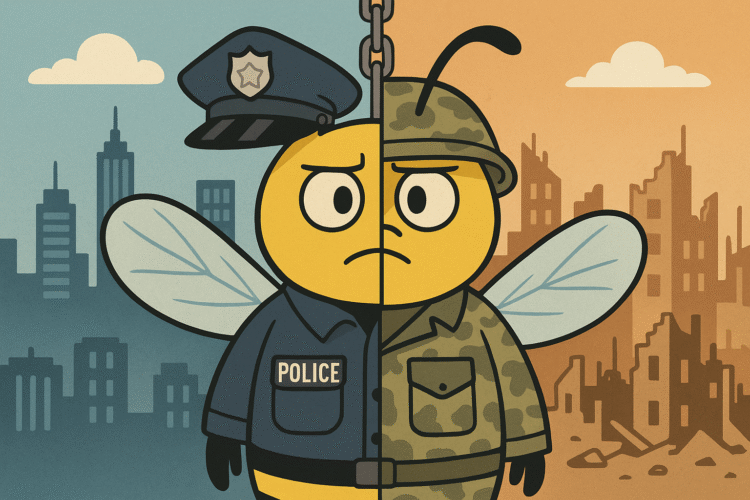
Local control has always been sold to us as one of democracy’s purest virtues. The idea that the people who live in a place—the ones who pay the taxes, send their kids to the schools, ride the buses, complain about the potholes—are the ones who get to decide how that place is run. It’s the political equivalent of eating what you cook. You grow it, you season it, you serve it. And if the meal’s terrible, you’re the one who has to eat it.
But in the real world, that kitchen door is on a hinge, and lately, it’s swinging wide open to people who were never invited to the table in the first place.
In one capital, the federal government took over the local police department, citing a “public safety emergency” despite crime rates being at a decades-long low. In another part of the world, a city’s daily life is dictated not by its own leaders but by a distant government’s military occupation plan. Both moves come wrapped in tidy rhetoric—security, order, stability—but the core is the same: local governance is just a prop, and someone else is writing the script.
This isn’t just a coincidence. It’s a global trend. And it’s worth looking at both stories side by side, because once you see the parallels, you can’t unsee them.
The Federal Playbook in the Capital
The federal government didn’t just step in—it marched in. Overnight, the local police chief answered not to the city’s mayor or council but to officials appointed miles away. Troops appeared on street corners, not for a parade, not for a national emergency, but for what amounted to a political optics exercise. Residents didn’t wake up to a safer city. They woke up to a show of force designed to send a message: you might live here, but this place doesn’t belong to you.
This is the kind of move that works best when you can sell it as protection. The script is simple: talk about rising crime (even if it isn’t rising), use scary statistics out of context, and insist the locals just can’t handle the problem themselves. It’s paternalism with a side of theater, complete with press conferences and heavily staged “walk-throughs” of neighborhoods.
For the people on the ground, though, it doesn’t feel like safety. It feels like being watched. It feels like decisions about your streets are being made in rooms you can’t enter, by people who don’t live here and won’t have to deal with the consequences.
Occupation as Policy
Half a world away, in a place that’s been under some form of control for generations, there’s nothing surprising about outsiders running the show. But this time, it’s being dressed up as a fresh start. The government in control approved a new plan for the occupied city—security checkpoints, restricted movement, tight control over resources. The justification? Order, stability, prevention of violence.
The people who actually live there don’t get a vote on this plan. They don’t get to decide whether their neighborhoods will be patrolled by soldiers, whether their businesses will be subject to sudden inspections, whether their roads will be blocked. Those choices belong to officials in distant offices who see the city not as a community but as a security puzzle to be solved.
And that’s the thing about occupation: it doesn’t have to call itself by that name to function exactly like one. You can wrap it in the language of counterterrorism, border control, or “temporary measures,” but at the end of the day, it’s the same reality. Someone far away has the final say over your life.
The Illusion of Local Input
Both cases share another common trait: the appearance of local involvement. In the capital, federal officials still talk to the mayor, still meet with city leaders. In the occupied city, there are still municipal councils, still “consultations” with local stakeholders. But these are like the children’s menu at a fancy restaurant—carefully curated, small in scope, and never containing the real options.
Local leaders can offer suggestions, but the decisions are already made. They can voice concerns, but the policy is already set. Their role is to nod, smile, and make it look like this is all a partnership instead of a takeover.
Why This Is Happening Now
Centralized power grabs are nothing new. But what’s striking about this moment is how openly they’re being done and how interchangeable the justifications have become. Whether you’re talking about a city in the United States or one under foreign military control, the language is eerily similar.
Officials talk about restoring order, protecting citizens, preventing chaos. They cite “temporary measures” that mysteriously have no end date. They describe their actions as unfortunate but necessary, regrettable but unavoidable. It’s the same script, just in different languages.
And in both cases, the underlying problem is the same: a refusal to trust the people most affected by these decisions to govern themselves.
The Danger of the Precedent
Once you’ve established that it’s acceptable for a higher authority to step in and take over local governance, it’s very hard to put that genie back in the bottle. In the capital, if federal control of the police force is justified once, why not again? Why not for longer? Why not for other departments—transportation, housing, education?
In the occupied city, the precedent has been set for decades. Any moment of instability becomes an excuse for more control. Any act of resistance becomes proof that the control must be tightened. The cycle feeds itself, and there’s no incentive for the people in power to end it.
The Human Cost
It’s easy to talk about governance in abstract terms, but the impact is personal and immediate. In the capital, residents may find themselves policed by officers who don’t answer to their elected officials. Complaints get routed into federal bureaucracies where they vanish into case numbers and form letters.
In the occupied city, people live with the knowledge that their movements can be restricted at any moment, that permits can be revoked without explanation, that their leaders are powerless to intervene. The psychological toll of knowing you have no real control over your own environment is as damaging as the physical restrictions.
Global Echoes
Look around the world and you’ll see variations of this same dynamic: national governments taking over provincial authorities, foreign powers dictating local policy, “emergency measures” that last for decades. The details differ, but the throughline is the same: local autonomy is fragile, and once it’s gone, it’s almost impossible to restore.
What makes the capital and the occupied city stand out is how starkly they illustrate the point. One is supposed to be a symbol of democracy. The other is a byword for contested sovereignty. Yet both are living under versions of the same system: decisions made from the top down, with the people at the bottom expected to adapt without protest.
The Lie of Temporary Control
One of the most persistent myths about these situations is that they’re temporary. Federal officials assure residents that once the “emergency” is over, control will be returned. Military leaders promise that once “stability” is achieved, the occupation will end.
But what counts as the end of an emergency? What does stability look like to the people in power? Conveniently, it often looks like a situation where they’re still in charge. And because there’s no independent authority to judge when the conditions have been met, “temporary” control can last as long as the controllers want it to.
The Role of Public Perception
Central authorities know that they don’t just need to control the territory—they need to control the narrative. In the capital, the takeover is framed as a bold move to protect citizens from crime. In the occupied city, it’s presented as a necessary step to prevent violence and maintain order.
If you can convince enough people—especially those outside the affected area—that your actions are justified, you’ve won half the battle. Public outrage fades quickly, especially when the people most outraged are the ones with the least power to change the situation.
What Real Local Control Would Look Like
Real local control means the people in a community decide how to address their problems, even when they make mistakes. It means living with the consequences of your own governance, not someone else’s. It means that change comes from within, not imposed from above under the guise of protection.
In both the capital and the occupied city, that vision is nowhere in sight. The people who live there have been relegated to spectators in the governance of their own lives. And as long as the people in charge can point to some form of unrest or danger, they have all the justification they need to keep it that way.
The Bee’s Final Sting
The lesson here is simple but uncomfortable: local control is only as strong as the willingness of those in power to respect it. Once that respect is gone, the structures that protect autonomy can be dismantled piece by piece until all that’s left is the illusion of choice.
From the capital’s federalized police force to the occupied city’s military-administered streets, the pattern is the same. Someone far away decides what’s best for you, and your role is to comply. The rhetoric of safety and stability may change, but the outcome doesn’t.
And if it can happen in places as different as these two, it can happen anywhere. The hinge on that kitchen door swings both ways, and the people who want to run your house are already knocking. The question is whether we’ll recognize it for what it is before we’re told the menu, the portions, and the price—and realize we never got to sit down at the table at all.