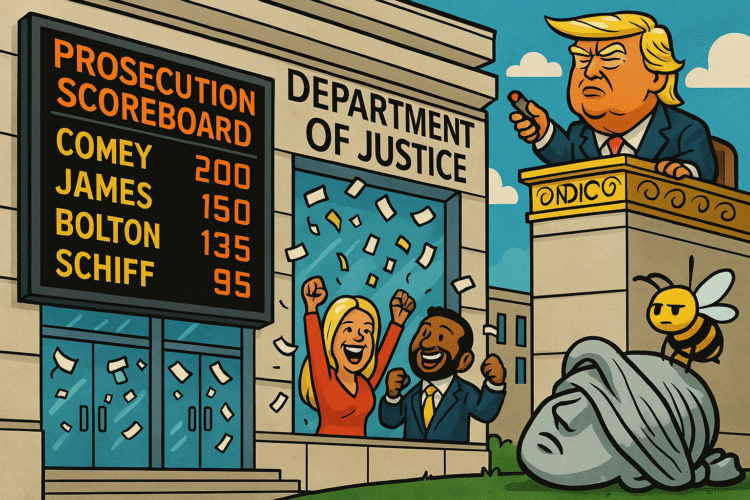
There’s something almost admirable about the efficiency of it all. America’s justice system, once the weary guardian of impartial law, now runs like a Vegas rewards app for political vendettas. Axios’ reporting on the “enemies to defendants” scoreboard inside Trump’s Justice Department reads like dystopian fan fiction written by a disbarred screenwriter who found QAnon too subtle. The premise is simple: prosecute critics, rack up wins, move up the leaderboard. The prize? Presidential approval, a Fox News hit slot, and maybe a future ambassadorship to a country that no longer wants one.
The scoreboard is apparently real—a running tally inside the DOJ of who’s been charged, who’s next, and which prosecutors are “delivering.” It’s not enough to win elections anymore; power must be televised, quantified, and gamified. Attorney General Pamela Bondi, that beacon of impartiality last seen weeping through a Fox News makeup chair, reportedly heads the “victory calls.” FBI Director Kash Patel, who used to write self-published “deep state” revenge fantasies, now supervises the reality show version. Together they have transformed the Justice Department into what one insider called “a content engine with subpoenas.”
The Scoreboard Era
If you’ve ever wondered what Watergate would look like with push notifications, here it is. Axios describes a literal running list of “hits”—completed prosecutions of Trump’s perceived enemies. Former FBI Director James Comey, charged with obstruction and false statements tied to the Russia inquiry. New York Attorney General Letitia James, indicted for “bank fraud” shortly after humiliating Trump in civil court. And John Bolton, charged under the Espionage Act for leaking national defense information—his Maryland case so airtight it’s practically vacuum-sealed.
Bondi and Patel reportedly circulate these victories internally, complete with celebratory briefings and “next up” teasers. Among those previewed: Senator Adam Schiff, over a “mortgage discrepancy,” and former special counsel Jack Smith, the man who once prosecuted Trump. In any other democracy, this would read as political persecution. In this one, it’s Tuesday.
Vice President JD Vance insists it’s all “driven by law, not opinions,” which is how you know it’s the opposite. Vance’s poker face is impressive considering Patel’s prior book literally published a “non-exhaustive list of deep state operatives” that matches the DOJ’s defendant lineup almost name for name. It’s less a conspiracy theory now than a to-do list.
From Blindfolds to Scoreboards
Justice is supposed to be blind. Now it wears merch. The scales have been replaced with a running tally. If Lady Justice had a smartphone, she’d be refreshing her follower count between indictments. This isn’t corruption hiding in the shadows; it’s corruption taking a bow.
The FBI has reportedly shifted resources away from right-wing threats, shut down its public corruption unit, and redeployed investigators toward what Trump calls “traitors.” Each prosecution is announced with the pomp of a halftime show, complete with Bondi’s signature catchphrase, “Law and order doesn’t mean soft.” That would sound better if the “law” part wasn’t applied selectively and the “order” part didn’t resemble a mob hierarchy.
The most chilling part isn’t even the prosecutions themselves. It’s the permission structure. Each case that follows a Trump tweet or rally threat reinforces the same lesson: speak against the regime, and the machinery will find you. Criticism becomes evidence. Oversight becomes conspiracy. Investigating the president becomes the crime.
The Spectacle of Retribution
This new model of governance doesn’t enforce laws—it performs dominance. The DOJ isn’t a department anymore; it’s a stage. Every indictment is an act of theater, choreographed for the nightly news cycle. Bondi and Patel don’t need to win every case. They just need to show movement. The process is the punishment.
And it’s working. State officials who once oversaw Trump’s civil liabilities now whisper about “keeping their heads down.” Legal scholars track retaliatory prosecutions like hurricane forecasts. “Selective enforcement litigation” is now a growth industry. Motions to dismiss on “vindictive prosecution grounds” fill federal dockets like pop-up ads. And every defense lawyer in America now uses the same phrase: “show me the tweet.”
Because that’s how you find the trigger. A demand from Trump at a rally, a Truth Social tirade, a Fox segment about “corruption,” and within weeks—subpoenas. The cause and effect are so transparent they could be diagrammed on a whiteboard. The timeline itself is the confession.
Bolton as the Fig Leaf
The Bolton indictment, all 18 counts of it, is the fig leaf of legitimacy covering the naked ambition of the rest. Prosecutors say it’s airtight. It probably is. Bolton, who once bragged about “bombing the International Criminal Court,” kept thousands of pages of classified notes like a teenager hoarding love letters. The evidence speaks for itself. But its timing, origin, and political packaging do not.
This is how laundering works: take one clean case, surround it with dirty ones, and claim it proves the system still works. Bolton’s prosecution isn’t just justice—it’s branding. It’s the administration saying, “See? We only target the guilty,” while the definition of “guilty” contracts to mean “inconvenient.”
The playbook is simple: every legitimate conviction justifies ten illegitimate indictments. Every real spy becomes cover for the political dissident. And because the Espionage Act still sounds serious, the public hesitates before calling foul. It’s legal theater with the moral compass of a casino.
The Collapse of Proportion
What makes this moment uniquely dangerous isn’t just the politicization of justice—it’s the normalization of spectacle. The scoreboard trivializes prosecution. Law becomes content. Crime becomes clickbait. The question is no longer “Was justice served?” but “Who’s trending?”
When the White House treats criminal indictments like campaign rallies, it forces the courts to become the last adults in the room. Judges, once the quiet referees of democracy, now find themselves presiding over political demolition derbies. Their rulings are dissected like election returns. Their security details grow by the week.
Meanwhile, the public grows numb. Once you’ve seen the Department of Justice turned into a loyalty test, what’s left to shock you? When the scoreboard updates daily, outrage loses its shelf life. The moral muscles atrophy.
The Long Con
This isn’t about the individual cases—it’s about precedent. If one president can prosecute enemies and call it “law,” every president after him will have the same power. That’s not revenge; that’s reprogramming the Constitution.
The genius of the scoreboard system is its deniability. No one ever says, “We’re targeting enemies.” They say, “We’re enforcing the law.” They quote the statutes, file the paperwork, and smile for the cameras. It’s clean enough to pass the smell test, dirty enough to corrode trust. And every time the media debates “whether the charges are legitimate,” the scoreboard wins.
Trump doesn’t need to control every judge or jury. He just needs enough Americans to stop believing justice exists outside of politics. Once you’ve done that, it doesn’t matter who wins in court. The real trial takes place in the mind.
The Loyalty Economy
Bondi’s DOJ runs on loyalty economics. Prosecutors rise not by seniority but by zeal. Every successful indictment of a Trump critic is a ticket upward. Every leak to Fox News is an audition for the next administration. The line between government lawyer and campaign surrogate has vanished like separation of powers after dark.
Axios’ report even describes “future defendant chatter”—names floated like stock tips. Adam Schiff, Jack Smith, maybe a journalist or two. The goal isn’t conviction; it’s deterrence. Keep the next critic from speaking. Make every whistleblower pause. Turn fear into efficiency.
It’s the same logic authoritarian regimes have used forever: prosecute enough truth-tellers and the silence polices itself. What’s new is the presentation—slick, televised, American. Retribution with production value.
The Optics of Innocence
JD Vance’s statement that prosecutions are “driven by law, not opinions” could be the slogan of a dictatorship that still needs tourists. The administration clings to the appearance of fairness because appearance is all it has left. It’s the political equivalent of a counterfeit designer bag: convincing enough at a distance, unraveling at the seams.
The shuttered FBI corruption unit, the resource shift away from white nationalist threats, the purges of dissenters inside the department—all of it signals that the machinery of state is now decorative. The badge, the oath, the mission statement—they’re just costumes.
The irony is painful: the people shouting “weaponization of government” for years have now built the perfect weapon. And like all weapons, it points outward until it doesn’t.
THE ACCOUNTABILITY SECTION
The consequences to watch are immediate and systemic. Selective enforcement suits are already forming like antibodies. Courts will be asked to decide if presidential speech is evidence of intent, if timing equals targeting, if satire has become discovery. Congress will demand oversight hearings, but good luck subpoenaing the scoreboard when its keepers are the referees.
The chilling effect is harder to quantify but easier to feel. State officials who handle Trump-related civil judgments will think twice before signing a ruling. Prosecutors will calculate career risk before filing charges. The next journalist who uncovers a scandal might pause before hitting publish. Democracy doesn’t need censors when fear does the editing.
And hovering over it all is that one pristine case—the Bolton indictment—used to justify the rest. If it holds, it becomes the moral laundering device for everything around it. If it collapses, it exposes the rot beneath the golden lighting.
The true test isn’t whether these prosecutions stick. It’s whether Americans can still tell the difference between justice and revenge. Whether juries can deliberate without fear. Whether courts can operate without choreography.
Because once the scoreboard becomes the system, there’s no whistle left to blow.