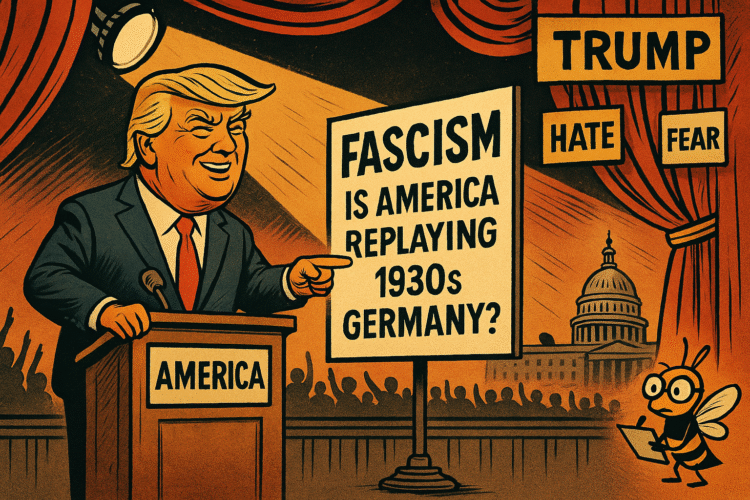
I remember sitting in history class as a kid and staring at the photos they always brought out for the chapter on Germany, the ones with the flags and the straight lines and the faces that were either rapturous or empty, and thinking how did they let this happen. I was convinced there must have been a secret weakness in their water, a national allergy to the word no, something mystical that made a whole population walk past the sirens and pretend they were church bells. I told myself that if I had been there I would have recognized the costume, I would have seen the trapdoor under the stage, I would have raised my hand and said this is not politics, this is theater with handcuffs waiting behind the curtain.
I grew up believing America was the extra credit answer to that chapter, the country that learned the lesson and laminated it, the place where the guardrails had guardrails and the guardrails had volunteers who brought snacks to the meeting. We had debates with rules, and newspapers that fought with punctuation, and civics classes that taught you to underline the word consent because it explained everything important. My teachers said shining city and I looked at the posters and thought light means safety, because light means people are awake, because light means someone will notice if the door that should stay open suddenly clicks shut.
What you learn later, when you are old enough to keep your own receipts, is that light can also be a spotlight, and a spotlight is what you use when you want everyone to look in one direction while the set changes behind them. You sit at a coffee shop and your phone produces a clip of masked agents moving a person across a sidewalk like furniture, and you glance up to see a line of regulars practicing their morning order with the fidelity of prayer. Nobody is evil, they are busy, nobody is blind, they are tired, and the brain has a talent for translating shock into errand so you can make it to work on time. I used to think complicity was a costume with medals, now I know it is a jacket you put on because the room is cold.
Otherism is not a new word, but it has new packaging, and the packaging is comfortable. It tells you that difference is a policy issue rather than a person, which saves you the trouble of thinking about your neighbor’s rent or the look on their face when a car slows near their block. It tells you that the category does not belong to anyone you love, which is a trick as old as war posters and as current as a platform algorithm that feeds you stories about caravans until you start to dream in arrows. Once people are a category the verbs change, you relocate categories, you detain categories, you count categories with clipboards and then congratulate yourself for being organized.
When a leader wants this to spread, he does not wear a mask, he wears a microphone. He tells you the press hates you, then offers his feed as therapy, he calls the media an enemy so you will forgive him for lying like it is a public service. He treats reporters like hecklers and threats like misunderstandings, then rewards friendly hosts with proximity and converts that proximity into truth. You can watch the air shift in a room when he says they are lying about me, you can watch people relax because it is a simple story that explains every embarrassment he does not want to carry.
The military is a set piece in this show, less a last resort than a polished prop that looks terrific under television lighting. He talks about soldiers like a personal brand extension, he uses the language of war when he is lecturing a city council, and he sells the idea that uniforms are a lubricant for every civilian jam. Ordinary force becomes the first option in his sentences, not because it is necessary but because it looks decisive on screen and decisiveness produces applause. The country that taught me civilian control as a sacred balance is asked to clap for the fantasy of deployment as customer service.
The target list rotates but the shape stays the same. Democrats and liberals become the permanent other, not opponents to be beaten at the next election but suspicious characters who must be monitored for sedition. A protestor is redefined as a threat, an advocate is renamed as a radical, a mayor becomes a saboteur if the mayor reads the Constitution out loud in an inconvenient register. Call it terroristic and you get to treat dissent like a security incident, and once dissent is a security incident every response becomes legitimate to the people who prefer quiet to freedom.
Power grabs are presented as corrections. The leader names enemies, then reaches for the levers that were built to be used carefully, and you can hear the bolts complaining as he yanks. Inspectors general become obstacles, independent prosecutors become vendettas in the wrong direction, civil servants are demoted by tweet so the camera will be nearby when someone thanks him for the firing. He learns quickly that public punishment is a discipline tool, so he uses the federal bureaucracy like a shopping cart, taking what he needs and leaving the rest in disarray.
There is always a scene where the party that should object decides to supervise instead, as if history were a toddler who needs watching more than correction. The GOP that once wrote pamphlets about restraint finds itself auditioning for the role of chorus, nodding on cue and calling it strategy. Members who know better say history will judge them kindly for keeping the peace inside a storm, which is how people explain their silence when they are counting votes and praying their names will not appear on the next target list. Checks and balances become greetings and compliments, and the oath shrinks until it reads like fan mail.
Courts become weathervanes for a season. The Supreme Court remembers its muscle some days and forgets where it put it on others, and the fickleness is not random, it is the logic of institutions trying not to be dragged into the center of a brawl that has no off switch. You can feel the capitulation in small phrases, in decisions that pretend neutrality while tilting toward deference, in opinions that treat power like a sensitive instrument that must not be disturbed. The tragedy is not that courts fail loudly, it is that they fail softly, with footnotes that sound like apologies to the future.
When I was a kid I thought Germans were bewitched, that a spell was cast and everyone applauded at the wrong moments because hypnosis is a fun story and accountability is not. Now I understand fatigue. You get up, you scan headlines that read like a broken record with new scratches, you tell yourself everyone is overreacting because you do not want to lose your morning, and then you go to work and keep your head down because a head down is easier to carry. The terrible secret is that democracy asks for inconvenience, and inconvenience is the one commodity a country that worships efficiency will never budget.
The media tries to describe this without becoming part of it, which is like trying to film a storm from inside the storm and still keep the lens dry. Balance, the god we pray to when we do not want to be yelled at, invites false equivalence, and the leader knows this. He stages controversies the way a magician stages misdirection, something shiny on the right while the hand moves left, and an entire news cycle jogs obediently after the shine. It is not that journalists are bad, it is that the business model rewards drama and the subject delivers it on time with captions.
If you want to know how it happens, sit inside an ordinary day. An unmarked van appears on a street you do not live on, a body is stuffed inside it without fanfare, social media yawns, your barista calls the next name, and the line moves because the line always moves. Your friend texts, your boss pings, your dog needs to be walked, and the part of your brain that is supposed to scream already did too much screaming last year and is pacing in the back of the room. Authoritarianism is not a sudden costume change, it is wardrobe notes added every week until the mirror can no longer remember your old shirt.
Trump’s gift is the ability to turn consequence into entertainment. He markets the silencing of the press as a cleansing ritual, he sells contempt for courts as courage, he flirts with emergency powers like they are cologne, and he narrates his grievances as if the nation is obligated to carry them like pallbearers. He wants Democrats and liberals to be permanent antagonists because a story needs a villain, and it is easier to be the hero when your villain list includes teachers and librarians and whoever read the budget out loud. He uses the federal government as a personal instrument, then calls the resulting music patriotic, then scolds anyone who covers their ears.
The GOP, a party that once taught me to respect caution and process, has become a spoon for his appetites. The minority inside it that still believes in limits speaks in committee voices, careful and low, while the majority studies the polls and decides the risk of honesty is worse than the risk of history. Oversight becomes a press release, hearings become therapy, and the only red line that matters is the one drawn by a base that has been told for years that their pain is a calling. The hardest thing to admit is that many of them believe it, not because they are stupid, but because a steady diet of grievance is addictive and sobriety is lonely.
The Court is not a monolith, but it has sent enough signals to convince a hungry executive that deference can be harvested. Immunity theories are floated like trial balloons, and each time one does not pop loudly, the next one rises a little bigger. The public watches and shrugs because the words are technical and the stakes are disguised as procedure, and procedure is boring until it rearranges your life. The great misunderstanding is that freedom is permanent, when in fact it requires daily volunteers, and daily volunteers require the kind of stamina that social media burns through in a week.
I never thought I would see masked agents in my country pulling people into vehicles with no markings and driving off into traffic like law was a suggestion and not a promise. The first time I saw it I waited for the street to stop, then I realized the street had a latte to pick up and a meeting to join, and civilization cannot miss a meeting. The second time I saw it I thought the video must be old, because the mind comforts itself by pretending time is a shield. The third time I saw it I learned that normalization is not a decision, it is a reflex that needs training to resist.
What do we do with that realization besides drink coffee stronger than any doctor recommends. We remember that empathy is not a luxury, it is a public safety tool. We teach ourselves to notice categories creeping into our vocabulary, then swap them for names. We remind each other that the First Amendment is not a suggestion and the separation of powers is not a decorative phrase to be dusted for State of the Union speeches. We practice the boring parts of citizenship until they feel like exercise, because they are.
The story we tell about Germany should not be a bedtime story for scolding other people, it should be a set of instructions for how to keep your eyes open when a showman is promising relief in exchange for silence. That chapter is a warning about the praise of strength without purpose, about rallies that flatten the mind, about neighbors who become strangers because the leader said the word purity with just the right lighting. The United States is not condemned to repeat any of it, but it is not immune either, and immunity is the lie that kills vigilance.
Trump is not a magician, he is a marketer, and his pitch is simple. Trust me, I alone can fix it, and if the fixing requires new powers, those powers belong to me because my enemies are your enemies and therefore the rules do not apply. He is ushering in the version of politics where punishment is a platform, where federal levers are handles for revenge, where the press is a mood disorder to be medicated with rallies, where soldiers are backdrops for a tweet that needs gravitas, where an entire party becomes a human shrug. He is not the disease, he is the symptom of a country that forgot the gym membership for its civic muscles.
It turns out the question I asked as a kid was the wrong one. I kept saying how could they let it happen, like there was a single decision that opens a gate and invites disaster in. The better question is how do you keep a million small decisions from tilting the floor, how do you train a public to hear the pitch of creeping power grabs, how do you convince people to care about laws before those laws find their front door. The answer is unglamorous. You name what you see while you still have the words, you support the reporters who keep receipts, you encourage officials who choose principle over career, you fight the story that says politics is a game rather than a map.
I still believe in the shining city, not as a metaphor for perfection, but as an agreement to keep replacing bulbs. Light is not a trophy, it is maintenance, and maintenance is everyone’s job. The city is only a hill if we climb, and climbing is repetitive and sweaty and therefore honest. I want to grow old in a place where my neighbors check my breath when the nights get long, where the local clerk insists on the correct signature, where the judge writes sentences that are boring to read and brave to issue, where the party in power understands the difference between victory and vengeance.
Maybe that sounds naive, but I have lived through enough to make sincerity feel like a rebellion. I have buried versions of myself that did not expect to make it to this paragraph. I have watched institutions save someone because a form was filled out correctly, I have watched them harm someone because a shortcut was rewarded, and I have paid in time and sorrow for the difference. I serve humor because it keeps the lights on without burning the house down, and I write because the spell breaks when enough people call the trick by its real name.
So here is mine. We are not special in our ability to resist, we are special in our responsibility to try. The creep is real, the othering is deliberate, the masked agents are not an accident, the weaponization of power is a plan written in bold and sold as common sense. The answer is not a louder chant, it is a longer memory, the kind that looks back at the classroom photo and sees not aliens, but tired humans who wanted a normal day and were offered a fantasy instead. We can do better than that, which is not a slogan, it is a schedule. Show up, speak clearly, defend the messy press, starve the appetite for revenge masquerading as order, insist your representatives remember the oath they took, and treat the Court like a coequal branch rather than a celebrity panel show.
If you need a moral to tape to the fridge, use this one. It is easy not to care about things that do not touch you, until they do, and by then the van has learned your street. Caring is cheaper early. Caring is louder when it happens in groups. Caring is what turns a shining city from a speech into a place where the law belongs to the people who will not sell it for applause.