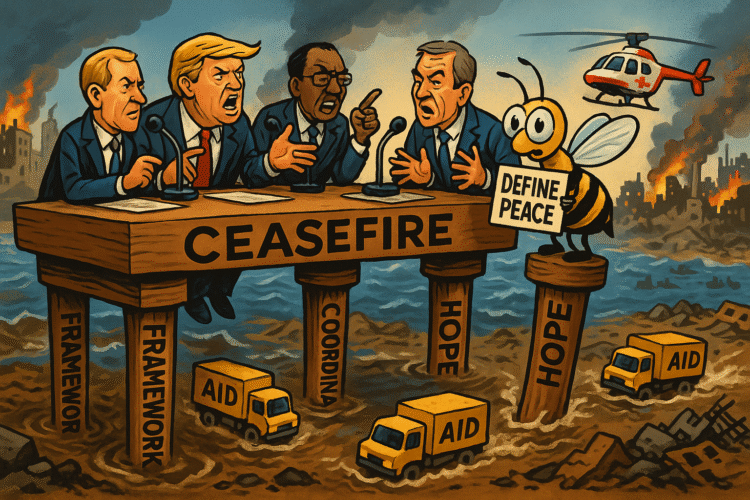
At the midpoint between “mission accomplished” and “please hold,” the Gaza ceasefire now lives in the liminal space where optimism is just fatigue wearing better clothes. Cameras caught the handshakes, the solemn statements, the flags arranged like theater props—but now the applause has faded, and the work has begun to creak under its own paperwork. The International Committee of the Red Cross shuttles remain and detainees across checkpoints like a grim Uber service, Israel identifies two more hostage bodies, Hamas issues denials wrapped in accusations, and Egypt quietly rearranges the logistics map to look busy while waiting for someone to make an actual decision. Everyone’s honoring the truce, technically. They’re just doing it in their own way: with accusations, conditions, and memos about why it’s someone else’s fault that things are still on fire.
The Intermission That Forgot to End
Peace, or its stand-in, always begins as choreography. This one started with the Red Cross convoying hostages, the release of Palestinian detainees, and enough hashtags to fill a stadium. For forty-eight hours, the cameras lingered on buses and tears. For the next forty-eight, attention moved to the next trending crisis. What’s left now are the fragments—the “partial reopenings,” the “interim patrols,” and the kind of cautious adjectives diplomats use when “failure” is still a few press briefings away.
Aid trickles in through Kerem Shalom, which has become less a crossing and more a metaphor for bureaucratic endurance. Rafah, the southern artery of humanitarian access, remains closed to civilians but open to speculation. Egypt and Israel are reportedly “coordinating,” a word that now means “stalling politely.” Every side blames the other for why aid convoys move slower than press releases.
It’s a ceasefire by committee, and the committee’s printer is jammed.
The Math of Grief
Israel confirms two more bodies identified, their names absorbed into the national ledger of loss. Hamas insists on its own narrative of victimhood, claiming dozens of Palestinian deaths since the truce began. The numbers duel like propaganda chess pieces: every death, a talking point; every life spared, a bargaining chip. It’s an arithmetic of mourning that runs on political fuel.
The humanitarian agencies try to make sense of the mess, counting deliveries that never make it past bombed roads, rationing fuel for hospital generators, and reporting “limited access” to the north, a phrase that barely conceals despair. Every time a U.N. convoy reaches a checkpoint, someone somewhere announces a violation. Every time a journalist reports progress, a new explosion reminds everyone that the ceasefire is more conditional than it looks in headlines.
This is the paradox of modern diplomacy: the numbers never add up, but the spreadsheets always balance.
The Architects of Nothing
Washington, eager to prove relevance, unveils a new “coordination cell.” It sounds impressive until you realize that no one can define what it does. Its job, apparently, is to “buttress the monitoring architecture,” which means reading reports from Egypt, Qatar, and the U.N. and agreeing that things are complicated. It’s diplomacy as IT support: “Have you tried rebooting your expectations?”
Meanwhile, European partners prepare inspectors for “border support,” a phrase that conjures clipboards and fluorescent vests. Brussels loves process almost as much as Washington loves optics, so together they produce the world’s most elaborate flowchart for a ceasefire that still relies on enemies not shooting at each other. The idea is to install a verification scaffold faster than Hamas can dig another tunnel. The reality is that scaffolding takes time, and rockets don’t respect building codes.
The result is an elaborate monitoring network built on Wi-Fi signals, mutual distrust, and diplomatic caffeine.
The Politics of Pretending
The domestic pressures on each side look eerily similar. Israeli families demand answers, remains, and accountability. Hamas factions jostle for street control and narrative supremacy. Regional actors in Lebanon and the Red Sea test boundaries under the guise of “resistance,” as if geography itself were daring them to start something new. Everyone’s trapped in a feedback loop of grievance management.
The White House, eager to call the ceasefire a victory without claiming ownership of its fragility, issues statements that sound like they were written by a risk-averse fortune cookie: “We are encouraged by the progress while acknowledging challenges.” The president calls it “a step toward durable peace,” which is the kind of sentence that can mean anything if you say it slowly enough.
The vice president, when asked about violations, pivots to discussing “hope.” It’s always hope. Hope is free, and it polls well.
Logistics, or How to Lose a War Slowly
The real heart of the story isn’t in the conference rooms or press pits. It’s in the convoys—those long, slow lines of trucks that must navigate craters, checkpoints, and armed men with contradictory orders. The trucks carry food, fuel, medicine, and the illusion of control.
Every crossing becomes a moral test: how much aid gets through before someone declares it propaganda? Every delivery becomes a headline: “Relief Arrives” on Day One, “Insufficient Aid” by Day Two, and “Ceasefire at Risk” by Day Three. The people waiting for supplies don’t read the headlines—they just notice whether the bread shows up before the diesel runs out.
On the ground, the ceasefire is neither peace nor pause. It’s triage.
The Diplomacy of Deadlines
In the language of negotiation, “implementation phase” means “delay dressed as diligence.” Each side releases statements that sound like cooperation but function as leverage. The Israeli government demands more remains; Hamas insists on more detainee releases. The mediators—Egyptians, Qataris, and the occasional American envoy—shuffle lists like dealers trying to bluff their way through a broken deck.
In Cairo, officials speak of “sequencing,” which is diplomacy’s way of admitting nothing’s ready but we’ll pretend it is. In Doha, the tone is more optimistic—Qatar specializes in optimism—but even their envoys admit the “verification mechanism” is still theoretical. Everyone agrees that “progress is being made,” which is international code for “we’re still arguing about who holds the clipboard.”
Deadlines slip, tempers rise, and press conferences fill the silence where trust should be.
The Truce Industrial Complex
There’s a certain economic ecosystem around ceasefires now. Analysts analyze, pundits punditize, contractors contract. Each phase of “implementation” creates new opportunities for consultants, interpreters, and logistics experts who thrive in the gray zones between conflict and calm. Peace, after all, doesn’t just happen—it gets billed by the hour.
Western governments fund “post-conflict stabilization” programs that sound visionary but operate like short-term grant cycles. NGOs write proposals for “community resilience” that expire faster than the generators they’re meant to power. Aid agencies negotiate access, lose access, regain it, and start over. The humanitarian sector is a kind of moral treadmill: endless motion, no arrival.
Everyone wants the ceasefire to hold, but no one wants to admit it’s not built to last.
The Semantics of Survival
Language has become the most flexible casualty. “Ceasefire” now includes “limited strikes.” “Humanitarian corridor” means “one road not bombed this week.” “Verification mechanism” means “Excel sheet.” Every term is redefined to make failure sound like patience.
Reporters on the ground describe “calm punctuated by explosions,” a phrase that could double as the region’s motto. Spokespersons insist that “talks are ongoing,” as if talking were itself a solution. When pressed about accountability, one official famously said, “We are in the process of establishing the process.” That sentence should be engraved on the tombstone of modern diplomacy.
The public, long accustomed to this linguistic acrobatics, stops expecting clarity. Instead, they count convoys and funerals.
The Theater of Accountability
As the truce wobbles forward, everyone is already rehearsing for the blame phase. Governments gather dossiers proving why it’s not their fault when it collapses. Militants draft statements about “provocation.” Donors prepare talking points about “unexpected challenges.” The U.N. readies another report no one will read but everyone will cite.
Accountability in this context is performative. It’s less about responsibility than about plausible deniability. The moment something breaks, the world’s leaders will emerge, freshly shocked, to announce that “lessons will be learned.” Spoiler: they won’t.
Hope Management
The only thing harder to distribute than aid is hope. Hope requires belief in process, in institutions, in promises made by people who never visit the ruins their policies produce. The diplomats talk of “durable frameworks.” The families of the dead talk of durable grief. Somewhere in between lies the truth: peace isn’t built by summits—it’s built by repetition, by work that’s too boring for headlines and too fragile for ego.
The real heroes of ceasefires aren’t in press pools. They’re the drivers who keep convoys moving, the doctors who operate in the dark, the translators who explain why a checkpoint guard won’t lift the gate without a different stamp. These are the architects of temporary mercy. And they’re running out of time.
The Optics Economy
As journalists film aid trucks inching forward, politicians craft statements that make the crawl look like a sprint. The White House touts “visible improvements.” The Israeli government emphasizes “caution and vigilance.” Hamas broadcasts “steadfastness.” None of these words feed the hungry or fix the sewage systems.
In global capitals, the optics are the outcome. Leaders need footage of movement more than movement itself. The world measures progress not by lives saved but by press conferences scheduled. If you can control the narrative, you can survive the news cycle. The people living it rarely get that luxury.
The Punchline of Realism
The question now isn’t whether the ceasefire holds, but what it means if it does. A truce can freeze violence without healing anything. It can institutionalize stalemate, turn desperation into management, and call it “stability.”
Diplomats love the phrase “hardening the framework,” as if governance were epoxy. But no amount of scaffolding can support a peace built on exhaustion alone. The ceasefire, in its current form, is less a bridge than a balance beam—a delicate act performed above an abyss while cameras cheer from the sidelines.
The world wants closure, but closure requires truth. And truth is the one thing everyone still treats as negotiable.
The Politics of Pause
The Gaza ceasefire endures, for now, because collapse would be inconvenient. Everyone has something to gain from pretending it works: the mediators, the militaries, the media, the markets. But endurance is not peace. It’s just delay.
Somewhere, a family waits for remains that might never come home. Somewhere else, a child stares at a truck full of aid that may or may not reach her town before the next round begins. And in Washington, Cairo, and Doha, the adults in charge congratulate themselves on “progress,” unaware that the world they’re managing is bleeding through their spreadsheets.
If the measure of success is simply keeping the truce alive long enough to schedule the next one, then congratulations—we’ve mastered survival as spectacle. But if peace means anything beyond silence between shellings, the verdict remains pending.
The Pause Between Wars
The Gaza ceasefire is a study in modern diplomacy’s favorite illusion: motion without movement. It exposes how the global order now treats stability as a branding exercise, not a moral project. As long as leaders can point to meetings, frameworks, and coordination cells, the machinery of empathy keeps humming.
But the people living under the drones and waiting at the crossings don’t need frameworks—they need guarantees. They don’t need optics—they need safety. Until that gap closes, every ceasefire will remain a press release with a body count.