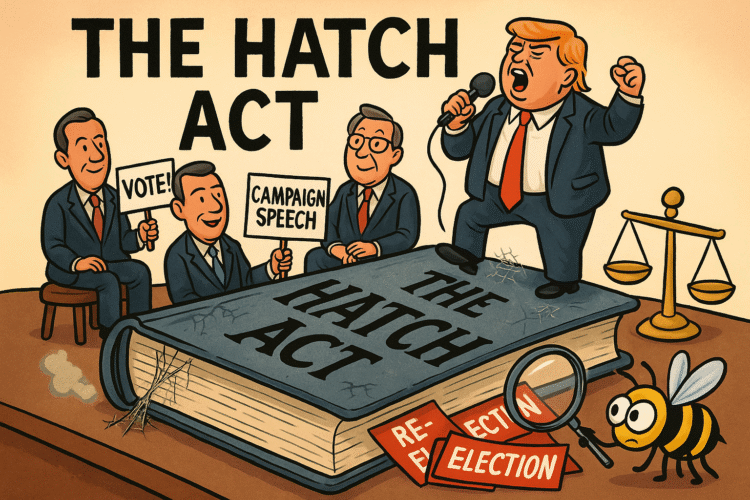
Somewhere in the dusty filing cabinets of American democracy, beneath the “Do Not Remove Under Penalty of Law” mattress tags and the ghost of civics classes past, lies the Hatch Act. Passed in 1939, it was meant to be the firewall between government work and campaign work. The promise was simple: no mixing taxpayer business with partisan business. No turning federal employees into campaign props. No “I approve this message” coming from someone on the public payroll.
Eighty-six years later, the Hatch Act is that firewall in name only—a polite “please don’t” taped to the door of a burning building.
The Birth of a Boundary Nobody Respects
Let’s start at the beginning, before the law became the nation’s favorite suggestion. In 1939, Congress noticed that federal workers were being pressured to campaign for their bosses, donate to political committees, and—if they didn’t—lose their jobs. The Hatch Act, named after Senator Carl Hatch of New Mexico, was supposed to fix that. It said, in essence, “You can serve the people or the party, but not both at the same time.”
The idea was noble. The execution was doomed. The law was written for a world with telegraphs and door-to-door campaigning, not livestreams, burner accounts, and Fox News hits. It banned politicking “in an official capacity,” but in the era of performative governance, what counts as official? When every statement from a podium becomes campaign content before the microphone cools, the boundary dissolves.
The Age of the Permanent Campaign
In modern Washington, the Hatch Act is less a law than a mood. Administrations of all stripes have treated it as a suggestion, but the second Trump era has turned suggestion into performance art.
In theory, federal employees—especially high-ranking ones—can’t use government time, titles, or resources for partisan purposes. In practice, it’s become a national sport to see how close one can skate to the line without technically tripping over it. One might call this the “wink and nod” school of ethics: wink at the base, nod to the lawyers, and keep moving.
Political appointees appear on cable news in front of official seals, campaign on X (née Twitter) during work hours, and announce “official policy” that just happens to sound like a campaign ad. The president’s social media feeds blur statecraft and showmanship into a single, never-ending reality show. Cabinet secretaries stump for candidates at “official events.” White House staffers post taxpayer-funded press photos rebranded with campaign slogans.
And every time the Office of Special Counsel (the federal watchdog that enforces the Hatch Act) sends a letter, the cycle repeats: denial, deflection, and the magic words—“no disciplinary action recommended.”
The Toothless Watchdog
The Hatch Act’s enforcement mechanism is like watching a lifeguard blow a whistle at a tsunami. The OSC can investigate, write reports, and send recommendations, but it can’t punish. Its strongest weapon is a sternly worded letter, which in Washington ranks somewhere between a Yelp review and a sigh.
In theory, the Merit Systems Protection Board can enforce penalties—suspensions, fines, even terminations—but only if the White House or an agency agrees to act. And when the people accused of breaking the law are the same ones running the agencies, enforcement starts to feel like asking the fox to prosecute itself for henhouse-related misconduct.
During prior administrations, small-fry staffers occasionally took the fall—a campaign event held on government time here, a press release a little too partisan there. But under the current atmosphere, Hatch Act violations are badges of honor. They prove loyalty, not guilt.
When a cabinet member uses an official platform to attack a political opponent, the OSC might issue a “finding of violation.” The official response? “Fake news.” When a federal social media account reposts campaign material, the agency promises to “review its internal guidelines.” The review never ends, but the next post still goes up.
The law depends on shame as a deterrent, but shame no longer has jurisdiction.
The 24-Hour News Loophole
The Hatch Act’s architects couldn’t have predicted a world where the line between governing and campaigning is drawn in pixels. Every administration now lives in a permanent campaign, but none has embraced it so openly as the Trump model, where every policy announcement doubles as a rally speech and every rally speech doubles as a government directive.
The president speaks, and half the Cabinet rushes to amplify it from their official accounts, each tweet stamped with government insignia. They aren’t campaigning, they insist—they’re “clarifying policy.” When the policy happens to be “re-elect us or chaos,” well, that’s just coincidence.
In this digital hall of mirrors, even journalists struggle to separate official communication from campaign content. If a press conference ends with a fundraising pitch, was it a policy briefing or a political ad? If a “town hall” uses taxpayer logistics, is it constituent outreach or a campaign rally with better catering?
The Hatch Act doesn’t answer those questions. It was written for a world of memos, not memes.
When Everyone’s Violating It, No One Is
By now, the Hatch Act’s greatest power is its irony. It exists to prevent federal employees from using public resources for private gain, yet every violation becomes political capital. Breaking it loudly enough turns you into a martyr for “free speech.”
When a senior advisor endorses a candidate from the White House lawn, watchdogs issue press releases. When a cabinet official holds a campaign rally at a taxpayer-funded base, pundits debate “optics.” But optics don’t have a legal definition, and intent is almost impossible to prove when every statement can be framed as “official communication.”
The White House’s defense strategy is always the same: deny intent, mock oversight, accuse critics of bias, and claim victory in the court of public fatigue. The Hatch Act has become the jaywalking of federal law—technically illegal, rarely enforced, and normalized by sheer volume.
The Myth of Neutral Governance
Beneath the satire lies the real danger: the slow death of neutral governance. The Hatch Act isn’t just bureaucratic housekeeping—it’s the skeletal system that keeps a civil service from becoming a campaign army. Without it, every public servant becomes a partisan soldier, every department a propaganda organ, every press briefing an audition for the next election.
The law’s collapse doesn’t look dramatic. It looks banal. It looks like official Twitter accounts that end policy announcements with campaign hashtags. It looks like civil servants purged for insufficient loyalty. It looks like a president using executive authority to fund projects in swing states days before the election.
When accountability mechanisms fail quietly, the corruption that follows feels ordinary. That’s the brilliance of erosion—it doesn’t explode, it seeps.
Selective Enforcement as Strategy
The genius of the current moment is that enforcement has become politicized too. The Hatch Act is invoked not as a rule, but as a rhetorical weapon. When opponents violate it, it’s tyranny. When allies violate it, it’s “overreach by the deep state.”
The same administration that dismisses watchdog reports as partisan witch hunts still brandishes the Act when career employees criticize leadership. Suddenly, the law that “doesn’t matter” becomes sacred scripture. You can’t tweet an unflattering statistic without risking a “potential Hatch Act violation.” It’s not hypocrisy—it’s efficiency.
Power no longer hides its double standards; it flaunts them. The Hatch Act is no longer a check—it’s a mirror.
The Bureaucracy Bends
Every administration tests limits, but some treat limits as invitations. The civil service—the network of apolitical professionals who keep the lights on—has always depended on laws like the Hatch Act to shield them from political retaliation. But when loyalty becomes a condition of employment, neutrality becomes subversion.
Whistleblowers are reassigned. Inspectors general are replaced. Career scientists are “streamlined.” And through it all, officials claim the moral high ground of “draining the swamp,” even as they refill it with hand-picked partisans. The Hatch Act was supposed to prevent this exact scenario, but like most boundaries in modern politics, it survives only on the honor system.
The honor system is gone.
Satire Meets Reality
If this were fiction, it would be funny—a law so delicate that its violators can campaign on breaking it. But satire requires contrast. The absurdity lands only if there’s something sane to compare it to. Without accountability, the Hatch Act isn’t a punchline—it’s an epitaph.
Think about it: a law designed to keep politics out of governance now lives or dies by politics. The watchdogs bark, the violators grin, and the news cycle resets. The people supposed to be nonpartisan are punished for neutrality. The people supposed to enforce neutrality are replaced. The concept of “official capacity” dissolves in the acid of partisan loyalty.
If you drew this as a cartoon, it would be a federal worker standing in a field of campaign banners, clutching a copy of the Hatch Act while the wind rips out the pages. Somewhere in the background, the Capitol waves a giant sign that says “Under New Management.”
The Unwritten Rule: Power Protects Itself
The deeper truth is that the Hatch Act has always relied on cultural restraint more than legal force. It worked when shame was currency, when exposure carried consequences, when the line between right and wrong was still visible under the glare of power.
Those days are gone. The modern media ecosystem rewards outrage, not accountability. The more you break norms, the more attention you get, and in politics, attention is oxygen. The law can’t keep up with a culture that celebrates its own violations.
When the punishment for misconduct is a prime-time segment and a fundraising boost, laws like the Hatch Act become relics of a civilization that once believed laws mattered.
Why It Matters (Even If No One Cares)
It’s tempting to laugh it off. After all, if no one enforces it, why bother pretending? But laws like the Hatch Act exist not because they can stop corruption, but because they can still name it. They give the public vocabulary to recognize when power crosses a line.
Without them, every ethical breach becomes a “difference of opinion.” Every abuse becomes “political theater.” And eventually, governance itself becomes indistinguishable from campaigning—until the government isn’t governing at all.
You can’t run a democracy on vibes. At some point, someone has to care about the rules, even the ones that feel antique.
The End of the Hatch Era
So here we are: a law born in the Great Depression, dying in the Great Disinformation Age. The Hatch Act still exists, but only as a kind of bureaucratic ghost story—told to new employees at orientation, whispered in HR briefings, occasionally summoned by journalists like a half-remembered spell.
Its message was once clear: public service isn’t a campaign tool. Now, that sounds quaint. In an era where every action is political performance, the only true violation is admitting you still believe in rules.
The irony is that the Hatch Act might survive precisely because it’s so weak. It’s too harmless to repeal, too symbolic to enforce. It’s the perfect metaphor for modern democracy: still standing, technically, but hollowed out and fading fast.
Final Forecast
One day, historians will write about this period with a kind of weary fascination. They’ll note that we had laws, watchdogs, inspectors, courts—all the infrastructure of accountability—and that we treated it like stage décor. They’ll marvel that we turned ethics into entertainment, oversight into spectacle, and law into performance art.
And if we’re lucky, they’ll also find the punchline: that somewhere, in some forgotten office, a mid-level bureaucrat still believed the Hatch Act meant something—and kept following it anyway. Because someone has to, even when the people at the top don’t.