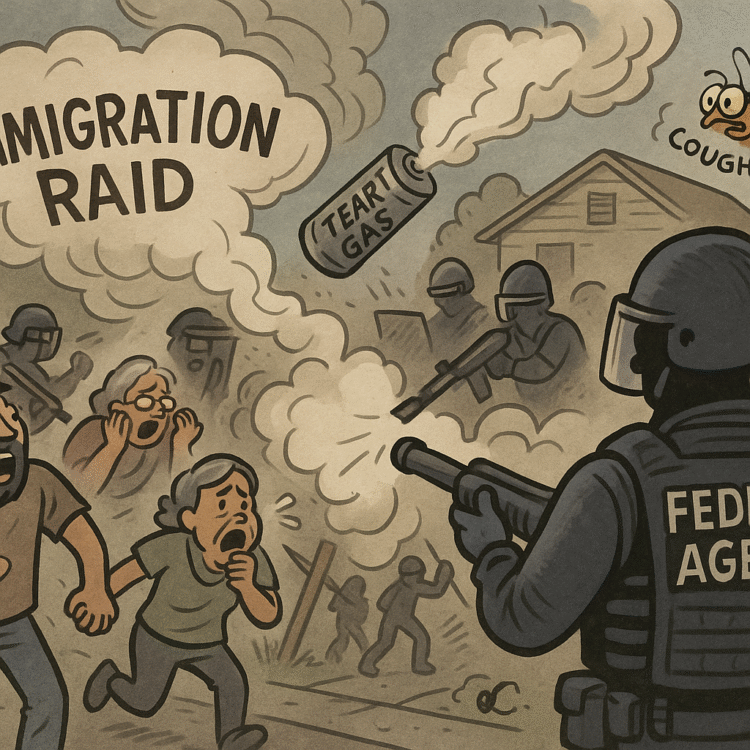
If the original American dream was that you could own a home, plant a tree, and not get gassed by your own government on a weeknight, that fantasy met its final act this month in the East Side of Chicago. A red SUV, a white SUV, a handful of agents playing Fast & Furious: Sanctuary City, and a few dozen ordinary residents—families, kids, grocery bags in hand—who now have to add “tear gas exposure” to the list of side effects of living in the United States in 2025.
The Chicago Sun-Times laid it out clinically: a “high-risk PIT maneuver,” pepper balls, smoke, tear gas, detained men, coughing officers, a shaken community. But the real headline should have been simpler—The Feds Just Gassed a Neighborhood Because They Could. And they did it in broad daylight, surrounded by witnesses, while cameras rolled. Because these days, the line between a “law enforcement operation” and a scene from The Purge is drawn in smoke and plausible deniability.
1. Theater of Operations (and Everyone’s Invited)
Let’s start with the basics. Two SUVs. Federal agents chasing immigration suspects through residential Chicago. The footage—because there’s always footage now—shows the agents ramming the smaller car, the suspects scrambling, and the street dissolving into chaos. Tear gas drifts across porches. Kids cry. Cops cough. The agents—mask-clad, armored, anonymous—declare it a “necessary tactical response.”
If this sounds less like public safety and more like performance art for the apocalypse, that’s because it is. America’s new governing principle seems to be: Why protect communities when you can gas them on camera? After all, the optics play better for a White House that thrives on chaos—one that treats “law and order” like a reality show concept rather than a moral principle.
And just like all great television, it’s got recurring themes: overreach, confusion, collateral damage. The tagline practically writes itself: Same Streets. New Season. Lower Budget.
2. The Agents of Nothing
In the official version, the agents were “responding to a threat.” In the video, the only visible threat is the SUV they’re driving like it’s a battering ram. DHS claims the suspects “rammed” them first, though no one—least of all the video—has seen this supposed first strike.
It’s a familiar choreography now. The government invents a threat, the operation justifies itself retroactively, and ordinary people get to be extras in someone else’s authoritarian fan fiction. The only thing missing was a press release about “precision enforcement” and “federal heroism under fire.”
What actually happened was a federally sanctioned panic attack: uniformed men with guns mistaking motion for justice. By the time the gas cleared, they had their two immigration arrests, four protester detentions, and a new batch of viral footage. The price? Thirteen Chicago police officers, dozens of residents, and one corner of the East Side temporarily turned into a chemical fog.
3. The Fog of Freedom
The United States has always been good at exporting chaos; now we’ve found a way to domesticate it. Tear gas on residential streets, flash-bangs in neighborhoods, unmarked vehicles prowling through the same blocks that host taco stands and bus stops. It’s all part of the shutdown-era aesthetic: austerity meets anarchy, bureaucracy meets brutality.
If you squint, you can almost see the old propaganda slogans rewritten for our times:
“Protecting the Homeland” becomes “Policing the Home.”
“The Land of the Free” becomes “The Land of the Free-Fire Zone.”
The agents, of course, will say it’s about “national security.” But whose security are we talking about? Because for the families ducking tear gas canisters in East Side, the only thing being secured is the federal government’s right to lose control.
4. Sanctuary Cities, Hostage Policies
The irony is impossible to miss: Chicago, one of the country’s most vocal sanctuary cities, just got a federal raid worthy of a war zone. The city’s police weren’t even participants—they were bystanders documenting the crash when the feds decided to start firing. It’s almost poetic, in a nightmarish way: a city that vowed to protect its immigrant residents ends up coughing alongside them in a fog of federal overreach.
Governor J.B. Pritzker and Mayor Brandon Johnson have spent months battling Washington over these rogue deployments. But it turns out you don’t need tanks on Michigan Avenue to create fear; you just need one federal SUV and a trunk full of gas grenades.
These operations, framed as “targeted enforcement,” are actually political theater disguised as policy. Each raid, each arrest, each cloud of tear gas becomes another bullet point in a campaign speech about “taking back our country.” It’s not about safety. It’s about spectacle. And the price of admission is paid by working-class families with no lobbyists and no line to the press.
5. The Cost of “Control”
Let’s talk numbers, since the government loves a good spreadsheet. Two immigration arrests. Four protesters detained. Thirteen CPD officers incapacitated. Dozens of civilians coughing, crying, and recording.
Now let’s estimate the unspoken costs:
- Lost wages for the parents who had to stay home because their kids were traumatized.
- Medical bills for asthma treatments and ER visits.
- Cleanup for local businesses caught in the chemical drift.
- The psychological tax of knowing that federal power can drop into your neighborhood without warning or accountability.
This isn’t law enforcement. It’s economic warfare disguised as order. And when communities absorb the trauma, Washington calls it “mission accomplished.”
6. The Empire Strikes Inward
If history is any guide, empires always bring their foreign policies home. The tactics honed in border zones and overseas conflicts eventually migrate to the streets of their own cities.
So now, the same playbook once used in Kabul and Fallujah is being rewritten for Chicago and Portland. The armored vehicles look familiar. The language—“force protection,” “threat neutralization,” “collateral damage”—is the same. What’s new is the target audience: U.S. citizens, unarmed, unprepared, and too exhausted by inflation and layoffs to protest effectively.
What was once foreign intervention has become domestic enforcement. And like all bad sequels, it’s dumber, cheaper, and shot in worse lighting.
7. The Gas We Breathe
Every generation has its defining scent. For the sixties, it was tear gas and freedom. For the eighties, hairspray and greed. For 2025, it’s the unmistakable blend of chemical irritant and moral decay.
It’s in the air—literally and figuratively. The erosion of civil liberties now comes pre-scented, packaged, and justified. You can almost imagine a dystopian perfume line:
- Eau de DHS: Notes of pepper and plausible deniability.
- Agent Orange 2.0: Now domestic!
- Mist of Freedom: Smells like overtime paperwork and regret.
The absurdity would be funny if it weren’t choking us.
8. The New Civics Lesson
Once upon a time, “civics education” meant learning how a bill becomes a law. Now it’s watching your street become a crime scene. Kids don’t need textbooks anymore; they’ve got live demonstrations.
The federal government is teaching the next generation what democracy really looks like in practice: a convoy of unmarked SUVs, no warrants, and an endless parade of excuses. “Checks and balances” has been replaced with “catch and detain.” “Due process” now means “wait until the video leaks.”
And the students are learning. They’re learning not to call 911 because they don’t know who will show up. They’re learning that authority isn’t accountable—it’s armed. They’re learning that citizenship doesn’t guarantee safety; it guarantees exposure.
9. The Neighborhood That Became a Headline
The East Side of Chicago wasn’t supposed to be a battlefield. It’s a working-class neighborhood with schools, small businesses, and the kind of resilience that comes from decades of being overlooked. But now it’s part of a larger story—one in which federal agents treat local streets as backdrops for political performance.
Neighbors described the scene as surreal. Children crying, elders clutching their faces, police officers coughing. It was the kind of chaos you’d expect from a failed state, not the city that invented the skyscraper.
The alderman who showed up to brief reporters found the corner still hazy with tear gas. That image—a public servant standing in a cloud of state violence—says everything about where we are as a nation.
10. The Fine Print of Power
The administration insists it’s following the law. But then again, this administration treats the law like a buffet: take what you want, ignore the rest.
There’s an Antideficiency Act somewhere that says agencies can’t spend money during a shutdown without congressional authorization. There are statutes that require 60 days’ notice for RIFs. There are constitutional protections that supposedly limit federal intervention in local jurisdictions.
And yet, here we are—watching agencies invent new ways to act without oversight, to spend without appropriations, to enforce without restraint. The only consistent rule is impunity.
11. The Real Immigration Crisis
It’s not at the border. It’s in the moral vacuum that lets people justify this kind of enforcement. The “immigration crisis” has become a catch-all excuse for authoritarian creep. Tear gas a neighborhood? Immigration. Deploy troops to a city? Immigration. Suspend labor rights, cut healthcare, purge civil servants? Somehow, still immigration.
This isn’t policy. It’s projection. Every crisis becomes a stage for the same script: blame the other, flex the power, and let someone else pay for the cleanup.
12. The Gas Clears. The Story Doesn’t.
When the smoke finally lifted over East Side, the official version of events was already being rewritten. DHS called it a “controlled operation.” The mayor called it “unacceptable.” The residents called it what it was: terrifying.
And somewhere in Washington, a speechwriter is already turning that terror into talking points about “strong leadership.” Because in this America, everything is content—even chemical warfare on civilians.
EPILOGUE: THE LAND OF THE COUGHING FREE
When future historians look back on this moment, they’ll see a country that confused control with chaos, patriotism with cruelty, and safety with surveillance.
They’ll see a government that weaponized fear against its own people, and a populace trying to breathe through the fog.
And maybe—if there’s any justice left—they’ll see that somewhere in Chicago, on a street still stained with smoke, people gathered the next morning to clean up, to check on each other, to prove that no amount of tear gas can erase community.
Because for all the talk about strength and security, real power doesn’t come from armored SUVs or flash grenades. It comes from the quiet defiance of people who still believe that no one—not even the federal government—gets to turn their neighborhood into a war zone and call it law.