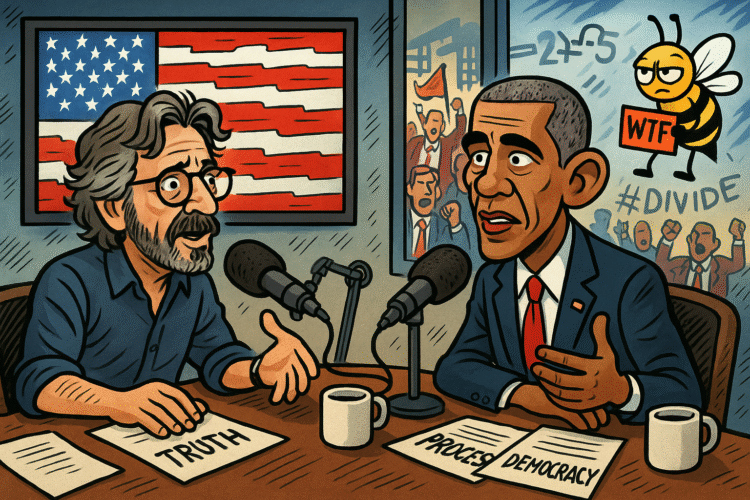
There’s a particular tone you can hear only in the voice of a man who has seen the apocalypse, accepted it, and still shows up for soundcheck. Marc Maron has been that voice for sixteen years—equal parts therapy session, post-mortem, and open-mic confession booth—and on October 13, 2025, he turned off the mic for good. The final episode of WTF wasn’t a stunt or a live show or some sentimental reunion tour. It was a quiet conversation in Barack Obama’s Washington office, and it felt less like closure and more like a wake for American adulthood.
The symbolism was so thick you could spread it on toast. Maron, the godfather of podcasting-as-therapy, closing his show with the last functioning adult in American politics. Obama, looking a decade older but still sounding like a constitutional conscience trapped in a country that replaced civic literacy with TikTok. The two men talking about democracy, truth, and the steady corrosion of institutions—while outside, a government shutdown dragged on and Trump’s surrogates called for new loyalty oaths.
If WTF began as a show about what it means to be human, it ended as a field report from a civilization trying not to collapse in real time.
The Scene of the Farewell
Axios and AP both described the setting with reverence: Obama’s Washington office, lined with books and the muted hum of a republic that used to believe in paperwork. Maron arrived with his usual emotional shrapnel—self-deprecation, dread, sincerity hidden inside sarcasm—and Obama met him with the weary calm of a man who’s been watching democracy melt for sport.
They weren’t there to reminisce about the “good old days.” They were there to diagnose how everything went to hell and whether anyone still cared.
Obama, ever the rhetorician, began with a civic sermon. He warned that institutions—law firms, universities, corporate boards—are collapsing not because of coups, but because of cowardice. “When you keep appeasing bullies,” he said, “you stop being an institution and start being a hostage.”
He talked about DEI being quietly renamed, about universities disinviting speakers to avoid audits, about corporate leaders deciding that neutrality is safer than decency. And then he said the line that should have been printed on the national flag by now: “Pluralism isn’t branding. It’s the work.”
It was vintage Obama: patient, eloquent, and just angry enough to remind you that patience isn’t passivity.
Marc Maron, Patron Saint of Existential Maintenance
Maron didn’t try to compete with Obama’s gravitas. He just listened—something America forgot how to do somewhere between the last mass shooting and the latest streaming deal.
“I guess that’s the question, right?” he said. “How do you keep doing the work when everything feels performative? When the good faith is gone?”
And Obama, in that slow, careful cadence that makes cynics twitch, said, “You do it anyway.”
This is where the real meaning of the finale lives—not in the politics, but in the posture. Two men sitting in a quiet room, insisting that conversation itself is resistance. That listening—real listening—is a form of civic repair.
Because WTF wasn’t just a podcast. It was a long-running experiment in vulnerability during a time when America replaced dialogue with dueling microphones. It made us remember that conversation could be complicated and messy without being malignant.
And now it’s ending at the exact moment we need that reminder most.
The Algorithm Ate Our Empathy
It’s not hyperbole to say that longform conversation is now an endangered species. The algorithms don’t reward reflection—they reward reaction. They turn curiosity into clickbait, disagreement into death threats, and moral nuance into engagement metrics.
Obama called it “a weaponized clip economy,” where everyone’s goal is to be the loudest, not the most honest. He’s not wrong. If 1984 was about Big Brother watching, 2025 is about Big Algorithm feeding—on outrage, misinformation, and whatever’s left of your attention span.
Platforms that once claimed to democratize speech now curate it for maximum division. Universities that once prided themselves on dissent now issue talking points vetted by counsel. Even late-night hosts have become risk-averse monks of relatability, terrified of losing brand partners.
And in that vacuum, Trump’s second administration thrives—not through charisma or competence, but through corrosion. They don’t need to jail every dissenter. They just have to exhaust them.
Obama’s Sermon at the End of the World
Obama’s central message in the WTF finale was simple but devastating: democracy isn’t dying because of a coup. It’s dying because everyone’s too busy rebranding to notice.
He talked about law firms that quietly purge associates for signing open letters, about CEOs who issue “values statements” while cutting DEI budgets, about universities that rename departments instead of defending them.
He even went after the left, warning progressives not to “confuse moral clarity with moral superiority.” Because nothing fuels authoritarianism faster than smugness packaged as justice.
It was classic Obama—disappointing to activists who want fire, but indispensable for a country that needs oxygen.
Maron, for his part, didn’t let him off the hook. “So what do you do,” he asked, “when people have stopped believing in the process itself?”
Obama paused. “You remind them that personality isn’t process,” he said. “That democracy is supposed to be boring. And that boredom is a privilege.”
In a culture addicted to spectacle, boredom sounds radical.
The Death of Boring Institutions
If Obama’s first presidency was about hope, his current role is about hospice. He’s the last surviving adult in a landscape of toddlers with press credentials. His faith in institutions feels almost quaint now, like someone defending rotary phones in the age of neural implants.
But he’s right about one thing: when universities, corporations, and media companies start bending to state pressure, democracy isn’t just compromised—it’s auctioned off.
Today, companies hire “freedom consultants” to interpret censorship laws before they post a diversity statement. Universities hire PR firms to spin faculty firings as “strategic realignment.” And corporate boards quietly scrub the word “equity” from mission statements because it makes shareholders nervous.
It’s not that the fascists took over. It’s that the accountants did.
Trump’s Shadow in the Room
Even though neither man said it outright, Trump was the ghost haunting the conversation. Every line about “institutional integrity” and “the corrosion of truth” was a veiled eulogy for the republic we once pretended to have.
This is a president who treats the DOJ like a private law firm, the military like a stage prop, and the Constitution like a Yelp review. He doesn’t need to censor the press; he just floods it until the truth drowns.
When you live in a political ecosystem built on intimidation and disinformation, cowardice becomes the default setting. And Obama knows it. He’s been the target of that machinery for fifteen years.
So when he tells law firms and universities to “hold the line,” he’s not speaking in metaphors. He’s saying: stop laundering fascism through corporate compliance. Stop pretending neutrality is nobility.
Because neutrality, in 2025, is collaboration.
Maron’s Existential Goodbye
In the quieter half of the episode, the conversation turned inward. Maron reflected on endings—how to know when to stop, when to move on, when to let go.
Obama told him to “take a beat.” Don’t rush into the next thing. Let silence exist for a while.
It’s advice that feels like heresy in an economy where silence is death. But it’s also the only sane response to a world that’s turned every human interaction into content.
Maron’s whole career was about the tension between wanting to be understood and being terrified of being known. He made neurosis feel noble. Now, by ending WTF, he’s making rest feel radical.
He’s saying what Obama’s been saying for years: you don’t fight the noise by yelling louder—you fight it by staying human.
Nostalgia vs. Playbook
The mainstream coverage of the finale treated it like nostalgia bait—a cultural callback to simpler times, when liberals cried to Obama speeches and podcasts felt subversive. But that’s the wrong frame.
The point wasn’t sentimentality. It was strategy. Obama wasn’t waxing poetic about hope. He was handing out a playbook: rebuild the boring parts of democracy before the spectacle eats them alive.
Hold your institutions accountable. Protect academic freedom. Fund public media. Refuse to rename decency for political comfort.
It’s not romantic. It’s procedural. Which is exactly why it matters.
When Two Plus Two Becomes Five
Somewhere in the middle of their talk, Maron joked that it feels like “truth has a PR problem.” Obama laughed, but then said, “That’s the danger. Once truth becomes negotiable, it’s just another brand.”
He’s right. We’ve reached the point where facts are optional accessories. Reality bends not to evidence but to engagement.
Two plus two equals five now, and half the country applauds because five has better branding.
That’s why this episode mattered. It wasn’t just a podcast finale. It was an emergency broadcast from the last functioning neurons of the American psyche.
If the adults in the room keep choosing expedience, the next generation won’t even have the vocabulary to describe what they lost.
The Long Pause Before the End
When the episode ended, there was a silence that felt heavier than usual. Not awkward—funereal.
Obama thanked Maron for “keeping the conversation alive.” Maron thanked him for “still showing up.” They both laughed, the way people laugh when they know the joke is over but can’t quite let go.
Then the credits rolled.
No outro music, no ad break for mattresses or meal kits. Just the sound of two men sitting in a room, acknowledging that truth is now an endangered species and conversation might be the last sanctuary we have left.
It wasn’t cathartic. It was clarifying. And maybe that’s the point.
Because if the podcast era taught us anything, it’s that talking isn’t enough. Listening is the revolution.
Closing Transmission: The Sound of Civilization Breathing
Marc Maron’s WTF didn’t end because the world stopped needing it. It ended because the world stopped hearing it. The attention economy devoured the empathy economy, and now all that’s left are clips fighting for seconds of rage before the next algorithmic purge.
But for one last hour, Obama and Maron carved out space for something different—a reminder that grown-ups used to talk like this, and maybe could again.
The question isn’t whether the republic can survive. It’s whether it deserves to, if cowardice keeps dressing up as pragmatism.
So here’s the moral, if satire can still have one: If you find yourself applauding the fire while the house burns, congratulations—you’re the demographic.
And if you can still hear the silence after the last WTF fades out, that’s the sound of civilization breathing. For now.