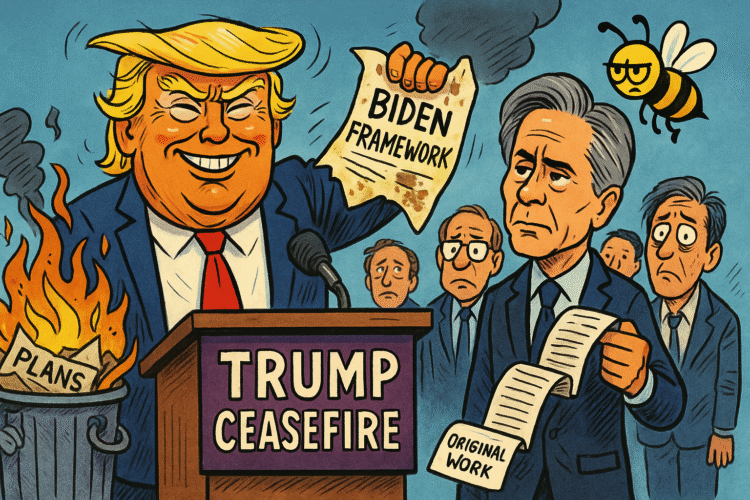
In international diplomacy, plagiarism usually comes in subtler forms. A reworded communique here, a borrowed talking point there, maybe a flag repositioned in front of the podium to make it look like something new. But leave it to Donald Trump to turn global peacemaking into the intellectual equivalent of copying someone else’s term paper and stapling your name to the cover.
According to The National Desk, Secretary of State Antony Blinken decided this week to do something few diplomats ever dare: tweet receipts. In a lengthy thread, Blinken laid out—methodically, almost gleefully—how the ceasefire framework Trump just declared a “historic Trump peace plan” was, in fact, the Biden administration’s meticulously negotiated blueprint. The one Trump once called “weak,” “globalist,” and “a disaster” before apparently deciding it was too detailed not to steal.
If irony had a frequency, this one registered on the Richter scale.
The Return of the Great Diplomatic Improviser
Let’s start with the facts. The ceasefire between Israel and Gaza that President Trump triumphantly announced last week isn’t new. It’s the same multi-stage plan built under Biden’s foreign policy team—a delicate lattice of U.S., Qatari, and Egyptian diplomacy that took months to construct and about five minutes for Trump to rebrand.
It had everything: phased Israeli withdrawal tied to security benchmarks, humanitarian corridors, hostages exchanged for detainees, and a carefully balanced civil-administration plan to avoid Hamas dominance while keeping local governance viable. It even had donor oversight mechanisms to make sure the billions in reconstruction aid didn’t end up funding the next war.
Trump, of course, took one look at all that and said, “Perfect—let’s print that with my name on top and see if Fox will call it a miracle.”
He announced the “Trump Ceasefire Accord” flanked by flags, cameras, and the unmistakable aura of a man convinced he’d just ended 75 years of Middle Eastern conflict through sheer force of branding. “The war is over,” he declared, moments before Israel’s defense minister clarified that, actually, the war was merely “paused pending verification of compliance.”
Which is diplomatic code for “we’ll see how long this lasts once the cameras are gone.”
Diplomacy by Headline
The hallmark of Trump’s foreign policy—if one can use “policy” in the same sentence as “Trump”—is its utter devotion to optics. Forget institutions, enforcement mechanisms, or post-conflict stabilization; all that matters is the shot of him at a podium declaring victory.
It’s the same strategy that gave us Kim Jong-un’s “beautiful letters,” the Taliban photo op that somehow counted as a peace deal, and the infamous moment he tried to buy Greenland because “it would look cool on a map.”
Now we get Trump’s “ceasefire” rollout, which reads like the world’s most chaotic group project: Biden’s diplomats built the framework, Qatar and Egypt handled the hard conversations, the IDF did the logistics, and Trump showed up at the last minute to slap his name on the final slide.
And somehow, half the class clapped.
Biden’s Blueprint, Trump’s Sharpie
Let’s be clear: everything about the plan’s substance—the sequencing of hostages for detainees, the gradual Israeli pullback, the humanitarian corridors, the Arab-state security participation, the donor oversight committee—was engineered during Biden’s tenure. It’s all still in the memos, the cables, and the readouts of the Doha and Cairo rounds.
Trump changed exactly three things:
- He rebranded it as “The Greatest Peace in History.”
- He inserted vague promises about Palestinian “internal security patrols” that directly contradict the disarmament clause.
- He removed the paragraph about “international monitoring” because, in Trumpworld, oversight is for suckers.
The result is a ceasefire plan that looks complete until you read the fine print and realize no one’s quite sure who’s supposed to enforce it—or what happens when someone inevitably breaks it.
Even the phrase “The war is over” feels like a Trumpian hallucination, the same way a foreclosure notice becomes “a great opportunity for investment.”
The Sound of Applause in an Empty Room
Blinken’s thread was the diplomatic equivalent of subtweeting your ex after they reposted your vacation photos and tagged themselves as “content creator.” Each tweet carefully credited “months of shuttle diplomacy,” “quiet coordination,” and “framework continuity,” which is State Department jargon for: he stole our work and called it genius.
Foreign policy insiders, meanwhile, watched the performance like theater critics at a bad musical revival. “Yes, the staging is familiar,” one former envoy quipped, “but the actor forgot half the lines and added some that make no sense.”
The Arab partners—Qatar, Egypt, Jordan—played along in public, nodding gravely and thanking Trump for his “decisive leadership,” while privately wondering if Washington had developed amnesia. It’s hard to take victory laps seriously when everyone on the track remembers who laid the asphalt.
The Paper Ceasefire Problem
The danger isn’t that Trump wants credit for peace. It’s that he doesn’t seem to understand what peace requires.
Diplomacy is like architecture: you can’t skip the structural reinforcements because you want to open early. Trump, however, treats treaties like casinos—throw up the facade, invite the cameras, and hope no one notices the plumbing isn’t connected.
Analysts already see cracks in the plan. There’s no clear language on Palestinian statehood. The verification mechanism for ceasefire violations is practically nonexistent. The U.S. role in ensuring humanitarian access is undefined. The donor oversight board is toothless. And the clause allowing “local internal security” forces reads like a backdoor for Hamas to patrol the same streets the plan supposedly liberated.
Meanwhile, border control remains unresolved, aid convoys bottleneck at checkpoints, and “reconstruction funds” float in bureaucratic limbo waiting for someone—anyone—to establish the rules.
In short: Trump’s “peace” looks fine on a press release but falls apart under gravity.
The Art of the Unravel
The irony is that Biden’s framework was designed precisely to prevent this. The original plan had sequencing, verification, donor conditioning, and a rotating oversight council with Arab participation to ensure accountability. It was slow, yes, but sturdy. It required real work, real diplomats, and a functioning bureaucracy—all the things Trump has historically viewed as personal insults.
He prefers the one-man show version of foreign policy: dramatic reveal, self-congratulation, abrupt exit. “We did a tremendous job,” he said in the announcement, surrounded by generals who looked like they’d rather be anywhere else.
A week later, journalists asked the Pentagon whether any new U.S. funding or personnel had been allocated to enforce the ceasefire. The answer was a long pause followed by, “We’re evaluating options.” Which, in bureaucratic English, means: no one told us this was happening.
When Propaganda Becomes Governance
The strangest part isn’t that Trump claimed credit. It’s how effortlessly half the media went along with it. “Trump Ends Gaza War,” blared headlines that might as well have been written by his campaign staff.
The country has become so desensitized to spin that we treat it like policy. Announce it, tweet it, meme it, and reality will catch up eventually. Except it doesn’t. It just piles up in the archives, another press conference fossil from an administration that believes governance is a vibe.
Meanwhile, the diplomats and NGOs still on the ground are the ones cleaning up the mess. They’re trying to secure border crossings, coordinate aid delivery, and prevent the ceasefire from collapsing under its own contradictions—all while the Commander-in-Chief is busy declaring the mission accomplished on Truth Social.
It’s political theater with a body count.
A Peace Plan Without Peacekeepers
Every serious expert warns the same thing: without monitoring, funding, and enforceable sequencing, ceasefires die young. But Trump’s team seems allergic to follow-through. There’s no plan for verifying arms withdrawals. No clarity on who pays for reconstruction. No designated authority to arbitrate disputes.
Even the timeline is vaporous. The press release promised “immediate steps toward normalization,” which sounds encouraging until you realize no one knows what steps, by whom, or when.
Biden’s diplomats left a map. Trump threw away the legend and started wandering with a flashlight.
The Theater of the Absurd (and the Profitable)
You almost have to admire the efficiency of the grift. Why spend years negotiating when you can just rebrand someone else’s work, hold a press conference, and watch the stock market rally? It’s geopolitical pump-and-dump—buy low on Biden’s quiet diplomacy, sell high on Trump’s performative chaos.
Foreign leaders have caught on. “We’re learning to ignore the first announcement,” said one anonymous European diplomat. “The second or third version usually matches the real policy.”
That’s the problem with governing as performance art: eventually the audience gets tired of clapping.
Blinken’s Revenge
To Blinken’s credit, his thread wasn’t just about setting the record straight. It was a warning. Beneath the calm prose lay a message familiar to every career diplomat who’s ever had their work hijacked by a headline-chasing executive: “If you break it, you bought it.”
And Trump just bought the world’s most fragile ceasefire with no warranty.
If it collapses—if aid stalls, if border skirmishes resume, if the interim government fails—he owns every piece of the fallout. But of course, he won’t see it that way. The minute reality intrudes, he’ll blame Biden for “setting him up,” the Pentagon for “not following orders,” and the press for “failing to understand greatness.”
It’s the circle of Trump: claim credit, cause chaos, deny ownership.
The Echo of an Empty Victory
In the end, Trump’s ceasefire might hold for a few weeks. Maybe even months. But the cracks are already visible. It’s a deal made for television, not governance—a story that looks great in a chyron and collapses under scrutiny.
What Blinken’s thread reminded everyone is that peace isn’t a performance. It’s a process. It doesn’t survive on applause; it survives on institutions, trust, and detail. All the boring stuff Trump never cared to learn.
The irony, of course, is that he’ll still get his headline. “Trump Ends War in Gaza.” And for most people, that’ll be enough. The correction will come later, buried somewhere between the market crash and the next executive tantrum.
Until then, the world will keep spinning, the diplomats will keep patching, and Blinken will keep subtweeting like a man who’s seen the future and can’t stop screaming into the void.
Because somewhere, in a parallel timeline, the Biden plan worked exactly as intended—quietly, competently, anonymously. But in this one, we live under the reign of the man who thinks the Nobel Peace Prize is just a participation trophy for not nuking anyone before lunch.